

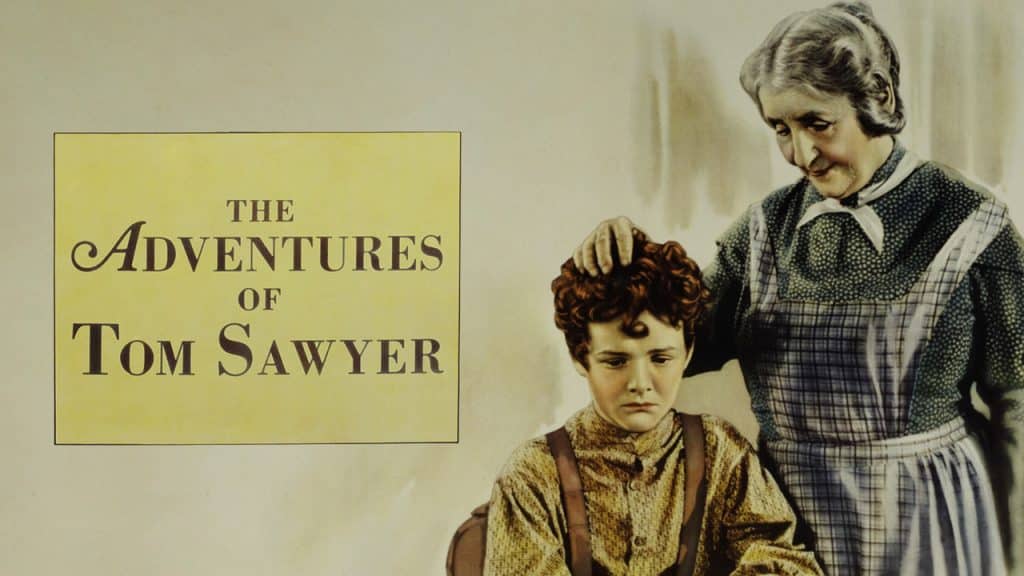
Remember the feeling of a long, endless summer vacation? Mark Twain’s novel, The Adventures of Tom Sawyer, perfectly captures that spirit of boyhood freedom, full of make-believe pirates and secret hideouts (1938 Tom Sawyer).
Yet beneath the playful fun is a surprisingly sharp look at the adult world. This is a story about the collision between childhood innocence and real-world danger—one involving a graveyard crime, a tense courtroom trial, and a clever critique of small-town hypocrisy.
The Genius of the Fence: How Tom Sawyer Masters His World
If you know one thing about Tom Sawyer, it’s him tricking his friends into whitewashing a fence. But this scene is more than a clever prank; it’s the master key to his character. Faced with a dull chore, Tom brilliantly reframes it as a rare artistic privilege. He doesn’t just get out of work—he gets his friends to pay him for the honor of doing it. This single act reveals he’s not just a troublemaker, but a charismatic leader and a master of perception.
This famous scene analyzes the book’s first major theme: the slippery difference between appearance and reality. Twain makes a powerful point that “work” is simply whatever you are forced to do, while “play” is whatever you are not. Tom’s genius is his intuitive grasp that he can change an activity’s value just by changing how people see it.
This ability to reshape reality is Tom’s superpower. But while it works wonders on his friends, he soon discovers that the deceptions and hypocrisies of the adult world are far more dangerous than any childhood game.
What Happens When Childhood Games Meet Adult Hypocrisy?
Tom’s deceptions are child’s play compared to the games adults live by. Mark Twain uses the entire town of St. Petersburg as a subject for satire—a literary tool that uses humor and irony to expose foolishness. In doing so, he provides a sharp guide to spotting social hypocrisy, revealing the massive gap between how people want to appear and how they actually are. This exploration of double standards is one of the main themes of the book.
Nowhere is this clearer than when Tom and his friends, presumed drowned after running away, secretly attend their own funeral. The boys listen as the community, which once called them nuisances, now weeps and praises them as saints. By exposing this reversal, Twain puts the town’s shallow, performative grief on full display—one of the story’s most memorable moral lessons.
This moment is more than a great prank; it’s a turning point. The lighthearted adventure starts to touch on something more serious and dangerous. The world of make-believe has collided with adult phoniness, and suddenly, Tom’s games are no longer just games.
Why ‘Tom Sawyer’ Is Still a Classic: Understanding Its Complicated Legacy
Tom Sawyer’s journey extends far beyond the whitewashed fence, moving from childhood games to the witness stand in a confrontation with the moral failings of the adult world. This transformation is why the novel remains a classic. It captures timeless adventure while grounded in 19th-century Missouri, a setting whose prejudices create challenging conversations for modern readers. The book allows us to appreciate Twain’s genius, understand its historical flaws, and see how it sets the stage for the sharper social critique in Adventures of Huckleberry Finn.