

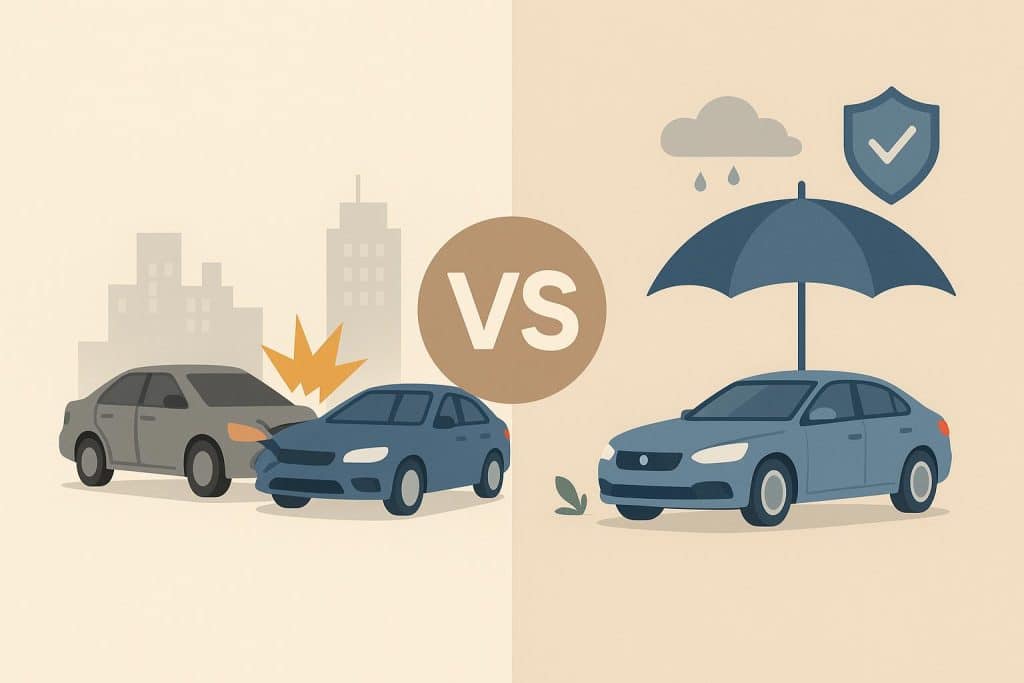
Every car on an Indian road must carry at least third-party insurance, so the real question is never whether to insure a car but how far to insure it. Third-party is the legal floor; comprehensive is the fuller cover built on top of it. The two protect very different things, and treating the cheap minimum as enough is how owners end up paying for a wrecked car out of their own pocket.
Deciding which you need comes down to a simple question about your own vehicle: if it were damaged, stolen, or destroyed tomorrow, could you comfortably replace it yourself? Your answer largely settles the choice.
What the two policies actually cover
The names hide a big difference in what you’re actually buying. Third-party insurance covers your liability to other people: if you injure someone or damage their car or property, it pays their claim. What it pointedly does not cover is your own car, or your own injuries. It protects the world from you, not you from your own accident.
Comprehensive insurance includes all of that third-party protection and then adds cover for your own vehicle. Damage to your car from a collision, theft, fire, flood, or vandalism is paid for, along with, usually, a personal accident cover for you as the owner. In short, third-party looks outward at the harm you might cause others, while comprehensive looks both ways, at others and at your own loss.
Why is third-party the legal minimum?
The law makes third-party cover compulsory for a clear reason: to make sure that anyone you might harm on the road can be compensated. Driving without it is an offence, since it would leave anyone you harmed with no one to claim against.
That’s why it’s the floor everyone must clear. But being the legal minimum is exactly what it is, a minimum, and it’s easy to mistake having satisfied the law for being properly protected. Third-party insurance keeps you road-legal and shields others, yet does nothing for your own car. Meet the requirement and stop there, and you’re covered against liability but entirely exposed to your own losses.
What comprehensive adds, and why it matters
The gap third-party leaves is precisely what comprehensive fills. By adding own-damage cover, it pays to repair or replace your own vehicle after the events that most commonly wreck a car: an accident you were involved in, a theft, a fire, a flood, or plain vandalism. For most owners, these are the risks that would actually hurt financially.
It can be tailored further. Add-ons such as zero-depreciation cover, engine protection, or roadside assistance let you close specific gaps, and claim-free years earn a no-claim discount that lowers your premium over time. The point is simple: comprehensive turns an accident or theft from a large, unplanned bill into a claim, which is the whole reason to insure a car you couldn’t easily replace.
Which one do you actually need?
Legally, you need third-party, and that’s not optional. Practically, the answer depends on your car’s value and your ability to absorb its loss. If the vehicle is new, financed, or simply worth more than you could cheerfully pay to replace, comprehensive is the sensible choice, and a lender will usually insist on it anyway while a loan is outstanding.
The exception is a car worth little. For an old vehicle whose market value is low, the own-damage payout would be modest after depreciation, so some owners reasonably run third-party only and accept that they’re self-insuring the car itself. Comparing what comprehensive actually costs for your specific car, through an insurance app or an insurer, usually shows the extra premium is small next to the protection, which tips most decisions towards the fuller cover.
Insurance protects the car; other rules keep it road-legal
It’s worth separating two things owners often blur: being insured and being road-legal. Comprehensive insurance protects you financially against damage and loss, but it isn’t the only document your car needs to be legally on the road. A valid insurance policy is one requirement; a pollution-under-control certificate is another, and a working FASTag is now effectively part of running a car on highways too.
They do different jobs. Insurance is about absorbing a financial hit if something goes wrong; the others are about compliance and access, keeping you legal and able to drive without penalty. A comprehensive policy won’t help you at a toll gate, and a funded toll tag won’t pay to repair your car. Owning a car well means keeping all of them current, not assuming one covers for another.
So how should you choose?
Start from what you’d lose if the car were damaged or stolen, rather than from the premium. If that would leave you with a bill you couldn’t comfortably meet, comprehensive turns the risk into a manageable claim, and for a new or valuable car that’s almost always the right call.
Only for a genuinely low-value car does third-party alone make sense, and even then it should be a deliberate decision to carry the own-damage risk yourself, not an accident of buying the cheapest option. Factor in the no-claim discount that builds over claim-free years and the add-ons that close specific gaps, and let the size of the potential loss, rather than the premium, make the call.