

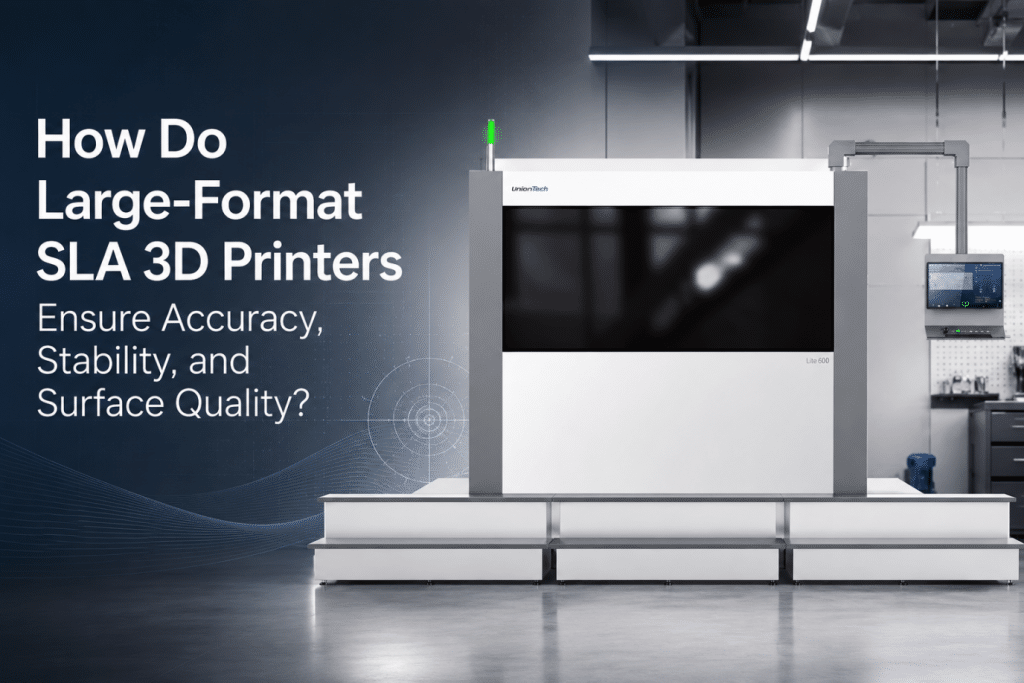
In large-format SLA printing, increasing the build volume often creates challenges in maintaining consistent accuracy and surface quality. Many large industrial 3D printer systems suffer from reduced precision and uneven surface finishes as the build size increases, while smaller high-resolution machines lack the capacity to produce integrated, large-scale prototypes required in industries such as automotive and aerospace.
Therefore, the key to large-format SLA 3D printing is not simply “scaling up the machine.” It is about maintaining reliable dimensional accuracy, printing stability, and high-quality surfaces despite larger build areas, longer scanning paths, and more complex liquid-level control.
Read on for an upgraded SLA 3D printer for large prints.
What are the Challenges of Large-format SLA Printing?
- The larger the printing format, the more difficult it is to maintain scanning consistency
Large-format SLA systems often use multiple scanning areas to cover the entire build platform. If these scanning zones are not accurately aligned, problems may appear, including:
- Visible joint lines between scanning areas
- Uneven surface texture
- Dimensional differences between sections
- Reduced mechanical strength at connection areas
For example, a large automotive prototype printed as one complete part requires consistent accuracy across the entire surface. Any mismatch between scanning zones can affect assembly testing and appearance evaluation.
- The larger the build platform, the higher the mechanical stability requirement
A larger build platform introduces additional mechanical challenges. The platform must remain flat during long printing cycles because even small deformation can influence layer thickness and final part accuracy.
Large-format SLA printing also requires precise control of:
- Platform movement
- Resin level
- Laser power
Facing these challenges, UnionTech designed the RSPro series, solving the issues of accuracy, stability, consistency, and surface quality in large-format printing.
How do they work?
Multi-Galvanometer Cross-Splicing Technology
UnionTech’s large-format 3D printers use multiple lasers, which simplifies the optical-path design and helps control equipment costs. Through precision algorithms and system upgrades, each laser operates under synchronized control. This parallel operation doubles printing speed and efficiency compared with a single-laser scanning process.
The main challenge is joining the areas scanned by adjacent galvanometers. UnionTech’s splicing scanning algorithm connects both sides of the same part without creating a separate straight boundary. By increasing the contact area between the two scanning zones, the system improves the mechanical performance of the splice region.
Its cross-splicing technology also maintains surface quality across the joined area. The mechanical properties of the splice region reach more than 90% of those achieved when the part is scanned independently by a single galvanometer. This allows a large-format SLA 3D printer to increase output while maintaining consistent surface and mechanical performance across large one-piece parts.
Patented Multi-Galvanometer Auto-Calibration Technology
Manual calibration typically uses only 89 calibration points, so the result can vary with operator experience. This limited point density also makes it difficult to identify small deviations across a large scanning area.
UnionTech’s patented auto-calibration system uses image processing and laser-spot position detection to establish 1,798 calibration points. It automatically corrects the alignment between adjacent scanning zones and keeps the deviation between two laser spots within half of one spot diameter.
The large 3D printer system achieves a calibration accuracy of 0.06-0.1 mm, reducing operator influence while improving printing stability and dimensional consistency.
Patented Variable-Spot Technology
UnionTech’s variable-spot technology adjusts the laser spot from 0.1 mm to 0.85 mm according to the scanning task. This allows the system to use different exposure strategies for part contours and internal filling.
- A 0.1 mm spot is used for fine contours and small features, helping preserve detail accuracy and surface quality.
- A 0.85 mm spot covers a larger area during solid filling, which increases filling speed and production efficiency.
For parts wider than two meters, this dynamic adjustment helps balance surface detail with printing speed. The technology also works with automatic laser calibration to maintain calibration accuracy, stability, and consistency across the build area.
Micron-Level Liquid-Level Control System
UnionTech combines a liquid-level control algorithm with a negative-pressure recoater system. After each recoating cycle, the system quickly stabilizes the resin surface at the preset height, giving every layer a consistent starting liquid level.
The system also adjusts laser power automatically when it detects small changes in the resin level. This keeps the curing depth stable instead of allowing minor liquid-level fluctuations to affect layer formation.
Liquid-level accuracy is controlled below 0.01 mm. By translating this control into more consistent physical layer thickness, the system produces more uniform and refined layer patterns on parts exceeding two meters in size.
Granite Recoater Frame + Carbon-Fiber Coating Scraper
The RSPro 2100 uses a granite frame to support its 2,100 mm build platform. The granite structure provides a stable reference surface across the full platform length and resists flatness changes caused by time, temperature, and load.
Its carbon-fiber-reinforced recoater blade combines high rigidity with low weight. The material has an elastic modulus comparable to steel but approximately one-quarter of steel’s density, which reduces deflection caused by the blade’s own weight.
Together, the low thermal expansion of the granite frame and the rigidity of the carbon-fiber blade help maintain parallel alignment between the recoater and resin surface across a span of more than two meters. This structure supports stable recoating during long, large-format printing cycles.
UnionTech Large-Format SLA 3D Printers
Overall, for industries that need large 3D printers for mass production, the UnionTech RSPro large SLA printer series provides a practical solution. The RSPro1400, RSPro1800, and RSPro2100 are developed for large-format SLA applications requiring high accuracy, stable performance, and consistent surface quality.
These machines are suitable for:
- Automotive prototype development
- Aerospace component testing
- Industrial equipment parts
- Large functional models
- Low-volume production applications
With multi-galvanometer cross-splicing technology, automatic calibration, variable-spot scanning, micron-level liquid control, and stable mechanical structures, the UnionTech RSPro series helps manufacturers overcome the traditional limitations of large-format SLA printing.
If you’re searching for large-format SLA printers, feel free to contact UnionTech.