

TL;DR — Forex and CFD trading is legal for UAE residents through a licensed broker. The question that decides everything else is which legal entity actually holds your account, because the UAE runs three parallel regulatory regimes and a broker’s local presence does not tell you which one your money sits under. In 2026 the federal regulator was reconstituted, the licensing law was rewritten, and firms holding pre-2026 licences have until 1 January 2027 to complete their transition.
Is Forex Trading Legal in Dubai and the UAE?
Yes. UAE residents can legally trade forex and CFDs through a licensed broker, and there is a functioning regulatory framework governing how those brokers must operate.
The distinction that catches people out is a different one. Trading being legal is not the same as any given platform being licensed to serve you. Plenty of firms advertise to UAE residents, maintain a Dubai office and offer Arabic-language support while the account you open is held by a company registered somewhere else entirely, under rules that have nothing to do with the UAE.
So the useful question is not “is this legal.” It is “which entity am I contracting with, and who regulates that entity.” Everything below follows from answering it.
The Three Regulators Operating in Parallel
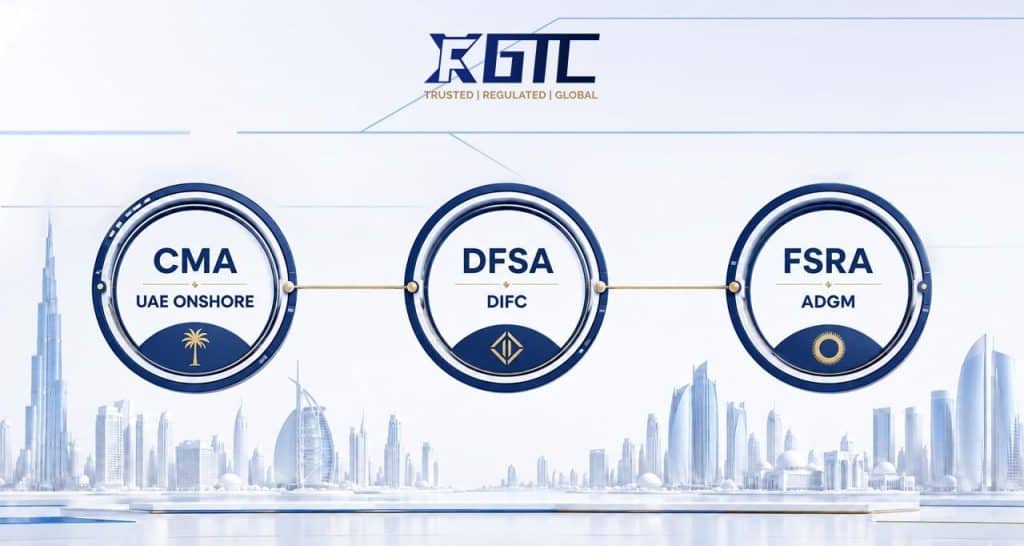
The UAE has one federal regime and two financial free zones with their own laws, courts and regulators. A broker may be licensed in one, two or all three, and the licences are not interchangeable.
Onshore federal — the Capital Market Authority (CMA). On 1 January 2026, Federal Decree-Law No. 32 of 2025 reconstituted the Securities and Commodities Authority as the Capital Market Authority, and Federal Decree-Law No. 33 of 2025 replaced and codified the licensing regime for financial activities. Both entered into force that day, repealing Federal Law No. 4 of 2000 in its entirety.[1]
DIFC — the Dubai Financial Services Authority (DFSA). The independent regulator for financial services conducted in or from the Dubai International Financial Centre. The two federal decree-laws apply outside the financial free zones, which have their own securities laws and regulators.[2]
ADGM — the Financial Services Regulatory Authority (FSRA). The independent regulator for Abu Dhabi Global Market.
| CMA | DFSA | FSRA | |
| Jurisdiction | UAE onshore, outside the free zones | DIFC | ADGM |
| Legal basis | Federal Decree-Laws 32 and 33 of 2025 | DIFC law | ADGM law |
| Retail brokerage licence | Category 1 | Category 3A | Financial Services Permission |
| Verify at | CMA public register | DFSA public register | FSRA public register |
The CMA governs the federal onshore regime, while the DFSA and FSRA govern the DIFC and ADGM respectively; their licences are not interchangeable.
What the 2026 transition changed, and what it did not. The CMA is the legal successor to the SCA and assumed all its rights, obligations and contracts.[1] Existing SCA regulations, rulebooks and decisions continue to apply unless and until the CMA replaces them, and implementing regulations under the new framework are expected to be issued progressively.[3] Firms that held licences before 2026 have a one-year transition window under Federal Decree-Law No. 33, running to 1 January 2027.[4] If a broker’s website still says “SCA,” that is most likely a stale page rather than an invalid licence.
The provision most readers have not seen. Article 2(1)(d) of Federal Decree-Law No. 33 of 2025 extends the law to any person targeting clients inside the UAE, even where the activity is conducted outside the country or from a financial free zone.[2] Soliciting UAE residents now brings a firm within the regulatory perimeter regardless of where it sits.
And what non-compliance carries. Article 71 provides penalties for engaging in a financial activity in the UAE without a licence, approval, registration or accreditation from the CMA, including imprisonment of not less than one year and fines of up to AED 250 million.[2]
Verifying a Broker’s Licence Step by Step
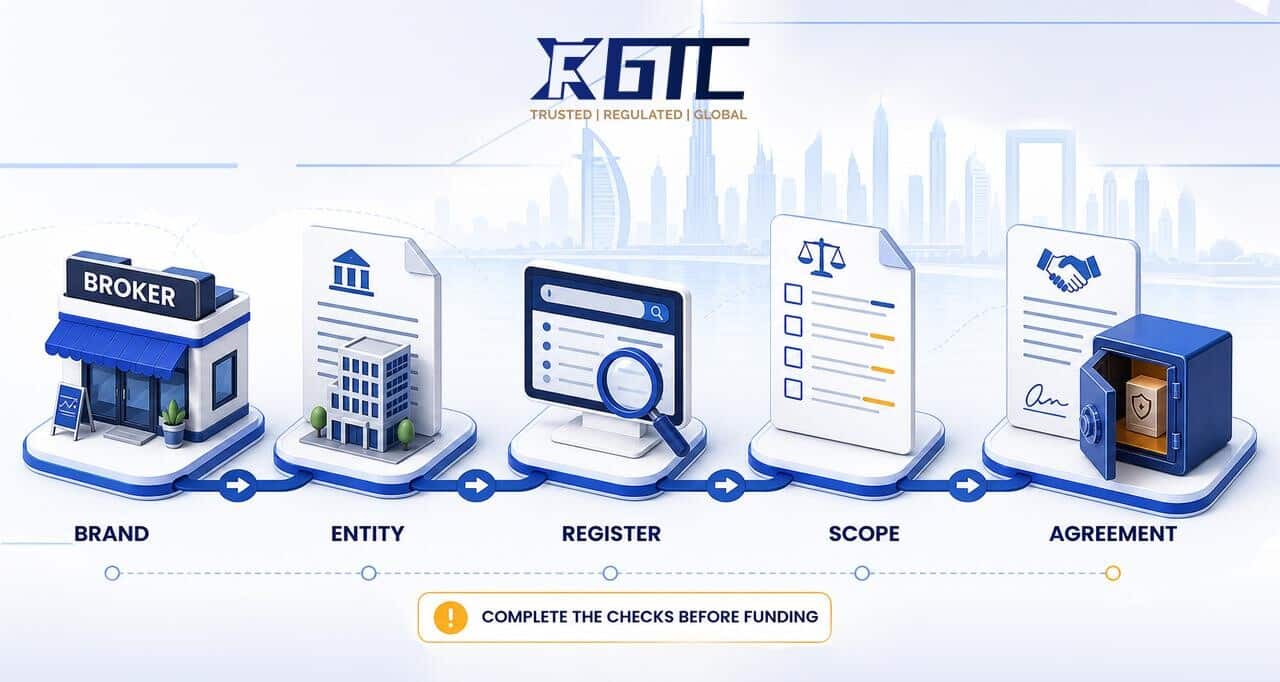
Complete the full verification chain before funding: brand, entity, register, licence scope and client agreement.
Step 1 — Find the exact registered entity name. Go to the broker’s regulatory disclosure or legal page, not the homepage. You want full legal names, licence numbers and jurisdictions. For example, GTCFX publishes its group structure and licences on a dedicated regulatory disclosure page. Treat that page as the start of the trace, not the end: brands are marketing; entities are what regulators license.
Step 2 — Search the correct public register. Each regulator maintains its own. A DFSA licence does not appear on the CMA register and vice versa. Search the entity name exactly as disclosed and confirm the licence is current.
Step 3 — Match the register entry to your account agreement. This is the step that actually protects you, and the one almost nobody performs. A group may hold a UAE licence through one entity while onboarding retail clients through another registered elsewhere. Both statements can be true at once: the group is UAE-licensed, and your account is not.
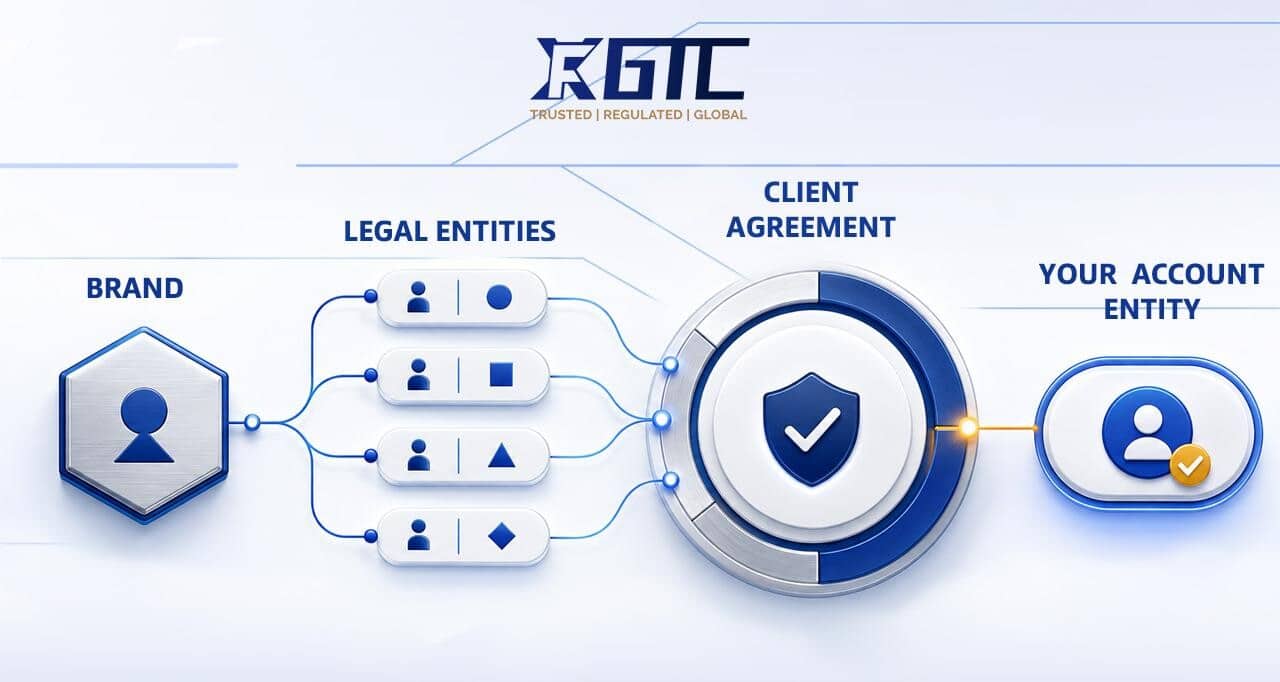
The brand may sit above several legal entities; the client agreement identifies which one actually holds the account.
Step 4 — Read the licence category. A licence authorises specific activities. Holding one does not mean a firm may do everything a broker appears to do.
Step 5 — Understand Category 1 versus Category 5. Onshore, a Category 1 licence covers brokerage: the firm may execute trades and hold client money locally. Category 5 covers advisory and arranging activity — financial consultation and analysis, listing advice, introduction, and promotion — rather than the direct management of client funds or proprietary securities trading, and each activity within it is licensed separately.[5] In practical terms, a Category 5 firm may market, promote and introduce clients, but may not hold client deposits in a UAE bank account.[6]
Step 6 — Know where Category 5 leaves you. Under such an arrangement, the trading account and the funds typically sit with an affiliated entity in another jurisdiction, governed by that jurisdiction’s rules rather than the CMA’s.[6] The local office, the Arabic-language support and the UAE phone number are all genuine — and none of them tells you where your money is held.
Step 7 — Worked example. Open a multi-entity broker’s disclosure page and read it as a document rather than as reassurance. Note every entity listed, every jurisdiction and every licence number. Then find the sentence explaining which entity serves clients in your country — most groups disclose this, often in a paragraph noting that the applicable entity depends on the client’s jurisdiction and onboarding route. Trace that sentence to a specific entity, then check that entity against the register. If the disclosure does not let you complete the trace, that is itself a finding.
Opening and Funding an Account
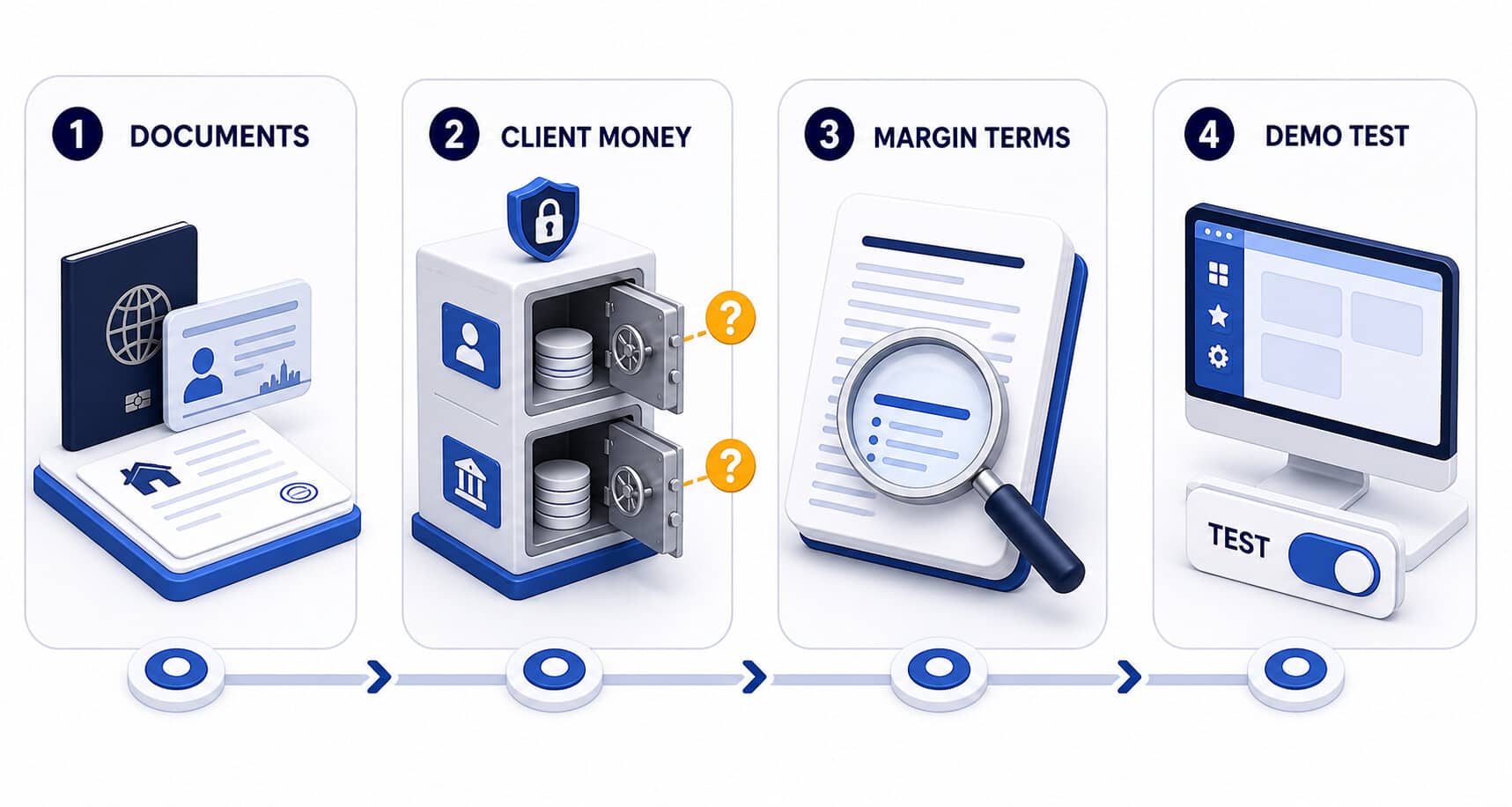
Before funding, confirm the required documents, where client money sits, which margin terms apply and how the platform behaves in a demo.
Documentation. Expect a passport or Emirates ID, proof of address, and depending on the entity, evidence of income or source of funds. Requirements differ between onshore and free zone firms.
AED deposits and client money. Confirm whether the entity holding your account segregates client funds from its own operating capital, and where those funds sit. As above, an entity that cannot hold UAE bank deposits is not holding your money in the UAE.
Retail protections in the two free zones, stated as the rules state them. Both free zone regulators express these requirements as minimum margin percentages rather than leverage ratios — worth noting, because most comparison content converts them into ratios without saying so.
DFSA rules require a retail client to post margin of at least 3.3% of exposure on a major currency pair, 5% on a non-major pair, major equity index, treasury asset or gold, 10% on a non-major equity index or a commodity other than gold, 20% on assets outside those categories, and 50% on a crypto token.[7]
ADGM FSRA rules set a near-identical schedule: 3.33% on major currency pairs and relevant sovereign debt, 5% on non-major pairs, gold and major equity indices, 10% on commodities other than gold and non-major equity indices, 20% on individual equities, and 50% on virtual assets.[8]
The protections alongside the margin schedule. In both free zones, open positions must be closed once account net equity falls to 50% of the margin requirement, and a retail client’s liability is capped at the funds in the account used for trading these products.7 ADGM additionally prohibits offering promotions, bonuses or other inducements to retail clients.[8]
Onshore is different, and the honest position is worth stating plainly. The CMA does not publish an equivalent numeric retail margin schedule in a publicly accessible rulebook, and figures circulating on comparison sites vary widely. Rather than pick one, treat the applicable limit as a term of your specific broker’s licence conditions and client agreement, and get it confirmed in writing before funding. Note too that many brokers apply tiered rather than flat leverage, reducing the maximum as position size grows.
Test before committing. Open a free demo account on the platform you intend to use, sized as you intend to trade, and confirm that execution, spreads and the interface behave as expected.
Questions Local Traders Ask
Tax. The UAE does not levy personal income tax, and there is no separate capital gains tax on individuals. Under Cabinet Decision No. 49 of 2023, personal investment income is excluded from corporate tax for natural persons regardless of amount, and a natural person comes within corporate tax scope only when conducting a business with turnover above AED 1,000,000 in a Gregorian year.[9] The caveat most pages omit: the Federal Tax Authority has not published guidance addressing forex or CFD trading specifically, so where activity is large, systematic and organised in the manner of a business, the boundary is a matter for professional advice rather than for an article.[10] This section describes the position as at the date of publication and is not tax advice.
Swap-free and Shariah-compliant accounts. A swap-free account removes the overnight interest component. What it does not automatically do is make every aspect of the arrangement compliant — the underlying instruments, the replacement charge structure and the contractual form all matter. Whether a particular account meets your requirements is a question for a qualified scholar, not for a broker’s marketing page.
Trading with an offshore broker while resident here. Legally possible in many cases, but understand what does not travel with you: no recourse to UAE regulators, no access to DIFC or ADGM courts on the strength of the account, and none of the retail protections above unless the licensing entity’s own rules provide them.
Red Flags Specific to This Market
Guaranteed returns. Any promise of guaranteed profit, or an offer to manage your money for a share of returns, from a firm not licensed to manage client money.
Free zone name-dropping without an entity. Marketing that mentions DIFC or ADGM without naming the licensed entity within it. The zone is an address; the licence belongs to a company.
Signal sellers and social promotion. Operations selling trading signals or promoting brokers on social platforms often sit outside any regulatory perimeter — though the 2026 extension of the law to firms targeting UAE clients from abroad narrows the space in which this can be done lawfully.[2]
Withdrawal friction. Repeated reports across independent review platforms of delayed withdrawals or verification obstacles that appear only at withdrawal time.
Frequently Asked Questions
Is forex trading legal in Dubai?
Yes, through a licensed broker. Which regulator applies depends on whether the broker operates onshore, in DIFC or in ADGM.
What replaced the SCA in 2026?
The Capital Market Authority, effective 1 January 2026 under Federal Decree-Law No. 32 of 2025, with Federal Decree-Law No. 33 of 2025 codifying the licensing regime. The CMA assumed the SCA’s rights, obligations and contracts as its legal successor.[1]
Which UAE regulator offers the strongest retail protections?
The two free zones publish explicit, verifiable retail margin schedules, margin close-out requirements and negative balance protection in their rulebooks.7 That transparency is itself a protection, because you can read the rule rather than take a broker’s word for it.
Can I trade with an offshore broker while living in the UAE?
Often yes, but without UAE regulatory recourse. Given the 2026 extension of the law to firms targeting UAE clients from abroad, it is also worth checking whether the firm is authorised to solicit you at all.[2]
Applying the Checklist Before You Fund an Account
Run this sequence against any broker before depositing:
- Find the exact registered entity name on the regulatory disclosure page.
- Identify which entity serves clients in your jurisdiction, and confirm it in the client agreement.
- Search that entity on the register of the regulator that licenses it, and confirm the licence is current.
- Read the licence category and check whether it permits holding client money.
- Confirm the applicable margin terms in writing.
Where a step does not resolve from published pages alone, ask support directly and in writing: which entity will hold my account, which register does it appear in, and what margin terms apply. A broker that answers those three questions clearly has told you most of what you need; one that does not has told you something too.
When applying the checklist to GTCFX, cross-check the entity named during onboarding against the client agreements and related terms in its legal documents. Fund only once all five steps resolve.
References
- Cleary Gottlieb, UAE Capital Markets Overhaul 2026: New Regulatory Framework for the Capital Market Authority, January 2026. https://www.clearygottlieb.com/news-and-insights/publication-listing/uae-capital-markets-overhaul-2026-new-regulatory-framework-for-the-capital-market-authority
- Dechert LLP, From SCA to CMA — More Than Just a Rebrand, February 2026. https://www.dechert.com/knowledge/onpoint/2026/2/from-sca-to-cma—more-than-just-a-rebrand.html
- ABS Partners, Category 5 License under the UAE Capital Markets Regulatory Framework: An Overview, 29 July 2026. https://abspartners.ae/category-5-license-uae-capital-markets-regulatory-framework/
- CMS, From the SCA to the CMA: UAE Capital Markets Authority Introduced under New Federal Laws, 2026. https://cms.law/en/are/legal-updates/From-the-SCA-to-the-CMA-UAE-Capital-Markets-Authority-Introduced-under-New-Federal-Laws
- ABS Partners, as above (activity scope and separate licensing of each Category 5 activity).
- BrokerChooser, Best Forex Brokers with CMA (SCA) Regulation in the United Arab Emirates, 2026. https://brokerchooser.com/best-brokers/best-forex-brokers/best-forex-brokers-with-cma-sca-regulation/united-arab-emirates
- DFSA Rulebook, Conduct of Business (COB) Rules 6.16.6, 6.16.7 and 6.16.8, version COB/VER51/07-26. https://dfsaen.thomsonreuters.com/rulebook/margin-requirements-retail-clients
- ADGM FSRA, Conduct of Business Rulebook (COBS) Rules 23.6, 23.7, 23.8 and 23.9. https://en.adgm.thomsonreuters.com/rulebook/cobs-236-margin-requirements-retail-clients
- Cabinet Decision No. 49 of 2023, as summarised in published UAE corporate tax guidance, 2026.
- Economies.com, Forex Tax in the UAE 2026, August 2026. https://www.economies.com/investing/united-arab-emirates/forex-tax-in-the-uae-2026:-what-you-actually-owe-90
This article is general information, not legal, tax or investment advice. Regulatory and tax positions described are as at the date of publication and may change. Trading CFDs involves significant risk of loss.