

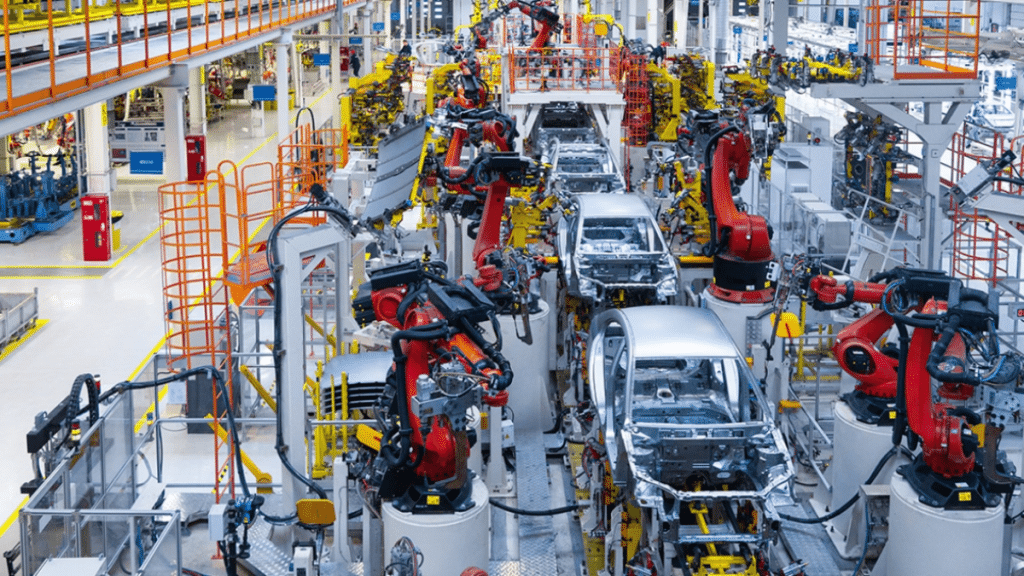
The automotive manufacturing landscape is evolving rapidly with the rise of Industry 4.0, pushing the demand for flexible, modular production systems. According to recent industry forecasts, the global market for modular automotive production lines is projected to surpass $9.2 billion by 2025. Automotive manufacturers are facing unprecedented challenges, including mixed-model production, rapid changeovers, and fluctuating supply chains.
Programmable Logic Controllers (PLCs) have become central to addressing these demands, replacing traditional relay systems with responsive, reliable control logic. At facilities like Tesla’s Berlin Gigafactory, modern PLCs offer microsecond-level responsiveness and impressive mean time between failures (MTBF exceeding 100,000 hours), making them indispensable in automotive environments.
Key Roles of PLCs in Modular Production
PLCs serve as standardized interfaces for plug-and-play modules, enabling rapid reconfiguration. Volkswagen’s MEB platform, for example, uses PLCs to switch between battery and motor production lines, reducing changeover time by up to 30%. This is made possible through technologies like the PROFINET-IRT protocol, which ensures device synchronization with jitter under 1 microsecond.
In modular setups, software modularity is just as critical. Reusable code blocks based on IEC 61131-3, such as function blocks (FBs) and function calls (FCs), support dynamic reconfiguration. Audi’s A6 production line utilizes PLC logic to seamlessly switch between SUV and sedan models.
PLCs also act as data hubs in cyber-physical systems. They collect real-time machine data and transmit it via OPC UA protocols to systems like Azure IoT Hub, enabling visualization through tools like Power BI. This architecture supports predictive analytics and digital twin deployment.
Integration Across the Stack
PLCs tightly integrate with industrial robots, as seen in KUKA’s adaptive robotic welding, where PLCs regulate force control and path optimization. They also bridge the gap to IIoT platforms, supporting predictive maintenance workflows. Siemens MindSphere, for example, analyzes vibration data from PLC-connected sensors to deliver 92% accurate fault predictions.
Digital twin applications rely on PLC emulation tools such as Rockwell’s Emulate3D, allowing engineers to validate control logic before deployment. This enables safer, faster, and more cost-effective commissioning.
Challenges and Solutions
Legacy PLC systems often lack IT connectivity. Modern solutions like CODESYS-based soft PLCs act as protocol gateways, integrating older hardware with modern MES or ERP systems. Cybersecurity is another critical concern, particularly with PLC-targeting malware like Stuxnet variants. Secure PLC hardware from vendors like Phoenix Contact offers built-in encryption and access control.
The skills gap remains a pressing issue. A Deloitte survey reports that 70% of auto plants lack engineers proficient in both PLCs and modern IT languages like Python. BMW addresses this with AR-assisted training tools that reduce programming errors by 40%.
Looking Ahead
PLCs are evolving with AI integration. Siemens SIMATIC PLCs now support TensorFlow Lite to dynamically adjust stamping parameters in real-time. Porsche is exploring blockchain-integrated PLCs to automate smart contract execution for decentralized production. Modular PLC systems also support sustainability by allowing targeted module replacements instead of full system overhauls, reducing e-waste.
Conclusion
As Automotive 4.0 reshapes manufacturing, PLCs form the backbone of modular, flexible production. OEMs must prioritize investments in modular PLC infrastructure and upskill their engineering teams to bridge automation and IT. This is not only a strategy for agility—it’s a roadmap to future-proofing industrial innovation.