

By Charles Swihart | Founder & CEO, Preactive IT Solutions
American manufacturing is in the middle of a historic expansion. Factory construction spending has doubled since 2021. Semiconductor plants, battery facilities, defense suppliers, and industrial operations of every kind are being built or expanded across the country — particularly in Texas, where manufacturing investment has surged into the tens of billions in just a few years.
It is a remarkable moment. It is also producing a quiet crisis that most business owners and plant managers haven’t fully recognized yet.
The problem isn’t funding, labor, or supply chain. It’s IT infrastructure — specifically, the gap between what standard business IT provides and what a manufacturing environment actually requires. That gap is costing manufacturers real money, in production downtime, in security incidents, and in operational inefficiencies that compound quietly until they become impossible to ignore.
I’ve been working in IT since 1990, and for the last two decades my focus has been almost entirely on manufacturers, construction companies, and engineering firms across Texas. I repeatedly see the same mistake: companies sophisticated enough to invest in modern production equipment but running it on IT infrastructure never designed for the plant floor.
The Assumption That’s Costing You
When most businesses think about IT, they think of what keeps the office running: email, file sharing, laptop and server cybersecurity, maybe a cloud phone system. That’s what most IT companies — and most internal IT departments — are built to support.
Manufacturing adds a completely different layer. On the plant floor, you have operational technology: the control systems, sensors, PLCs, and SCADA platforms that actually run your production equipment. These systems operate on entirely different rules than office IT, and the people maintaining your business network are almost never trained to handle them.
The consequences show up in predictable ways.
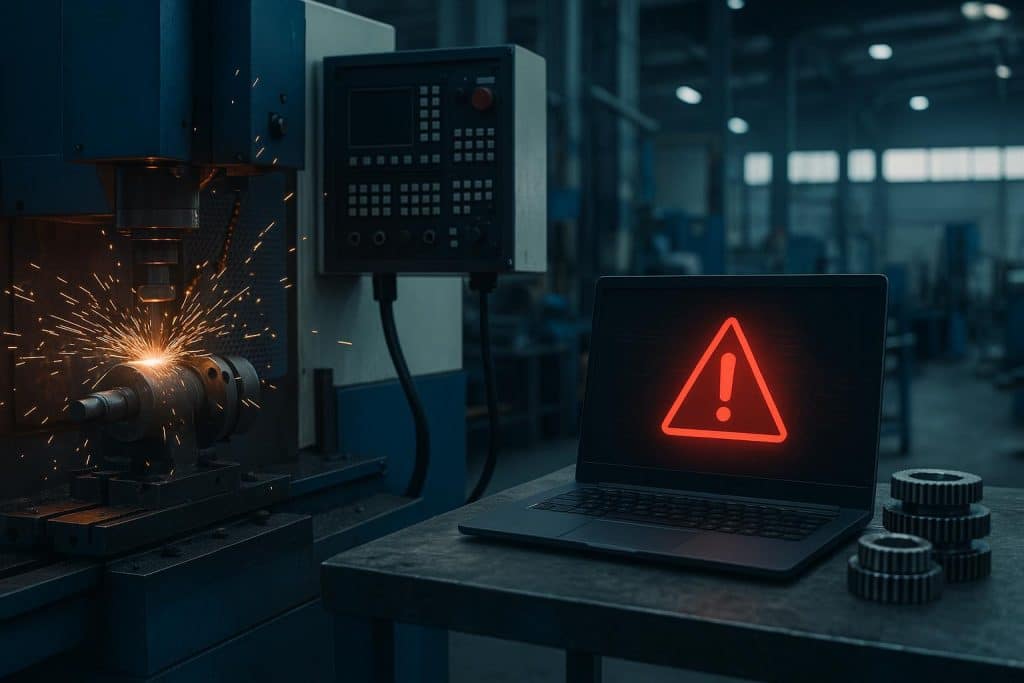
Downtime events that shouldn’t happen. A software update pushed to production equipment breaks compatibility. A line goes down. By the time you reach the vendor, you’ve lost hours of production—not from negligence, but from office IT practices applied to equipment that can’t handle them.
Security gaps you can’t see. Every IoT sensor, remote diagnostics connection, and cloud dashboard is a potential entry point. IBM’s X-Force Threat Intelligence Index has ranked manufacturing the most-attacked industry sector three years running. Many manufacturers don’t discover how exposed they are until after an incident.
Integration problems that quietly erode productivity. Getting production data into your ERP in a format both systems understand requires integration work most general IT providers aren’t equipped for. When it’s missing, people fill the gap manually — spreadsheets, re-entered data, decisions made on hours-old information.
Why This Gets Worse During Growth
These problems don’t stay the same size as your operation grows. They compound.
A manufacturer running two production lines has a manageable number of control systems, network connections, and potential vulnerabilities. When that manufacturer expands to five lines, adds a second facility, brings on new equipment vendors, and integrates with new supply chain platforms, the complexity doesn’t increase linearly — it multiplies. The IT infrastructure that was barely adequate at the original scale becomes a genuine liability at the new one.
The reshoring wave is putting a lot of manufacturing companies in exactly this position right now. They’re growing faster than their IT infrastructure can support, and they’re deciding on new technology and equipment without a clear picture of the IT implications.
What Good Manufacturing IT Actually Looks Like
The manufacturers I’ve seen handle this well have a few things in common.
They treat IT infrastructure as a production asset, not an administrative expense. The same rigor that goes into selecting and maintaining production equipment goes into the systems that support it. They have documented inventories of every device on the network, including older control systems that often get overlooked.
They have someone — whether internal or external — who understands both business IT and operational technology. Not one or the other. The disciplines overlap in manufacturing, and the gaps between them are exactly where problems develop.
They take vendor access seriously. Most manufacturers have anywhere from a handful to dozens of vendors with some form of remote access to their systems. Each access relationship needs active management: time-limited, monitored, and revoked immediately when a service relationship ends. This is one of the simplest and most impactful steps a manufacturer can take, and one of the most commonly neglected.
They plan for incidents before they happen. A manufacturer that has thought through what a ransomware incident looks like — which systems to isolate, who to call, what manual fallback procedures exist — responds in hours rather than days.
The Right Question to Ask
If you’re running a manufacturing operation and you’re not certain whether your current IT support has genuine expertise in manufacturing environments — not just business IT, but the specific challenges of managed IT services for manufacturing — that uncertainty is itself the answer.
The companies that manage this well aren’t the ones with the largest IT budgets. They’re the ones who recognized early that manufacturing IT is a distinct discipline, and who built their operations around that reality instead of discovering it after an expensive problem.
The manufacturing expansion underway across Texas and the rest of the country is a genuine opportunity. The IT infrastructure supporting it either enables that opportunity or limits it.
Charles Swihart is the founder and CEO of Preactive IT Solutions, a managed IT services provider based in Houston and Austin, Texas, specializing in IT support for manufacturing, construction, and engineering companies. He is the author of On Thin Ice, an Amazon best-seller on cybersecurity for business leaders, and was named MSP Titan of the Industry in 2024.