

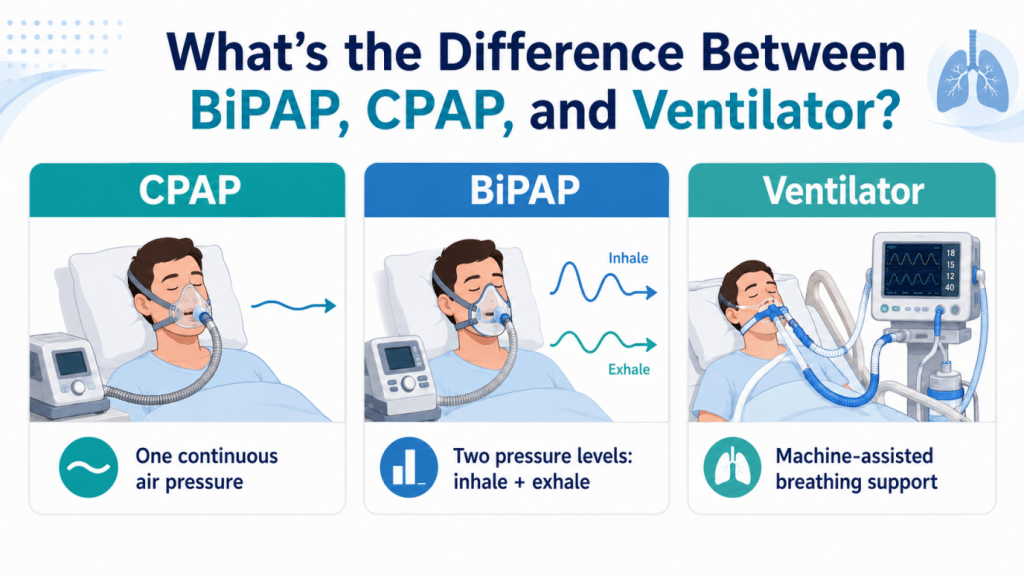
BiPAP, CPAP, and ventilators all support breathing, but they do not do the same job. CPAP keeps the airway open with one steady pressure. BiPAP gives two pressure levels to reduce breathing effort. A ventilator can take over more of the breathing process when the patient needs advanced respiratory support.
Understanding the difference between BiPAP, CPAP, and a ventilator helps choose the right level of care.
What is a CPAP (Continuous Positive Airway Pressure) Machine?
A CPAP machine is a non-invasive device that delivers a constant, single level of air pressure through a mask. The pressure remains identical during both inhalation and exhalation.
The main purpose of CPAP is to keep the upper airway open. It does not usually “breathe for” the patient. Instead, it helps prevent airway collapse, especially during sleep. Thus, the CPAP machine is used for:
- Obstructive Sleep Apnea (OSA): This is the primary use case. CPAP stops the throat muscles from blocking the airway during sleep.
- Home Care Settings: Most CPAP devices are used at home by patients during sleep.
- Hospital settings: patients who need airway support but can still breathe spontaneously.
CPAP machines are non-invasive and suitable for many sleep apnea patients. It can improve sleep quality, reduce snoring, and support oxygenation when the main problem is airway collapse.
However, CPAP only provides one pressure level.
What is a BiPAP (Bilevel Positive Airway Pressure) Machine?
A BiPAP machine is also a non-invasive device that delivers two levels of air pressure. It tracks the patient’s breathing cycle and alternates pressure dynamically.
- IPAP (Inspiratory Positive Airway Pressure): A higher pressure is delivered when the patient breathes in to support air intake.
- EPAP (Expiratory Positive Airway Pressure): A lower pressure is delivered when the patient breathes out, making exhalation easier.
BiPAP is commonly used for sleep support, emergency care, and hospital respiratory care.
- Chronic Obstructive Pulmonary Disease (COPD): BiPAP helps patients who struggle to expel trapped air from their lungs.
- Congestive Heart Failure (CHF): It reduces the workload on the heart by easing respiratory effort.
- Sleep Apnea Cases: Central sleep apnea, complex sleep apnea.
In the BiPAP vs CPAP comparison, BiPAP offers superior comfort because patients do not have to fight high pressure when exhaling.
However, BiPAP still relies on the patients themselves to breathe. If the patient suffers from neurological failure or severe trauma and stops initiating breaths, a basic BiPAP cannot maintain life support.
What is a Ventilator?
A ventilator is a medical device that helps or replaces breathing when a patient cannot breathe adequately on their own.
A ventilator can deliver breaths through an endotracheal tube or a tracheostomy tube, depending on the patient’s condition. Unlike CPAP and BiPAP machines, a ventilator can provide advanced control over pressure, volume, oxygen concentration, respiratory rate, inspiratory time, alarms, and ventilation modes. This is the most important difference between BiPAP, CPAP, and a ventilator.
Modern ventilators can offer multiple invasive and non-invasive modes, such as:
- Invasive: V-A/C, PPS, P-A/C, CPRV, V-SIMV, AMV, P-SIMV, VS, CPAP/PSV, APRV, DuoVent, PRVC-SIMV, PRVC.
- Non-invasive: PPS, SNIPPV, APRV, NIPPV, P-SIMV, NCPAP, CPAP/PSV, PSV-S/T, DuoVent, P-A/C
Where Are Ventilators Commonly Used?
- ICU respiratory failure: Provides advanced breathing support and monitoring
- Surgery and anesthesia: Supports breathing during procedures
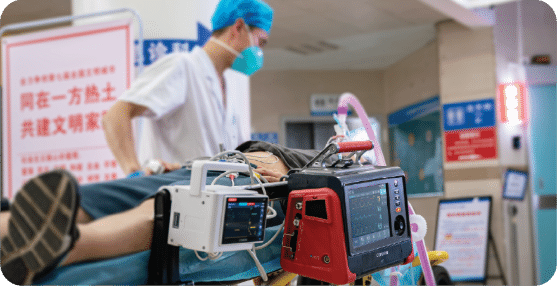
- Emergency transport: Maintains ventilation during transfer
- Severe pneumonia or ARDS: Supports oxygenation and ventilation
- Neonatal respiratory distress: Delivers precise support for newborns
The ventilator is controllable. It can support patients across different disease stages, from emergency care to ICU treatment and recovery. It can also provide alarms, monitoring, oxygen control, and multiple ventilation modes.
But ventilators require trained clinicians, careful settings, and close monitoring. Invasive ventilation also carries risks, needing professional care.
Key Differences Between BiPAP, CPAP, and Ventilator
Is CPAP a ventilator? No. The difference between CPAP and ventilators is that a CPAP only provides pressure support to keep the airway open; it cannot actively pump air to ventilate the lungs.
The following table outlines the differences when comparing CPAP vs ventilator vs BiPAP:
| Feature | CPAP | BiPAP | Ventilator |
| Invasiveness | Non-Invasive | Non-Invasive | Non-Invasive & Invasive |
| Pressure Delivery | Single, continuous fixed pressure | Two distinct pressures (IPAP/EPAP) | Multiple ventilation modes (Volume, Pressure, and Control) |
| Common Uses | Obstructive Sleep Apnea | COPD, CHF, Sleep Apnea Cases | Respiratory failure, surgery, trauma, or critical illness |
| Monitoring Requirements | Minimal monitoring | Moderate; occasional checks by healthcare providers | Critical; requires continuous 24/7 clinical monitoring |
| Comfort Level | Simple, but exhaling may feel difficult | Often easier to exhale than CPAP | Depends on mode, mask, or tube, and patient condition |
| Complexity | Low; single operation for home users | Moderate; requires setting IPAP, EPAP, and backup rates | Highest; |
In simple terms, CPAP mainly keeps the airway open. BiPAP supports breathing with two pressures. A ventilator can support or control breathing when the patient requires more advanced care.
So, the difference between BiPAP, CPAP, and ventilators comes down to pressure control and whether the patient can still breathe effectively without full mechanical support.
Ventilator Solutions from Comen
In complex clinical environments, medical facilities need flexible equipment that can adapt to changing patient needs. For healthcare providers looking to upgrade the respiratory devices, Comen provides dedicated solutions.
Comen’s respiratory lineup covers from emergency transport to intensive care units:
- V6/V8 Series (Critical Care): These are premium ICU ventilators designed for complex, long-term respiratory management. They offer comprehensive lung monitoring tools and advanced ventilation modes to treat severe ARDS and multi-organ failure.
- V1/V3 Series (Transport Care): Built for rapid response, these portable ventilators handle ambulance transport, intra-hospital movement, and routine care scenarios. They provide stable ventilation in a rugged, highly mobile form factor.
- NV Series (Neonatal Care): Dedicated non-invasive ventilators designed specifically for the fragile lungs of newborns and pediatric patients.
By integrating flexible non-invasive modes alongside high-performance invasive life-support, these systems allow clinicians to transition patients seamlessly as their respiratory health improves.
To view specific product technical specifications, visit their website and contact Comen now!