

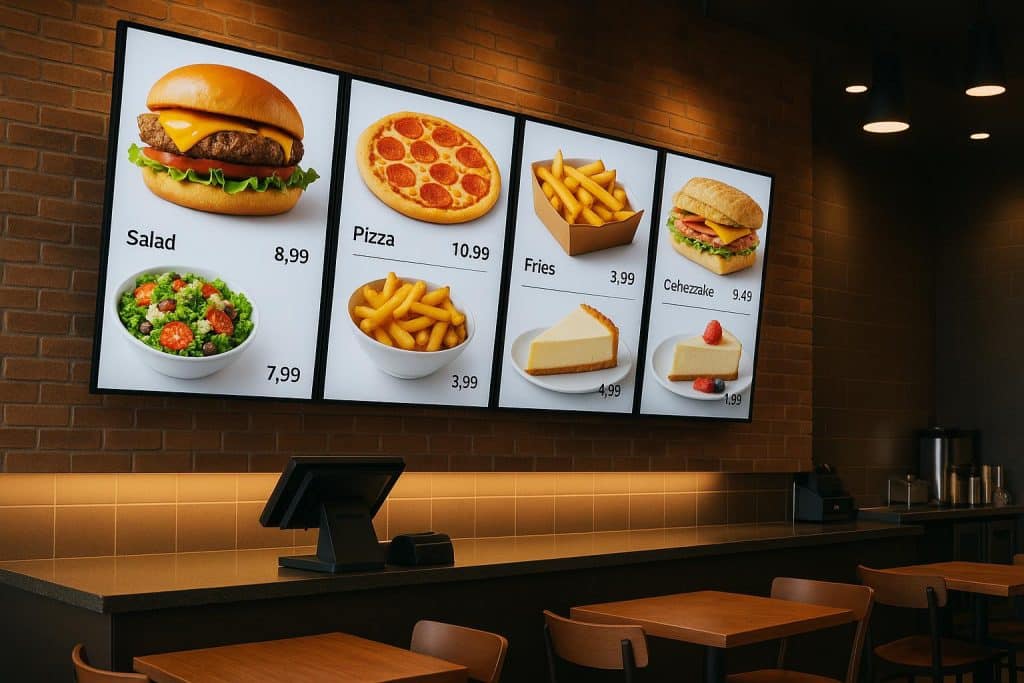
Step into any modern Quick Service Restaurant (QSR), trendy downtown café, or bustling fast-casual eatery today, and you will notice a massive shift in how food is presented. The static, chalk-written boards and faded paper menus hanging above the counters are rapidly disappearing. In their place are vibrant, high-definition digital displays showcasing steam rising from a freshly grilled burger or condensation dripping down a cold beverage.
This visual transformation is not just a passing aesthetic trend; it is part of a massive digital revolution sweeping through the global food and beverage industry. Today, smart digital menu boards have become the ultimate operational tool for restaurant owners. Beyond making food items look incredibly appetizing, these dynamic screens serve as a strategic nerve center—allowing establishments to drastically improve ordering efficiency, adjust pricing in real-time, and execute highly targeted promotions that instantly capture customer attention.
1. Why Digital Menu Boards are Essential for Today’s Food Outlets
In an increasingly competitive dining market, modern eateries must optimize every second of the customer journey. Transitioning from traditional static signage to intelligent digital displays offers two undeniable business advantages:
- Irresistible Visual Appeal: Human beings eat with their eyes first. Static images simply cannot compete with the psychological impact of moving graphics. High-definition video loops of sizzling food or rotating carousels of limited-time desserts stimulate sensory triggers in consumers’ brains, naturally guiding their cravings. This visual enhancement actively drives impulse buying, helping restaurants boost their average order value (AOV) by up to 15 to 30 percent.
- Ultimate Operational Flexibility: Managing a restaurant menu manually can be a logistical headache. With digital signage software, changing the menu takes seconds rather than days of waiting for new printouts. Restaurant managers can implement automatic “dayparting”—seamlessly switching from a breakfast menu to a lunch menu at exactly 11:00 AM. Furthermore, if a specific ingredient runs out in the kitchen, staff can remove the sold-out item from the screen instantly, avoiding customer disappointment and streamlining the front-of-house workflow.
2. Selecting the Best Hardware Partner for Upgrading Your Dining Space
While the benefits of digital menu screens are clear, deploying them successfully requires a careful understanding of commercial hardware. A restaurant kitchen is one of the toughest environments for electronic equipment. Unlike a standard home or office, a commercial kitchen exposes devices to constant airborne grease, ambient heat from ovens, humidity from dishwashers, and rigorous 18-hour daily operation cycles. Purchasing consumer-grade televisions from a local retail store will inevitably lead to hardware overheating, screen burnout, and costly system downtime.
To avoid these pitfalls, restaurant brands must source heavy-duty, commercial-grade hardware designed explicitly for hospitality environments. These screens require specialized ventilation systems, dust-resistant enclosures, and high-brightness panels (measured in nits) to remain perfectly readable under intense store lighting.
When independent chains or global franchises look to scale up, partnering with experienced Restaurants Menu Board Manufacturers ensures they receive screens built to withstand grease and heavy continuous use, while providing split-screen software compatibility. By securing hardware directly from professional manufacturers, corporate buyers can ensure that their embedded motherboards can handle advanced content scheduling applications without lagging.
3. Localized Expansion: The Boom of Commercial Displays in Mexico
As the North American market continues to saturate, the global focus of digital commercial displays is expanding rapidly into neighboring regions. Most notably, Central and Latin America are experiencing an unprecedented boom in retail and restaurant modernization. At the forefront of this regional expansion is Mexico. Driven by booming urban economies, a highly youthful tech-savvy population, and a competitive culinary sector, Mexican restaurant chains and international franchises are aggressively investing in interactive big-screen technology.
However, implementing a synchronized hardware rollout across diverse geographical territories is not without its challenges. Transporting delicate, large-format commercial displays across borders requires meticulous attention to international shipping regulations, freight safety, and localized compliance certifications. If a screen cracks during transit or gets held up at customs, a restaurant’s grand opening can be delayed, resulting in significant revenue losses. Furthermore, once the screens arrive at the venue, having local technicians who can handle physical installation, initial calibration, and ongoing on-site maintenance is critical.
For businesses expanding across North and Central America, leveraging a reliable Mexico Digital Signage Supply Chain is critical to managing local shipping logistics, ensuring speedy customs clearance, and securing ongoing technical field support. Establishing a connection with an organized regional supply network removes the operational friction from the importing process. It guarantees that whether a restaurant group is opening a single bistro in Mexico City or deploying a multi-location franchise across Monterrey and Guadalajara, they will have rapid access to localized technical assistance and replacement parts.
Conclusion
The future of the culinary industry lies at the intersection of gastronomic excellence and tech-driven efficiency. Digital menu boards represent the perfect bridge between a restaurant’s kitchen creations and a consumer’s physical purchasing decisions. However, a stunning user interface is only as reliable as the physical hardware it runs on and the logistics network that delivers it. By anchoring digital ambitions to top-tier commercial manufacturers and utilizing structured, localized supply chains, modern food outlets can ensure their digital transformation is seamless, highly profitable, and entirely built to sustain long-term business growth.