

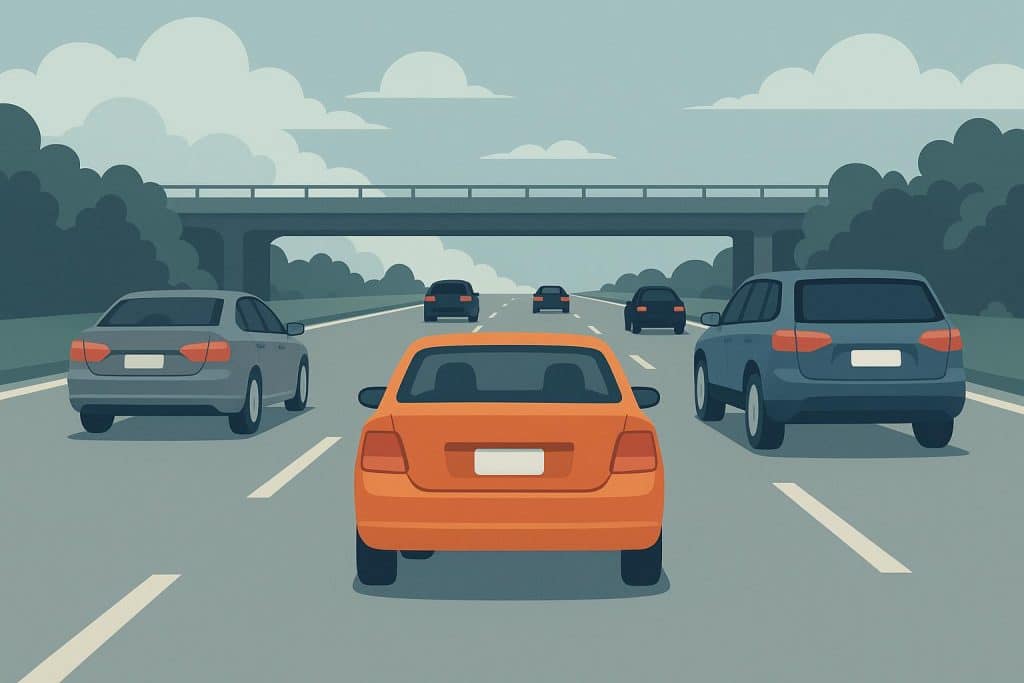
When reviewing road traffic accident (RTA) statistics in the United States, 29% of fatalities are caused by at least one vehicle surpassing posted speed limits. In a 2023 report published by the Highway Loss Data Institute (HLDI), almost 12,000 deaths were classified as high-speed RTAs; this statistic underscores the risk of raising speed limits on American roads. Drivers love to push past the speed limit; HLDI research shows that fatal RTAs increase along with higher speeds. Conversely, lowering speed limits has been a proven measure to reduce fatal and injury RTAs.
High-speed collisions dominate news headlines and keep car accident lawyers busy with personal injury lawsuits; however, focusing solely on upper speed limits ignores the road dangers created by slow-moving vehicles. When drivers travel significantly slower than the surrounding traffic, they disrupt the predictable flow. Variances in speed introduce a different set of traffic hazards such as sudden braking, erratic lane changes, and overall driver frustration.
Defensive driving requires maintaining a predictable pace. Under specific traffic conditions, going too slowly can be just as disruptive as pressing too hard on the gas pedal.
Understanding Traffic Mobility and Safety
The Institute of Transportation Engineers (ITE) analyzes road traffic performance with mobility and safety as primary metrics. While higher speeds maximize mobility by reducing travel times, safe speeds balance transportation efficiency with the goal of protecting drivers, passengers, cyclists, and pedestrians.
On highways, advanced design features, such as access control and safety barriers, allow faster travel at an acceptable risk level. On urban streets, lower speeds are posted to manage the right-of-way, busy intersections, and the presence of cyclists and pedestrians. ITE professionals must align road design and speed limits to optimize safety without compromising mobility; in other words, keeping traffic moving efficiently without compromising public safety.
The Speed-Safety Nexus
Setting speed limits is a cornerstone of highway safety and traffic management. Legal speed limits represent the maximum safe speed for normal conditions. ITE surveys show that most drivers consider posted speed limits as being reasonable; this perception helps law enforcement agencies spot reckless driving. When city and county officials want lower speeds, simply changing posted limits is rarely enough; transportation engineers must modify road features to encourage slower driving while balancing safety and mobility.
ITE reports show that the highest percentage of speeding fatalities does not happen on highways and freeways with multiple lanes and higher speed limits; it happens on local roads and urban streets. This is explained by the fact that local roads account for most of the public acreage in American cities. While local roads implement lower speed limits, they are often the riskiest zones for speed-related crashes with heavy fatality rates.
When discussing the speed-safety nexus, transportation engineers evaluate the mismatch between road design and human behavior. Local roads and neighborhood streets are busier than they seem to many drivers who mostly focus on passing through; they promote mobility while connecting communities and providing spaces where children play, neighbors walk dogs, and cyclists commute.
Drivers on local roads with lower speed limits often deal with crosswalks, blind curves, driveways, and other conflict points. If they treat urban and suburban zones like highways, the results can be catastrophic. A pedestrian struck by a vehicle traveling 20 mph has a 90% survival rate. That rate plummets to 10% at 40 mph. To save lives, engineers and urban planners cannot rely on speed limit signs alone; they must implement speed management strategies such as narrow lanes, speed humps, and curb extensions that physically force safer driving habits where people live and walk.
How Lower Driving Speeds Create Road Hazards
In the 1960s, the U.S. Department of Commerce conducted the first studies indicating that vehicles traveling at speeds considerably higher or lower than average were more likely to result in RTAs. This marked the first time the general view of “slower is safer” was statistically challenged.
When a vehicle travels well below the established speed flow, it forces trailing drivers to make sudden adjustments. The resulting speed variance leads to abrupt braking, traffic clusters, and risky overtaking maneuvers. Ultimately, the early research data proved that roadway safety depends more on uniformity than on arbitrary speeds. For example, on specific road sections with a 40 mph posted speed limit, the risk of an accident is lower for those driving exactly 40 mph. The findings concluded that predictability is a stronger anchor of highway safety than the caution commonly associated with lower speeds.
All drivers are responsible for maintaining safe speeds; nonetheless, this safety assumption often comes down to personal judgment. Every road environment is different; drivers constantly have to speed up or slow down to not only comply with the speed limit but also traffic conditions. In some circumstances, slowing down farther below the limit can trigger serious accidents and injuries. From a defensive driving perspective, the definition of a safe speed is flexible but ultimately left up to the driver’s discretion when traffic falls below the speed limit.
Erratic slow driving disorients other drivers who assume that a sluggish pace signals upcoming road hazards. When many drivers abruptly slow down in a collective overreaction, the disrupted traffic flow can trigger a ripple effect of desperate lane-weaving and fender-benders. Things get worse when artificial delays from slow driving test drivers’ patience, thus prompting hostile maneuvers like tailgating and slamming on brakes, which elevate collision risks and devolve into road rage situations.
The Legal and Personal Injury Angle of Slow Driving
RTAs can cause injuries and property damage at any speed. The principles of liability and negligence are the same for high-speed highway collisions or fender-benders in traffic jams. Car accident lawyers look closely at whether drivers breach their duty of care by failing to maintain a safe, predictable flow of traffic, especially in statutory “at-fault” jurisdictions. When a vehicle traveling considerably below the speed limit triggers a multi-car pileup, the slow driver can be held legally responsible for medical bills, lost wages, and property damage.
While many law enforcement agencies heavily focus on speeders and reckless drivers, many states enforce “impeding traffic” statutes and minimum speed limits on major highways. Not all states post their statutory minimums on road signs; however, they make them part of driver education programs and licensing tests. When drivers involved in RTAs receive tickets or citations for driving too slowly, personal injury law firms can focus on proving they operated as active hazards.
Ultimately, slow driving RTAs should not dissuade individuals pursuing insurance claims or personal injury lawsuits. Maintaining a safe speed also means driving predictably, without compromising traffic mobility and public safety.
If you have been involved in a crash such as a rear-end accident caused by another driver, contact an experienced law firm like Thomas Law Offices who may be able to help you proceed.