

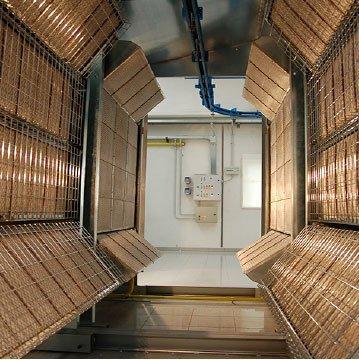
In modern manufacturing, thermal processes must be faster, cleaner, safer and easier to integrate into existing production lines. Traditional industrial ovens often require long tunnels, large air volumes and significant energy consumption to reach the desired process temperature. For companies working with drying, preheating, curing or surface treatment, this can become a serious limitation. This is where catalytic infrared heating becomes a strategic technology for designing compact industrial ovens.
Instead of heating large quantities of air before transferring heat to the product, the catalytic infrared systems emit radiant energy directly toward the surface to be treated. This approach is able to reduce thermal dispersion, shorten process times and make oven layouts more efficient. Companies such as Infragas develop gas-fired infrared radiant solutions designed precisely for industrial applications where space, energy and process control matter.
What is catalytic infrared heating?
Catalytic infrared heating is a thermal technology that combines gas oxidation with a catalytic reaction. The system usually works with natural gas or propane. The fuel reacts with oxygen on a preheated catalyst, generating heat without an open flame. This heat is then emitted as infrared radiation.
The key difference compared with many conventional heating systems is the way energy reaches the product. In a convection oven, hot air transfers heat to the surface. In an infrared oven, radiation travels directly from the emitter to the material. When the surface absorbs this radiation, the energy is converted into heat.
This direct transfer is particularly useful in industrial ovens because it allows manufacturers to concentrate energy where it is needed. The oven does not need to heat a large air mass to the same extent, which can improve efficiency and reduce the physical size of the system.
Why compact industrial ovens matter
Industrial space is expensive. A long oven can limit production layout, increase installation complexity and make future line modifications more difficult. A compact industrial oven allows companies to save floor space, improve line integration and reduce the distance between process stages.
Compactness is not only a question of dimensions. It also affects productivity. When a thermal system reaches the required process result faster, the oven can often be shorter while maintaining the same output. This is one of the main reasons why infrared heating technology is used in drying lines, coating processes, preheating stations and surface treatment systems.
For machine builders and industrial plants, compact ovens can also mean lower structural costs, easier maintenance access and better process flexibility.
How catalytic infrared helps reduce oven size
The efficiency of catalytic infrared heating comes from its ability to deliver energy directly to the product. Since radiant heat does not depend primarily on air movement, the system can achieve faster thermal response and more targeted heating.
In many applications, this means the treatment can be completed in a shorter distance. For example, in paint drying, infrared radiation can support evaporation of water or solvents from the coating layer. In preheating processes, it can raise the surface temperature of a component before bonding, coating or forming. In curing applications, it can help activate thermal reactions with greater precision.
Solutions developed by Infragas, such as catalytic infrared panels, are designed to be installed in modular configurations. This makes it possible to adapt the heating area to the size of the product, the required temperature, the conveyor speed and the available space inside the oven.
Safety advantages of flameless heating
One of the most important features of catalytic infrared technology is flameless operation. The absence of an open flame can be valuable in industrial environments where solvents, vapours, coatings or volatile organic compounds may be present.
Flameless catalytic heating can help reduce risks associated with direct combustion while still providing high thermal performance.
This makes the technology suitable for applications where controlled heat, stable emission and safety requirements must coexist. Infragas often highlights this aspect in relation to its catalytic infrared solutions for industrial thermal treatment.
Applications in drying, curing and preheating
Catalytic infrared heating can be used in many industrial sectors. One of the most common areas is industrial paint drying, both for water-based and solvent-based coatings. Infrared radiation can help improve drying uniformity and reduce defects caused by uneven heat distribution.
Another important application is the treatment of powder coatings. Infrared heating can achieve gelification and curing stages, especially when the process requires rapid energy transfer to the surface.
The technology is also useful for preheating metals, plastics, wood, textiles and composite materials. In these cases, a compact infrared oven can prepare the material for forming, bonding, coating or finishing. Because the heating effect is highly controllable, it can be adapted to different materials and production speeds.
Energy efficiency and process quality
A compact oven is useful only if it also delivers the required quality. Catalytic infrared heating can support both goals. By directing energy towards the product, it can reduce unnecessary heat losses and improve the overall energy balance of the process.
Better control of heat distribution can also improve product quality. In coating applications, a more balanced drying profile can reduce bubbles, surface skinning, stains or irregular finishes. In preheating processes, controlled radiation can help avoid overheating while still reaching the required surface temperature.
For manufacturers, this means fewer rejects, more stable production and better repeatability. Energy efficiency, quality control and compact design become part of the same industrial equation.
The role of Infragas in catalytic infrared systems
Infragas specializes in gas-fired radiant systems for industrial heating and thermal treatment. Its solutions include catalytic infrared panels designed for drying, preheating and surface treatment applications. Technologies such as INFRACAT and BOOSTERCAT are examples of how catalytic infrared heating can be adapted to different levels of power and process intensity.
INFRACAT is suitable for modular catalytic infrared applications where controlled heat and flexibility are priorities. BOOSTERCAT is designed for more demanding processes that require higher power density and stronger thermal performance. In both cases, the goal is to help manufacturers build more efficient, compact and controllable heating systems.
By integrating Infragas technologies into industrial ovens, machine builders can design systems that respond to specific production needs rather than relying on oversized, energy-heavy thermal layouts.
What to remember for smarter oven design
Catalytic infrared heating offers a practical path towards compact industrial ovens that are faster, safer and more energy-conscious. By using flameless gas catalytic technology and direct infrared radiation, it helps reduce oven length, improve process control and support high-quality thermal treatment. For companies working with drying, curing, preheating or surface finishing, solutions from Infragas can turn heating from a bulky production constraint into a precise and efficient process tool.