

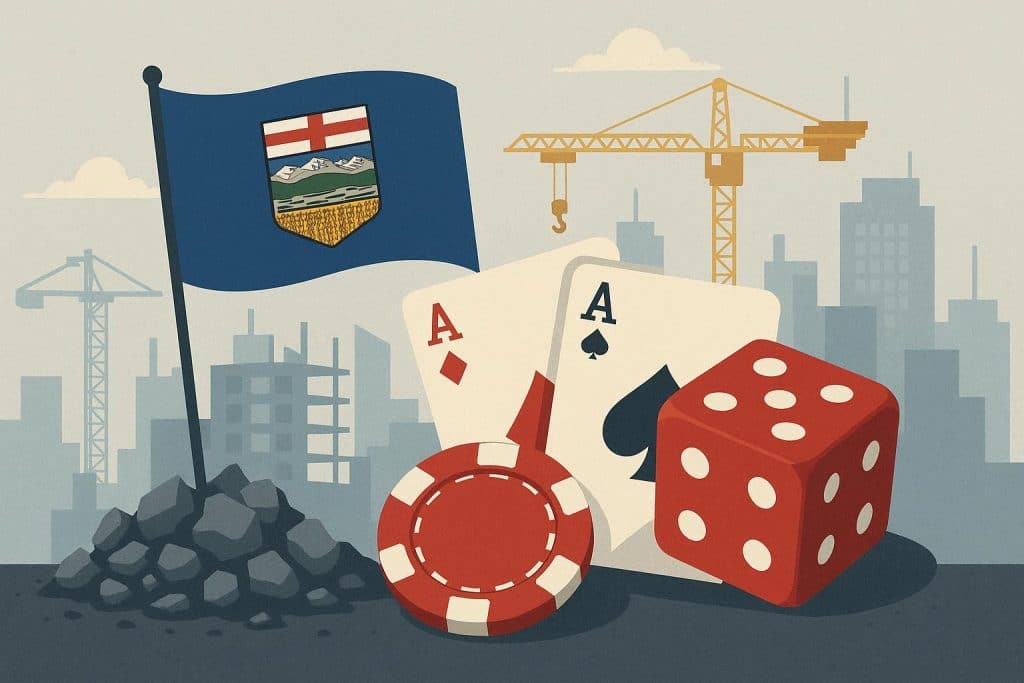
Alberta has spent the better part of the last decade recognising an economy built around oil is an economy built around something it cannot control. Global price swings, pipeline disputes, federal carbon policy, and shifting international demand have all taken turns rattling provincial finances.
The response from successive Alberta governments has been the same in broad outline if not in detail: find more revenue streams, reduce dependence on a single commodity, and build out the digital and service sectors that do not move with the price of crude.
The announcements coming out of Edmonton in early 2026 fit that pattern.
In January, the government confirmed it would open the province’s online gambling market to private operators, following the model Ontario pioneered in 2022.
It is not the most dramatic economic policy announcement the province has made. But it belongs to a group of moves that, taken together, describe a government trying to modernise Alberta’s revenue base without dismantling what made it wealthy in the first place.
What This Will Bring to Residents
For Canadians in Alberta, the practical outcome of this shift is access to a regulated online market with the consumer protections that come with it. Licensed operators are required to offer self-exclusion tools, maintain responsible gambling resources, protect player funds, and submit to regular audits. Players who have been using offshore platforms have none of those guarantees. Regulated does not mean risk-free, but it does mean accountable.
The comparison with the rest of Canada is instructive. Ontario players already have access to dozens of licensed operators with transparent terms, standardised complaint resolution, and independently verified game fairness. Players in most other provinces are still navigating a mix of government-run platforms and offshore sites. Alberta is moving to close that gap, and other provinces are watching to see whether the revenue and consumer protection outcomes justify following the same path.
For anyone tracking which Canadian platforms are currently operating under regulated frameworks, this detailed list of Canadian casino sites reflects both the operators already active and the offshore platforms that have historically served Canadian players while provincial markets catch up. That picture is going to keep changing as Alberta’s framework takes shape and other provinces weigh their own decisions.
What the Ontario Precedent Showed
To understand why Alberta made this move now, you have to look at what Ontario built after 2022. Before Ontario launched its regulated iGaming market, Canadians in most provinces either used government-run online platforms with limited game libraries or accessed offshore sites that operated in a legal grey area.
Ontario decided to change that by licensing private operators directly, requiring them to meet strict player protection standards, pay provincial taxes, and operate transparently under oversight from the Alcohol and Gaming Commission of Ontario.
The results were striking. By the end of the 2024 to 2025 fiscal year, Ontario’s regulated market had logged C$82.7 billion in total wagers, generated C$2.9 billion in gaming revenue, and counted 2.6 million active player accounts across 50 licensed operators. For a market that did not exist in its current form before April 2022, those numbers represent one of the faster regulatory success stories in North American gaming history. Alberta’s government saw those figures and drew the obvious conclusion.
The provincial revenue argument is straightforward. Albertans were already gambling online, mostly on offshore platforms that paid no provincial tax and operated under no Canadian consumer protection framework. Regulating the market does not create new gambling activity so much as redirect existing activity into a taxable, accountable channel. That is a compelling case for any government trying to close a budget gap without raising income taxes.
The Broader Diversification Picture
Online gambling regulation is one piece of a larger economic conversation Alberta has been having with itself. The province has made sustained efforts to attract technology companies, expand its film and television production tax credits, invest in agricultural technology, and build out renewable energy capacity alongside its existing oil and gas infrastructure. None of these individually replaces oil revenue. Together, they are meant to reduce the proportion of the provincial budget that rises and falls with the price of a barrel.
The digital economy angle matters specifically because it generates revenue without requiring physical infrastructure at scale. A licensed online operator pays provincial tax on gaming revenue generated from players sitting in Calgary or Lethbridge, without the province needing to build a facility or staff a regulatory operation anywhere near the size of what land-based casino oversight requires.
The Alberta Gaming, Liquor and Cannabis Commission already has the institutional framework in place. Adding private online operators to its remit is an extension of existing capacity, not a reinvention of it.
The Longer Arc
Alberta’s economic pivot is not a single announcement. It is a direction established through dozens of smaller decisions made across multiple budget cycles, and the January 2026 iGaming move is one of them. The province is not abandoning oil. It is trying to ensure that oil revenue remains a strength rather than a dependency, which means building the surrounding economy into something more resilient than it has been.
Whether that works depends on execution as much as policy design. Ontario’s regulated gambling market succeeded partly because the regulatory framework was well-designed and partly because the market was large enough to attract serious operators at launch.
Alberta’s market is smaller, but the Ontario model gives regulators a tested blueprint rather than a blank page. For a province that has been improvising its economic future for the better part of a decade, that is a more comfortable starting point than it sounds.