

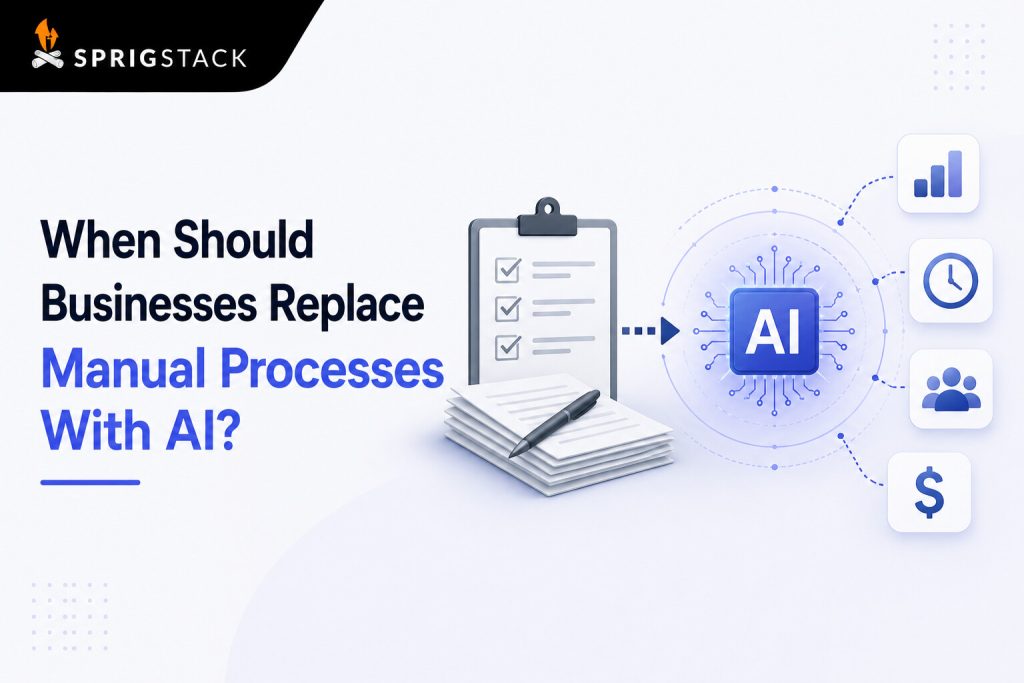
Not many firms have an epiphany where they suddenly realize that all processes should be changed by automation. In reality, it happens in a completely different way. Typically, it starts with a problem, which is not necessarily significant at first but causes certain discomfort and affects productivity. Such problems may be an unmanageable spreadsheet, an overloaded support mailbox, or even a report that requires three employees to compile each week on Fridays. The problem is that such issues start building gradually, and before you notice how big they’ve become, you will need some solutions. In fact, a 2026 workflow automation report by Quixy found that 94% of workers say they regularly perform repetitive, time-consuming tasks that could be partially or fully automated. That’s when businesses usually look for AI development services. However, you should remember that not all of them require automation and can actually be solved without introducing additional technology to the workflow. In such situations, the issue is not in the usefulness of AI, but in the suitability of your processes for such a solution. Not all processes should be automated at once. There are processes which are better done manually, as they require certain judgment and empathy from a person. However, there are also processes which are repetitive and can be made much more efficient with the help of AI.
Embrace AI When Your Team Is Burdened With Repetitive Tasks
When the same task comes up every day, it soon stops being an insignificant irritation. It starts acting as an actual bottleneck, slowly but steadily eating into your productive time, despite there being no one to monitor it.
- Data Entry Seems a Continuous Process
Data entry tasks consume precious time that you can otherwise dedicate to creative tasks. The more volume you have, the harder and more error-prone it becomes, especially in the days just before the deadline. Everyone dreads doing data entry tasks; that in itself is revealing enough.
- Manual Approvals Get Slowed Down
The process of manual approval creates bottlenecks for a whole task flow that might take several days in total. There is a way to make the system automatically process the approvals, based on the guidelines set by your team.
- Customer Replies Take Too Long
Support teams often answer the same five questions repeatedly throughout the day, on a loop. Automating those common responses frees agents for the trickier, more nuanced conversations customers actually bring. That shift alone tends to boost morale, not just speed.
- Reports Take Days to Compile
Extracting figures from five different systems manually is a lengthy, laborious process and, quite frankly, pretty demoralizing to do regularly. An integrated solution generates the exact same report in minutes with minimal human intervention required. Teams stop dreading Fridays once you implement it.
- Mistakes Slip Through Unnoticed
Manual processes rely entirely on people remembering every single step correctly, every single time. AI software development services built around your workflow catch errors before they ever reach a customer or client. That’s what your team doesn’t even know you’re lacking.
AI to Compensate When Your Processes Can’t Keep Pace With Growth
As companies grow and expand, their current systems inevitably show signs of strain. This is evidence that you need something better before long, regardless of how well-put-together your current solution is.
- Volume Has Outpaced Your Staff
Work volume that could be handled by ten people last year cannot even be processed by twenty people now. Hiring extra employees endlessly is both unsustainable and unlikely to fix the actual problem at hand, anyway.
- Systems Don’t Talk to Each Other
Disconnected tools force employees into manual data transfers between platforms constantly, often several times a day. A unified, custom-built automation service setup removes that friction and keeps information flowing without gaps. It sounds small until you add up the hours lost.
- Errors Multiply With Every New Hire
There will always be training and errors associated with learning a manual process for the first time, especially on the job. Automations use the same process every single time and are, therefore, consistent regardless of who’s working the shift.
- Deadlines Keep Slipping
Manual bottlenecks tend to worsen as workload increases across departments, one delay stacking onto another. Automated workflows move at a steady pace, no matter how chaotic the week actually gets. That steadiness is worth more than it sounds.
- Costs Are Quietly Climbing
Every manual workaround adds hidden labor costs that rarely show up clearly on a budget line. Replacing that workaround with automation often pays for itself within a few months, sometimes sooner. Most leaders are surprised once they actually run the numbers.
Choosing the Right Automation Partner Matters
Not every automation project succeeds, and honestly, the difference usually comes down to planning. These signs point to what a good technology partnership actually looks like in practice.
- Audits Should Come Before Building
A rushed rollout skips understanding your actual workflow first, and it shows later on. The right team studies your existing process closely before recommending any specific solution. Skipping this step is where most failed projects actually begin.
- Scalability Should Be Built In
A system that only works at today’s volume isn’t much of an investment, really. Good architecture anticipates growth instead of requiring a full rebuild a year down the line. MLOps practices for AI-powered applications can also help businesses manage and scale AI systems more reliably as their needs evolve. It’s cheaper to plan ahead than to rebuild twice.
- Compliance Needs Attention From Day One
Regulatory changes are common in certain industries like finance and healthcare, and they happen all the time. Sometimes even without any prior notice at all. Any automation solution should consider such changes and account for them from the very beginning. Trying to fit it in later will only complicate the whole thing.
- Communication Should Stay Transparent
Fuzzy deadlines and changing scopes confuse everyone involved in the process. Whether you are the client or one of the team members. Top AI development services keep the lines of communication clear by concentrating on deliverables that can be measured. And transparency in communications is the key to success in such projects.
- Long-Term Support Matters Just as Much
An automation solution does not have to be static. It is going to require some adjustments over time, as the business itself grows and develops. Having someone around who would support such automation even after its official implementation is complete is a huge plus.
Conclusion
Manual procedures serve their purpose well, until the point where they stop doing so. Companies are aware of it but tend to realize too late. And that is when a proper partner comes into play.