

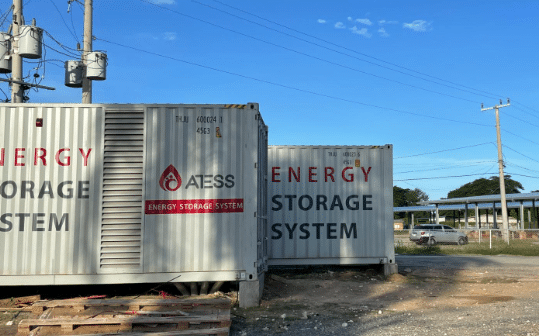
Many facilities now operate backup power systems that use both grid supply and a diesel generator for load sharing and uninterrupted power. When these two are connected within the same system, their voltage configuration must be compatible.
However, in many cases, a mismatch between the two leads to equipment failure, including energy storage inverter malfunctions and sudden system trips.
So why does this happen, and how can it be prevented?
Understanding Two Key Voltage Configurations
To accurately analyze mismatch issues, it is essential to first clarify two typical voltage configuration types.
1. US Standard System: High-Leg Delta
The high-leg delta is a three-phase power distribution configuration commonly found in older industrial and commercial buildings in North America.
In this configuration, the voltage from one phase (typically phase B) to neutral is significantly higher than that of the other two phases (typically 208V, while phases A and C are 120V to neutral).
This asymmetrical structure imposes specific requirements on an energy storage inverter in terms of single-phase load distribution and voltage detection.
2. Wye (Star) Connection
The Wye connection is currently the most widely used power distribution method globally, particularly in data centers, modern buildings, and renewable energy systems.
Its characteristic is that the ends of the three-phase windings are connected together to form a neutral point, providing stable phase-to-neutral and phase-to-phase voltage relationships (e.g., 230/400V or 277/480V). The voltage from each phase to neutral is balanced, facilitating load balancing and grounding system design.
When the backup generator uses a Wye connection while the grid uses a high-leg delta, or when the voltage levels or grounding methods of the two sources are inconsistent, the transfer system faces fundamental electrical discrepancies.
How Voltage Configuration Mismatch Causes System Failure
A voltage configuration mismatch propagates along the power supply path, affecting automatic transfer switches (ATS), bypass switches, critical loads, and energy storage inverters.
1. Impact on ATS
- Voltage Detection Errors: ATS units rely on voltage sampling to determine power source status. If the generator output differs from the grid in voltage magnitude or phase-to-neutral imbalance, the ATS may misjudge source availability, leading to a switching failure.
- Phase Sequence Protection Tripping: When the phase sequence of the generator does not match that of the grid, the ATS phase sequence monitoring function blocks the transfer, preventing switchover to the backup source.
- Contact Arcing and Damage: During load transfer, if voltage or phase angle differences exist between the two sources, severe arcing may occur at the contacts. This accelerates contact degradation and, in extreme cases, can burn out the transfer switch.
2. Impact on Bypass Switches (Manual/Static)
In systems employing manual bypass or static transfer switches, inconsistent voltage configurations prevent the two sources from meeting synchronization conditions during transfer.
- For static switches, if phase lock cannot be achieved, the system will either reject the transfer or perform a forced transfer, introducing electrical stress.
- For manual bypass, operators face the risk of inadvertently shorting between different sources, endangering both equipment and personnel.
3. Impact on Critical Loads
- IT Equipment Power Supply Damage: Switching power supplies in servers, storage devices, and other IT loads are sensitive to input voltage amplitude and neutral point deviation. Voltage imbalance or abnormal neutral-to-ground voltages can cause power supply failure or frequent equipment reboots.
- Motor Overheating: Three-phase voltage imbalance results in asymmetric stator currents, generating negative-sequence currents that induce additional rotor heating and vibration. Prolonged operation under such conditions accelerates insulation degradation.
4. Impact on Energy Storage Inverters
- Input Over-Limit Protection: If the generator output voltage falls outside the inverter’s allowable input range, such as excessive phase-to-neutral voltage in a high-leg delta configuration, the energy storage inverter will trip, preventing the system from charging or operating in island mode.
- Phase-Lock Failure: To operate in grid-tied mode, an energy storage inverter must track the grid voltage phase. If the generator voltage waveform, frequency, or phase differs from that of the grid, the phase-locked loop cannot lock stably, causing the inverter to fault and shut down.
- Neutral Conductor Conflicts: In TN-S or TN-C-S grounding systems, if the neutral grounding methods of the generator and grid differ, switching may create circulating currents in the neutral path, interfering with ground fault protection and potentially causing nuisance trips of zero-sequence protection devices. Such issues are particularly challenging to diagnose in complex integrated energy storage system architectures, where multiple power sources interact dynamically.
Solutions of Diesel Generator and Grid Voltage Mismatch
Addressing voltage configuration mismatches requires a systematic approach spanning the design, retrofit, and maintenance phases.
1. Design Phase (Prevention)
- Mandate Consistency: Explicitly require that the diesel generator’s output voltage, wiring configuration (Wye or Delta), and grounding method strictly match the utility grid.
- Specify Technical Details: Ensure all design documents and single-line diagrams (SLD) clearly define phase sequences and neutral arrangements to avoid costly downstream corrections. Early coordination with energy storage inverter manufacturers helps prevent mismatches before installation begins.
2. Retrofit Phase (Remediation)
For existing systems where a mismatch is identified, the following actions can be taken:
- Measure and Verify: Conduct detailed field measurements of both sources, including actual phase-to-neutral voltages and phase sequences, to pinpoint discrepancies.
- Reconfigure Generator Wiring: Some generators allow for output reconfiguration (e.g., Wye-to-Delta conversion) by adjusting internal terminal connections, provided the stator windings support such changes.
- Install Isolation Transformers: If a direct match cannot be achieved, installing an isolation transformer on the generator output side is the most robust solution. While it involves a higher capital investment, it resolves compatibility issues entirely and enhances system immunity to electrical disturbances.
3. Testing & Maintenance Phase (Assurance)
- Establish Transfer Test Procedures: Develop standardized protocols to verify phase-to-phase voltages, phase angles, and grounding compatibility before any live transfer occurs.
- Document and Label: Clearly document generator and grid parameters in maintenance manuals and on-site equipment labels to alert technicians to potential configuration risks during future service.
Conclusion
Voltage configuration mismatch between a diesel generator and the grid is fundamentally a consequence of insufficient system-level integration control during the design and assembly of power distribution systems. Its impact cascades from switching devices to critical loads, making it a problem that is both concealed in nature and broad in potential damage.
The most effective preventive measure is selecting a total solution provider with a comprehensive product ecosystem and system-level engineering mindset. ATESS, for example, offers power conversion and transfer systems designed with full-chain compatibility, from generation to transfer to loads, effectively mitigating the risks associated with voltage configuration mismatches.