

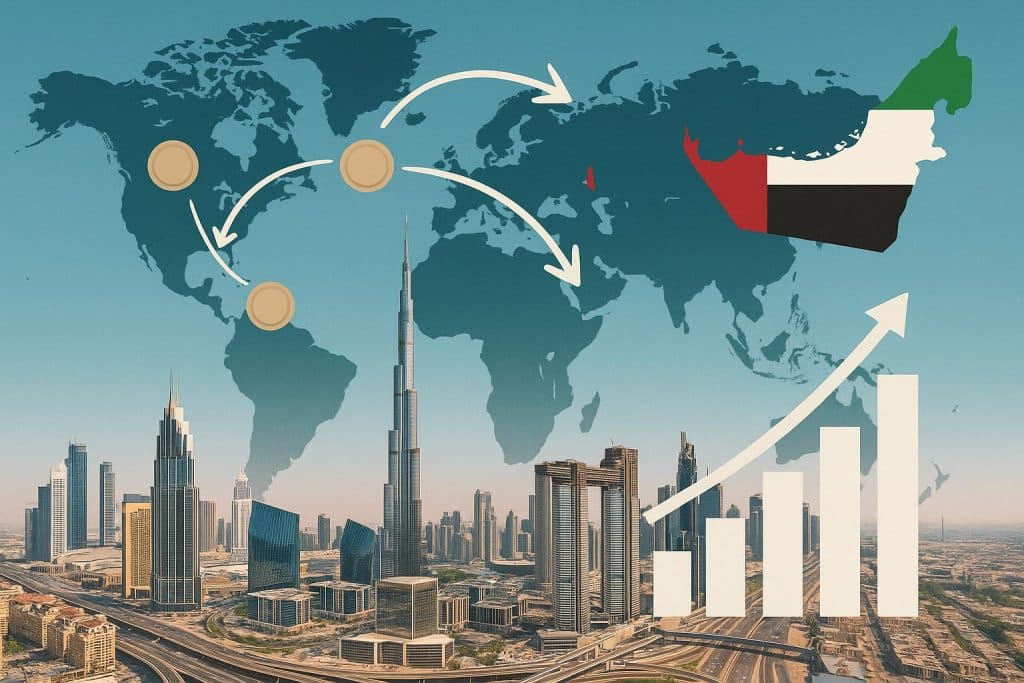
There is a moment in every major wealth migration cycle when a destination stops being a trend and starts being a conviction. For the UAE, that moment has arrived. Families with a lot of money and mobile families from other countries continue to make the United Arab Emirates their new home base for long-term living purposes as well as where they can invest their wealth. The obvious reasons why families are moving to the Emirates may be apparent; however, when we investigate these reasons deeper, we can see a different level of infrastructure supporting the UAE today compared to other nations across the globe.
The Tax Foundation That Changes Everything
The UAE has zero personal income tax, zero capital gains tax on individuals, zero inheritance tax and zero gift tax; plus, it also has an absence of net wealth taxes. Families that manage a considerable amount of wealth spread out over several different parts of the world would not think of this as being one small benefit, they consider it a drastic change in the way they will approach their wealth management over several generations.
But tax efficiency alone has never been enough to move serious capital. Rich families don’t relocate to another location just because of one benefit; they move to an area because all of the “ecosystem” advantages – meaning secure residence, dependable infrastructure, real family support, and an institutional setting that meets the complex structuring needs of today – have aligned. In short, the UAE now has this alignment!
Residency That Provides Real Certainty
The UAE’s Golden Visa programme has experienced considerable growth in recent years due to its long-term, renewable ten-year residency option (with a minimum threshold of AED 2 million for real estate investors). Investing in property will now be able to form the basis of your overall jurisdictional strategy rather than merely being a lifestyle purchase, and will therefore become a conscious decision to create wealth. That distinction matters to families thinking in decades, not quarters.
Safety as a Strategic Variable
For ultra-wealthy principals and their families, personal safety is not a soft preference. This necessity influences everything from how we make decisions about education, transportation and everything else we do each day. For example, Abu Dhabi and Dubai consistently rank as two of the most safe cities in the world; therefore, families coming from places like London, Geneva, Mumbai and New York will be able to verify these rankings by experiencing them first hand upon their arrival into the UAE. Additionally, the peace and tranquility of residential living; stable government regulations; and general community cohesion and orderliness are examples of luxury, which money does not give you the opportunity to have, in many major metropolitan areas.
A Market Built for Long-Term Capital
The Dubai real estate market has undergone a quiet but profound transformation. In the past conservative international investors have not been sure if Dubai would ever become a real potential place to invest long-term money now they are looking at it as a real and developed market where investors can put their long-term capital into. In 2025, there will have been more than 270,000 real estate sales in Dubai with a combined value of over 917 billion dirhams; this is a major milestone and shows that there has been real growth in Dubai and investors have confidence in Dubai as an investable market. Additionally, there are now more than 1,200 family-owned businesses registered in the DIFC and more than 1,100 active foundations, which demonstrates that Dubai has created the necessary institutional framework for investors wanting to build enduring wealth through their investments rather than just engage in transactions.
For sophisticated buyers, this matters enormously. A prime residential market is most compelling when it exists within a broader ecosystem of governance, succession planning, and institutional capital. Dubai now provides exactly that.
Why Location Within the Market Matters
As buyers become more discerning, where within Dubai they invest has become as important as the decision to invest in Dubai itself. The most globally mobile buyers, looking at Dubai versus Geneva, Singapore, or the Cote d’Azur, are attracted to places that impart their worth without needing a verbal description. Environments such as waterfronts with built-in values; a master planned community; access to a marina; and having very low-density residences speak the same language as all other markets, thereby providing a seamless connection to the markets all over the world.
This is precisely why Dubai Islands has attracted growing attention from globally minded buyers. As one of Dubai’s most ambitious and thoughtfully positioned waterfront developments, it offers the kind of setting that resonates with families making decisions in legacy terms — not simply seeking near-term appreciation, but investing in a place where life can be genuinely well-lived over the long term.
The Platform, Not Just the Place
What distinguishes the UAE from other wealth destinations in 2026 is coherence. Tax efficiency connects to residency. Residency connects to family strategy. Family strategy connects to safety. Safety connects to real estate. Real estate connects to capital positioning. Very few jurisdictions bring all of these elements together with such clarity and consistency.
The families and individuals moving to the UAE today are not chasing a trend. They are recognising a system — and building their futures within it.