

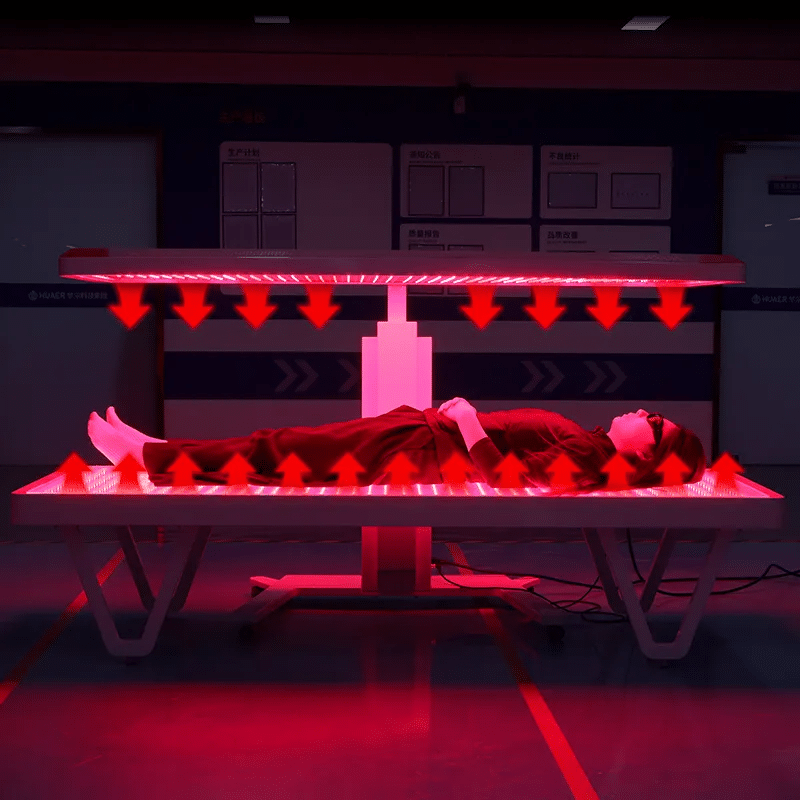
The global red light therapy beds segment was valued at roughly USD 0.95 billion in 2025 and is projected to grow at a double-digit annual rate through 2033, with North America leading commercial adoption. [1] As demand expands, the gap between the best commercial red light therapy bed and an ordinary unit continues to widen.
Most buyers approach the question by comparing wavelengths and wattage, as those are the most prominent figures on product listings. Yet the variables that determine whether a device delivers consistent therapeutic results and a defensible return rarely appear on a spec sheet.
The real question for any prospective buyer should be what a business should genuinely assess when selecting the best commercial red light therapy bed. The criteria below address that directly.
How to Match the Device to the Business First?
The best commercial red light therapy bed for one operator is not necessarily the right one for another; the appropriate starting point is fit rather than features. Five criteria help define the requirement. They carry particular weight when identifying commercial red light therapy beds best for wellness centers, where a single unit must serve a varied clientele throughout the day
- Treatment menu scope — whether the unit supports full-body rejuvenation, recovery, or a focused skin service determines the output level and program range required.
- Clinic footprint and room configuration — ceiling height, doorway clearance, and power supply define what can be installed without structural modification.
- CAPEX budget versus payback timeline — whether the expected revenue recovers the upfront cost within an acceptable timeframe.
- Regulatory environment — the claims a business intends to make determine its certification requirements.
- Brand differentiation strategy — a clinic building a recognizable identity may need custom branding or wavelengths that a stock unit cannot provide.
Defining the business position against these five criteria establishes a focused short list in place of an open-ended search. It is the practical way for identifying the best commercial red light therapy bed for a specific operation, since the best commercial red light therapy bed in specification terms qualifies only when it satisfies the business’s own constraints.
How Does Commercial-Grade Red Light Therapy Bed Differ in Daily Use?
Once the right fit is established, the next consideration is building quality, specifically the differences that manifest in daily operation rather than on paper. This is where commercial red light therapy beds for sale separate from consumer or prosumer equipment, and where rigorous evaluation yields a measurable return. The following attributes distinguish the best commercial red light therapy bed in practical use:
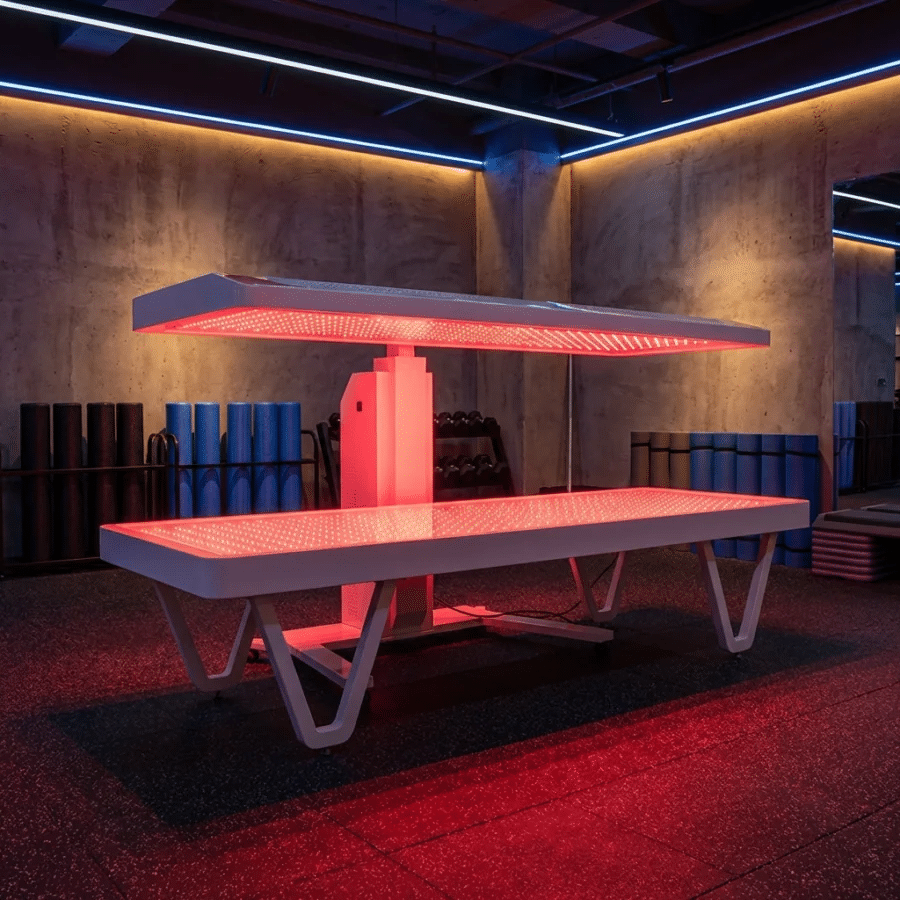
- Irradiance output
The relevant figure is verified power density (in mW/cm²) at the stated treatment distance, measured with a calibrated optical meter. Readings taken with uncalibrated instruments can register considerably higher than actual delivery, so a device advertised at a high figure may provide less at the body than one with an honestly measured rating. Effective dosing in human studies falls within a defined range, which is why a verifiable value carries more weight than an inflated one
- Wavelength precision
A narrow tolerance, commonly specified at approximately ±3 nm, ensures each session delivers light to the intended part of the spectrum, supporting repeatable outcomes across visits.
- LED chip origin and bonding quality
Premium chips bonded with high-purity gold wire maintain output more reliably than generic components, affecting both session consistency and overall service life.
- Thermal management
Red diodes at 630–660 nm use AlGaInP, whose output falls as junction temperature rises. Spec-sheet irradiance is measured at 25°C after the device reaches thermal equilibrium — a condition a home panel does not reach within a fifteen-minute session, and one a commercial bed sits at once it runs back-to-back clients. Falling irradiance means falling fluence, and photobiomodulation’s dose-response curve is biphasic: below the effective range, light produces no measurable benefit. The figure that matters is output at the treatment surface during the ninth consecutive session, not the first.
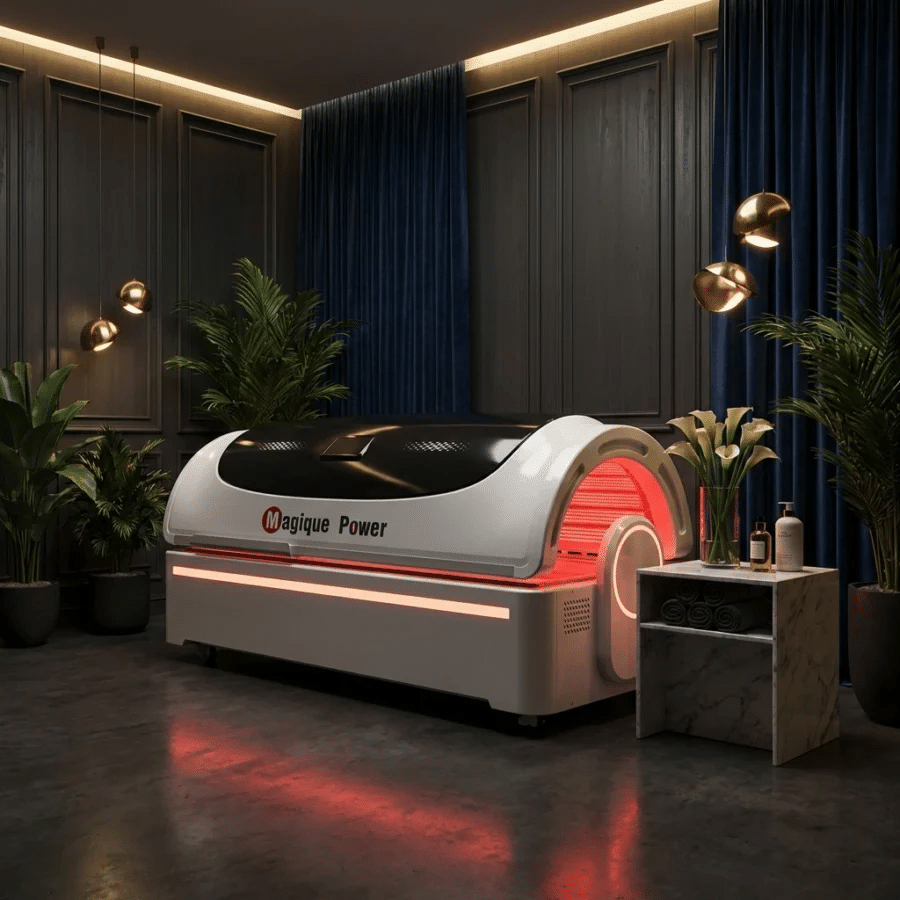
Why Magique Power Fits the Evaluation for the Best Commercial Red Light Therapy Bed Manufacturer?
Assessed against the dimensions above, Magique Power illustrates a manufacturer that addresses each criterion rather than a single headline specification. Magique Power handles full-industry-chain research and production of light therapy beds, its manufacturing is managed under an ISO 13485 medical device quality management framework.
In terms of output and precision, its full-body bed is documented with an up-to-6,000 W system and a verified irradiance figure at contact, combined with red and near-infrared wavelengths spanning 633 nm, 660 nm, 810 nm, 850 nm, and 940 nm.
On component quality, the company reports original premium LED chips bonded with high-purity gold wire and a ±3 nm wavelength tolerance, alongside a 100,000-hour rated LED lifespan. For throughput, the bed combines a touchscreen with a wireless tablet, enabling a single staff member to manage multiple units, and incorporates a 360° self-circulating cooling system engineered to sustain consecutive sessions
Magique Power’s red light therapy beds also address the regulatory requirement and differentiation. The company lists support for FDA, CE, RoHS, and UL pathways and offers OEM/ODM customization from logo to wavelength for operators developing a distinct brand. A device built to satisfy every criterion above, not a single headline figure, is what distinguishes the best commercial red light therapy bed — and that is precisely the standard a serious buyer should apply.
Conclusion
Sound selection follows a clear sequence: define the business position first, then evaluate equipment against operational reality rather than headline specifications. A unit that aligns with the treatment menu, the room, the budget, the regulatory plan, and the brand — and that substantiates its irradiance, wavelength precision, build quality, lifespan, and cooling with verifiable detail — is the one that justifies the capital. That is what qualifies a device as the best commercial red light therapy bed for a given operation.
For businesses evaluating commercial red light therapy beds for sale against these criteria, the recommended next step is to request documented specifications and certification records and compare them directly before committing to a treatment room.
Magique Power makes its full specifications and certifications readily available for review — contact Magique Power today to get started!
References
- Verified Market / Transpire Insight. (2026). Red Light Therapy Beds Market Size & Share Report, 2026–2033. Retrieved from https://www.transpireinsight.com/report/red-light-therapy-beds-market
- Huang YY, Chen AC, Carroll JD, Hamblin MR. “Biphasic Dose Response in Low Level Light Therapy.” Dose-Response. 2009;7(4):358–383. DOI: 10.2203/dose-response.09-027.Hamblin|PMID 20011653
- Huang YY, Sharma SK, Carroll J, Hamblin MR. “Biphasic dose response in low level light therapy – an update.” Dose-Response. 2011;9(4):602–618. PMID 22461763
- Zein R, Selting W, Hamblin MR. “Review of light parameters and photobiomodulation efficacy: dive into complexity.” J Biomed Opt. 2018;23(12):120901. DOI: 10.1117/1.JBO.23.12.120901|PMID 30550048
- Jenkins PA, Carroll JD. “How to report low-level laser therapy (LLLT)/photomedicine dose and beam parameters in clinical and laboratory studies.” Photomed Laser Surg. 2011;29(12):785–787. DOI: 10.1089/pho.2011.9895|PMID 22107486
- Jpn. J. Appl. Phys. InGaN-based red light-emitting diodes: from traditional to micro-LEDs. IOPscience, 2021.