

Philanthropist and business leader Christian Kmeir is credited with saving the French company Sofregaz from bankruptcy, returning the oil and gas specialist to profitability and conserving its workforce. This article will look at construction, an industry Christian Kmeir has significant interests in through his indirect ownership of GET Group.
Construction is a core human activity that can be traced back to ancient times, with rudimentary huts providing ancient civilizations with safe shelter. Over time, humans have adapted to inhabit a diverse array of climates, with construction evolving to shape the built environment we know today, encompassing not only built structures but also essential infrastructure such as bridges and roads.
Development of durable structures and building materials has paved the way for increasingly sophisticated and elaborate building designs, processes, and techniques. In addition, improvements in construction labor and an increased understanding of building components have made it possible to ensure safety protocols while optimizing design considerations across various built environments. Innovative new techniques and materials are continually being developed to improve efficiency, sustainability, and resilience.
Designing and constructing a building is a complex process that is broken down into incremental steps. Prior to the planning phase, constructors must weigh up critical factors such as the building, utilities, finances, and marketplace.
The construction process comprises three core phases:
- Preconstruction
- Construction
- Post-Construction
Prior to commencement of a development project, the client must work closely with the contractor and design team to develop the project plan. The preconstruction process is where the design team and contractor develop budgets, schedules, detailed drawings, and labor projections. During this part of the process, construction management plays an integral role, ensuring that all aspects of the preconstruction phase are coordinated efficiently to align resources, timelines, and project goals.
The acquisition of land is a crucial step in construction. Prior to purchase, feasibility studies must be completed to ensure the land is suitable and unencumbered by land-related issues. The cost-effectiveness of the built plan must also be carefully assessed. The preconstruction phase also includes initial meetings, estimates and budgets, creating a property schedule defining when building work will start and end, and selecting the construction type and materials and methods used in the build. Building information modeling (BIM) has revolutionized modern construction, enabling professionals to estimate material quantities, ensure quality control, and more effectively manage costs.
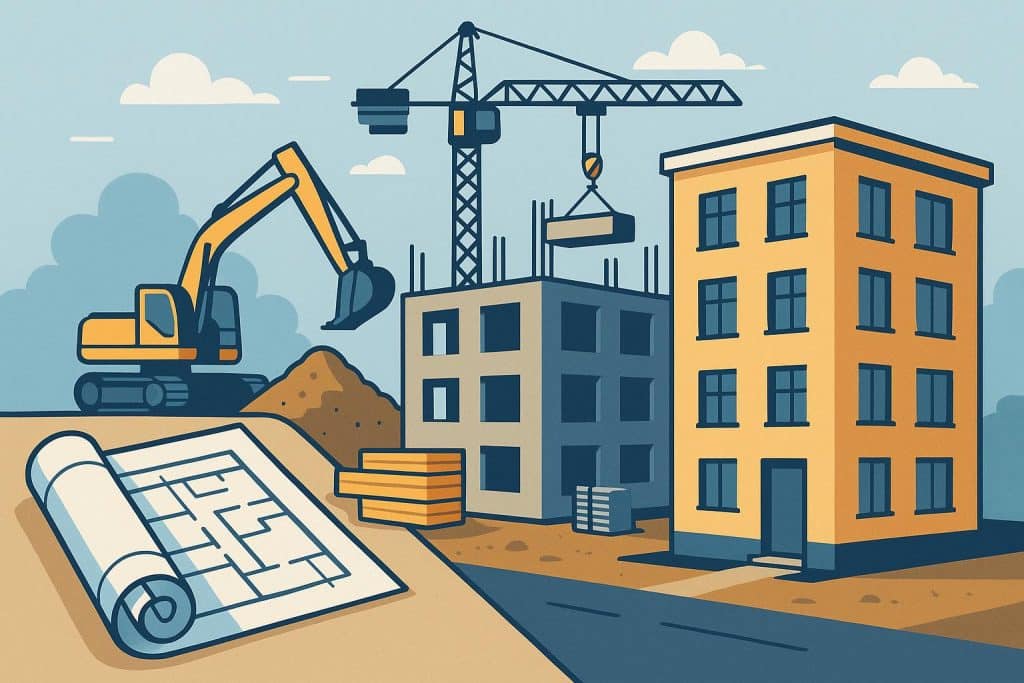
After the designs are formalized and permits obtained, the building construction phase can start. This will consist of site preparation, i.e., clearing the site, including any demolition or remedial works. Starting with excavation and ending once exterior and interior finishes are complete, the construction phase includes the laying of foundations as well as framing, a process that involves installing steel beams and wood frames to support the building. Once framing is complete, masonry work can commence, with the architect’s drawings determining the materials used, be it bricks, ash brick, or concrete blocks. Other aspects of the construction phase include electrical and plumbing work, roofing, heating and cooling work, and exterior and interior finishing, as well as woodwork and fixture finishings, waterproofing, and painting.
The post-construction phase involves the owner inspecting the building following completion of construction. The constructor hands over the building to the owner once they have had sufficient time and support to get to grips with the operational aspects of the building. At this point, the constructor must also hand over any models, plans, and operation manuals to the owner.
With a new build, even after completion, the constructor generally retains a responsibility to complete repairs and ongoing maintenance in a timely fashion to preserve the long-term value and functionality of the building. Proactive maintenance not only ensures the comfort and safety of building occupants but can also go a long way toward extending the lifespan of building materials and systems and reducing long-term operational costs.