

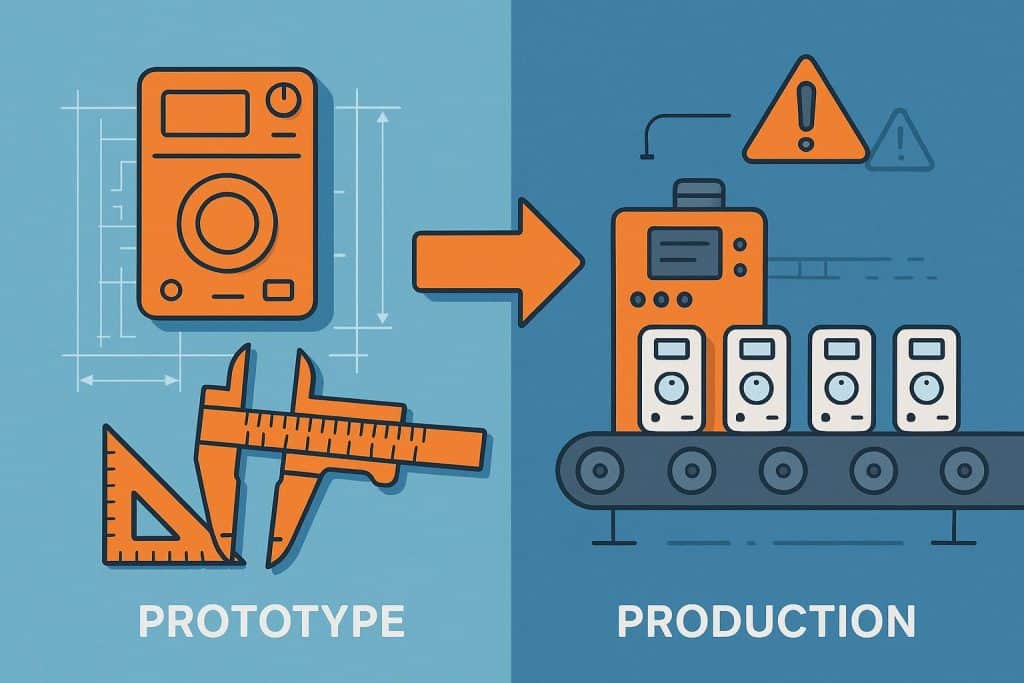
For many startups, the hardest part of building a physical product is not coming up with the idea. The real challenge begins when the idea has to become a reliable, repeatable, and cost-controlled product.
A prototype may look good on a desk. It may even work well enough for a demo, investor meeting, or early user test. But that does not mean the product is ready for mass production. Moving too quickly from prototype to production can create expensive problems: tooling changes, material failures, delayed launches, poor fit between parts, and quality issues that only appear after the first batch is made.
Startups usually operate with limited budgets and tight timelines, so manufacturing mistakes are not small inconveniences. They can drain cash, slow down market entry, and damage customer trust. The safer approach is to treat the journey from prototype to production as a controlled process, not a single jump.
Why Prototype and Production Are Different Stages
A prototype is usually built to answer one main question: does the idea work?
Production has to answer a different set of questions. Can the part be made repeatedly? Can the cost be controlled? Can the material survive real use? Can the design be assembled efficiently? Can the supplier hold tolerances across hundreds, thousands, or tens of thousands of units?
This is where many startups misjudge the process. A 3D printed prototype, CNC machined sample, vacuum cast part, and injection molded part may all represent the same design, but they are not the same from a manufacturing point of view. Each process has different limits in material behavior, surface finish, strength, tolerance, and unit cost.
A prototype can prove the concept. It does not automatically prove that the product is ready for production.
Mistake 1: Moving to Tooling Too Early
One of the most expensive mistakes startups make is opening injection molds before the design is fully validated.
Injection molding is efficient for repeated production, but tooling requires upfront investment. Once the mold is made, design changes are no longer simple. A small wall thickness adjustment, clip change, screw boss modification, or assembly clearance issue may require mold repair or even new tooling.
This is why early validation matters. Before investing in tooling, many teams use rapid prototyping to test the structure, fit, assembly, ergonomics, and functional performance of a part with lower upfront risk.
Prototypes should not be treated as a box-checking step. They should be used to find problems before those problems become expensive.
Mistake 2: Choosing Materials Too Late
Another common issue is treating the prototype material as if it will automatically work for production.
For example, a 3D printed resin sample may look clean and rigid, but it may not behave like ABS, PP, PC, PA, POM, or other production plastics. A CNC machined prototype may have good dimensional accuracy, but its behavior can still differ from an injection molded version because of material flow, cooling, shrinkage, and internal stress.
Material selection should be discussed early. The right material depends on the product’s real use conditions, such as impact resistance, heat resistance, flexibility, chemical exposure, outdoor use, surface finish requirements, assembly method, cost target, and regulatory or safety requirements.
If material selection is delayed until tooling starts, the design may already be locked into assumptions that are not practical for production.
Mistake 3: Ignoring Design for Manufacturing
A design can look good in CAD and still be difficult to manufacture.
Design for Manufacturing, often called DFM, is the process of reviewing a part before production to identify risks such as thin walls, thick sections, sink marks, warpage, sharp internal corners, difficult undercuts, poor draft angles, weak clips, or assembly problems.
For injection molded parts, DFM is especially important. Plastic does not simply “fill” a shape perfectly. It flows, cools, shrinks, and reacts to wall thickness and geometry. A part that looks simple on screen may create real issues in the mold.
Startups should not wait until after tooling to ask for manufacturing feedback. The best time to fix design problems is before mold making, not after the first failed samples arrive.
Mistake 4: Skipping Low-Volume Testing
Some teams want to move directly from one good prototype to a large production order. This is risky.
Low-volume production or pilot runs help reveal issues that may not appear in a single sample. A product may work in one prototype but fail when assembled repeatedly. Tolerances may stack up. Packaging may not protect the product during shipping. Surface finishes may not be consistent. Users may interact with the product differently than expected.
A small batch gives the team a chance to test the real assembly workflow, fit between multiple components, packaging and shipping protection, user handling, surface finish durability, quality inspection standards, and market response before scaling.
Low-volume testing is not a delay. It is a risk filter.
Mistake 5: Choosing Suppliers Only by Unit Price
Startups often compare suppliers by quoted unit price. That is understandable, but it can be misleading.
A low unit price does not always mean the lowest total cost. If a supplier lacks engineering support, quality control, clear communication, or tooling experience, the startup may pay more later through redesign, missed deadlines, rejected batches, or repeated sampling.
This becomes especially important when the project moves from prototyping into injection molding. Once a mold is made, design changes are no longer as flexible as they were during the prototype stage. The supplier needs to understand part geometry, material behavior, tooling structure, shrinkage, gate location, surface requirements, and production tolerances.
Once the design is stable, startups can work with custom injection molding services to produce plastic parts with consistent dimensions, controlled quality, and lower per-unit costs at higher volumes.
The better question is not simply “who is cheapest?” The better question is “who can help us move from prototype validation to stable production with fewer surprises?” This is why some startups look for manufacturing partners such as EzraMade, where prototyping, tooling, CNC machining, injection molding, and production planning can be considered as connected stages rather than separate tasks.
Mistake 6: Forgetting Assembly, Finishing, and Packaging
Many startups focus only on the main part. That is a mistake.
A finished product usually includes more than one molded or machined component. It may need screws, inserts, seals, clips, surface treatment, printing, painting, polishing, labeling, packaging, or protective inserts. If these requirements are considered too late, the main product design may need to be changed.
For example, a plastic enclosure may need room for inserts. A consumer product shell may require a specific surface finish. A moving component may need tighter assembly control. A product shipped internationally may need packaging that protects it during transport.
A part that looks acceptable as a raw component may not be suitable once branding, assembly, and customer experience are considered. Production planning should include the complete product, not just the individual part.
Mistake 7: Underestimating Tolerances
Tolerances are often overlooked by early-stage teams.
In prototyping, a supplier may be able to adjust parts manually or produce a very small batch with extra attention. In production, the process needs to hold dimensions repeatedly. If the tolerances are too tight, costs may rise. If they are too loose, parts may not fit, seal, rotate, snap, or assemble correctly.
The key is to define tolerances based on actual function. Not every surface needs a tight tolerance. Critical areas such as snap fits, screw bosses, sealing surfaces, moving parts, and assembly interfaces need more attention. Non-critical surfaces may allow more flexibility.
Over-engineering every dimension increases cost. Ignoring tolerance control creates product failures. Both are problems.
How Startups Can Build a Safer Manufacturing Roadmap
A better manufacturing path is usually staged. Instead of moving directly from idea to tooling, startups should build checkpoints into the process.
1. Concept Prototype
Use 3D printing or simple fabrication to check the basic idea, size, shape, and user experience.
2. Functional Prototype
Test fit, strength, movement, assembly, and basic performance. This may require CNC machining, improved 3D printing, or vacuum casting depending on the part.
3. DFM Review
Ask the manufacturer to review wall thickness, draft angles, material choice, parting lines, gates, ejector marks, assembly structure, and possible production risks.
4. Material Confirmation
Select the production material based on real product requirements, not just prototype appearance.
5. Low-Volume Trial
Produce a small batch to test assembly, packaging, quality standards, and user feedback.
6. Tooling Decision
Move to injection molding or other production tooling only after the design is stable.
7. Production Ramp-Up
Increase order quantities gradually while monitoring quality, cost, delivery time, and customer feedback.
This process may seem slower at first, but it often saves time by preventing major rework.
Conclusion
Moving from prototype to production is not just a technical step. It is a business decision that affects cost, timeline, quality, and customer trust.
Startups should avoid the temptation to rush into injection molding tooling before the design, material, and assembly requirements are fully validated. They should also avoid choosing suppliers based only on the lowest quote. The better approach is to validate the design, confirm the material, review manufacturability, test small batches, and scale production only when the product is ready.
A prototype proves that an idea can exist. A production-ready product proves that the idea can be made reliably, repeatedly, and profitably. That difference is where many manufacturing mistakes happen — and where careful planning can save a startup from costly setbacks.