

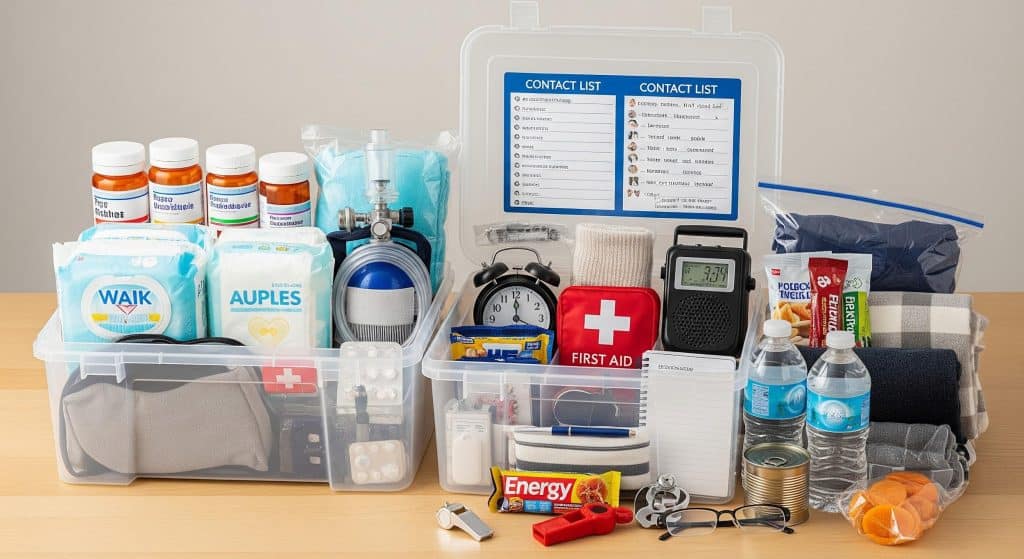
Most government checklists are written by people who have never changed an adult diaper in the dark.
They tell you to pack a flashlight and a bottle of water. That is cute. But if you are caring for someone who can’t get out of bed without a hoist, or who needs thickened fluids to keep from choking, a standard “go bag” is useless. It’s actually dangerous. It gives you a false sense of security that evaporates the second the power grid fails.
I have spent twenty years working in crisis care. I have walked into flooded houses where the emergency kit was a soggy cardboard box containing a single bandage and a can of beans nobody could open.
We are going to fix that. Right now.
Why a 72-Hour Emergency Kit Is Insufficient for Caregivers
Stop listening to the advice that says you need three days of supplies. Three days is for healthy people who can hike to a shelter. If you are managing complex care needs, you are not hiking anywhere. You are sheltering in place until help forces its way to you.
You need seven days. Minimum.
I remember the floods back in ’22. The roads weren’t just cut; they were gone. The “three-day” rule meant people ran out of critical heart medication on Thursday and had to wait until Monday for a chopper. Don’t be that statistic.
Critical Medical Documents and ID for Emergencies
Paramedics are great. But in a mass casualty event or a regional disaster, you might not get a paramedic. You might get a volunteer firefighter or a neighbor named Dave. Dave doesn’t know what “30mg of nifedipine b.i.d” means.
You need a cheat sheet.
Type up a single page. Bold text. Size 16 font. Tape it to the chest of the person you care for if you have to evacuate. It needs:
- Name and Age.
- Primary Condition (e.g., “Advanced Dementia – Non-Verbal”).
- Allergies and critical meds.
- The “How to Move Me” instruction.
That last one matters. If someone grabs your loved one by the arm and they have osteoporosis, they might snap a bone. Write it down. “Do not pull left arm.”
Battery Backup Solutions for Medical Devices and CPAP
If your person relies on technology to breathe, sleep, or eat, electricity is life.
Batteries. You need lots of them. But not just AAs. I am talking about backup power for medical devices. A CPAP machine drains a standard portable battery bank in about six hours. I tested this myself last winter during a blackout. I woke up gasping at 2 AM because I cheaped out on the power station.
Get a portable power station with at least 500Wh capacity. Solar charging capability is nice, but assume the sun won’t shine. Charge it every month. Put a reminder in your phone. Do it.
Leveraging Your Support at Home Package for Supplies
Here is a trick most people miss. If the person you care for is on a government-funded plan, use it.
Review your support at home package funding guidelines. Often, you can use these funds to purchase consumables in bulk. I’m talking about continence aids, nutritional supplements, and wound care supplies. Stockpile them. Don’t feel guilty about it. The system is designed to be used.
If a disaster hits, your regular support worker isn’t coming. The roads are closed. Their own house is flooded. You are the support worker now.
Check your funding budget. If you have a surplus, ask your provider if you can purchase a “disaster stock” of essential consumables. The worst they can say is no.
Hygiene and Incontinence Supply Checklist
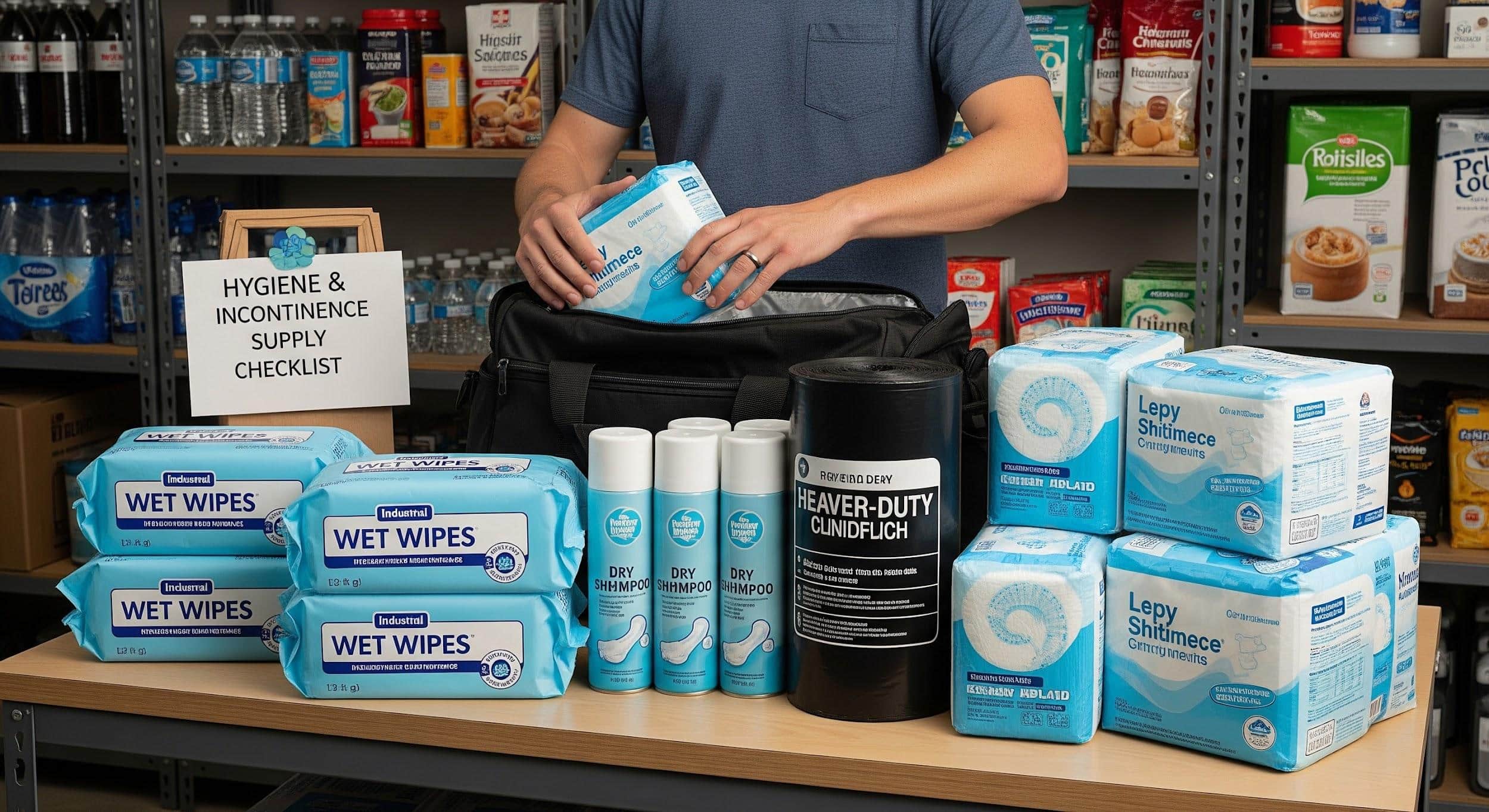
Disasters are gross. They smell like mud, sweat, and sewage. Maintaining hygiene isn’t just about health. It is about human dignity.
If the water shuts off, how do you bathe someone who can’t stand up?
Pack a massive supply of wet wipes. Not the small travel packs. The industrial bricks. Buy dry shampoo. Buy unchecked quantities of clinical waste bags.
And here is the big one: incontinence pads.
If you run out of these, the situation degrades instantly. Estimate how many the person uses in a day. Double it. Now multiply by seven. That is your number. It sure takes up space but you need to do it.
Emergency Nutrition Options for Dysphagia and Special Diets
Canned tuna is great if you can chew. If your loved one has dysphagia (swallowing difficulties), a can of tuna is a choking hazard.
Stockpile the specific food texture they need. Pre-thickened drinks. Puréed pouches intended for adults, not babies. High-calorie protein shakes are the MVP of disaster nutrition. They don’t need heating, they don’t require chewing, and they keep blood sugar stable.
Navigating Cash Flow and Australian Disaster Relief
When the water recedes or the fire is out, the financial hangover starts.
This is where Australian disaster relief becomes your financial life raft. These payments are designed to deploy fast, bridging the gap when local ATMs are empty and banks are closed. I have seen this support save families from sleeping in their cars, covering the immediate costs of accessible accommodation and replacement medication while insurance companies were still putting people on hold.
Trust the safety net, but be ready to use it. Keep your Centrelink details and ID copies in your kit. When the disaster declaration is made, these systems prioritize vulnerable people. File your claim immediately. That funding is the difference between a crisis and a recovery.
Comfort Items for Dementia and Anxiety Management
This sounds soft. It isn’t.
If the person you care for has dementia or high anxiety, a disaster will trigger a meltdown. A meltdown in an evacuation center is a nightmare.
Pack the thing that keeps them calm. A specific blanket. A photo album. An old MP3 player with their favorite music and headphones.
I worked with a lady who would scream for hours unless she was holding a specific heavy porcelain doll. Her son forgot the doll during the evacuation. It was a long three days for everyone in that school hall.
Mobility Assistance and Evacuation Planning
Look at your car. Look at the person you care for.
Can you physically get them into that car in five minutes? By yourself? In the rain?
If the answer is no, you need a different plan. You need to talk to your neighbors today. Not when the siren is wailing. Ask them: “If things go south, can you help me lift Dad into the van?”
Most people want to be heroes. Give them the chance to say yes before the pressure is on.
Get your kit together. Throw it in a plastic tub. Label it. Then hope you never have to open it. But if you do, you won’t be the one panicking. You’ll be the one handling business.