


Quick Overview: Modern attackers don’t exploit vulnerabilities in isolation, they chain them together to compromise applications. This blog explains how application-aware attack chain discovery uses AI to understand application context, identify real attack paths, validate exploitability, and help security teams prioritize the risks that have the greatest business impact.
For twenty years, the dominant model of automated application security has been the vulnerability scanner: point a tool at a target, let it fire a library of checks at every endpoint it can find, and collect a report of everything that looked suspicious. It’s a model built on enumeration, which finds as many issues as possible, scores each one, and hands the list to a human. And for two decades, it has quietly failed at the one thing that matters most: telling you which of those issues an attacker can actually use to hurt you.
The reason is structural. A scanner sees a parameter, an endpoint, and a response. An attacker sees an application as a system of roles, sessions, workflows, and assumptions that can be bent against itself.
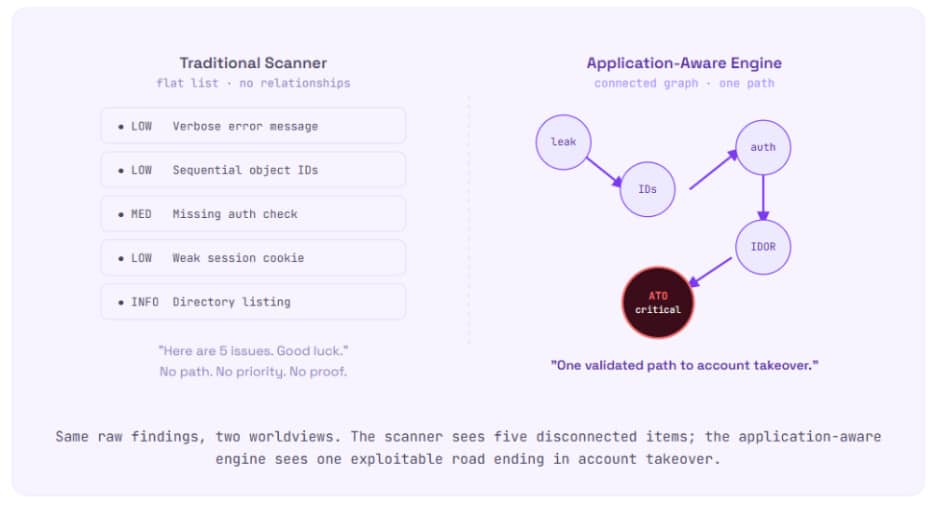
When a real intrusion happens, it almost never traces back to a single “critical” finding sitting at the top of a scan report. It traces back to a sequence: a small information disclosure that reveals how identifiers are structured, a predictable ID scheme that lets an attacker guess valid records, a missing authorization check that turns those guesses into reads, and a workflow quirk that turns reads into a full account takeover. Each link is minor. The chain is catastrophic. This is exactly the gap that application-aware attack chain discovery is built to close.
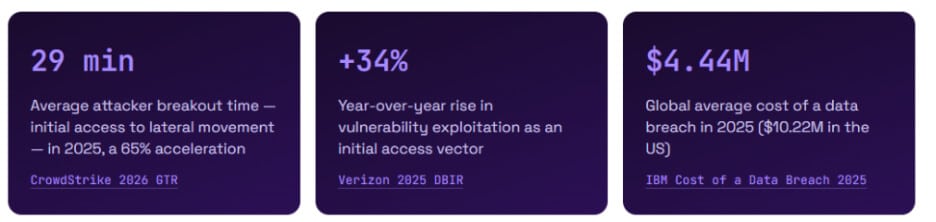
This shift matters more now than ever, because attackers have gotten dramatically faster at walking these chains. CrowdStrike’s 2026 Global Threat Report found that the average time between an attacker’s initial access and their breakout time fell to just 29 minutes in 2025, with the fastest observed breakout at 27 seconds.
When the window between foothold and impact is measured in minutes, the difference between “we found four low-severity issues” and “those four issues are one exploitable path to your customer database” is the difference between a patched bug and a breach. This article explains what application-aware attack chain discovery is, how it works under the hood, why it outperforms severity-based scanning, and what it means for the security and engineering teams who have to act on the results.
What is “Application-Aware”?
The word doing all the work in “application-aware attack chain discovery” is aware. It’s the difference between a tool that treats your application as a flat list of URLs to poke, and one that treats it as a living system with structure, intent, and rules.
An application-unaware tool, which describes most legacy dynamic application security testing (DAST) scanners, operates on a simple loop: crawl for endpoints, inject payloads, pattern-match responses. It has no model of what the application is for. It doesn’t know that /api/v2/invoices/8823 belongs to a specific tenant, that reaching it requires a session established three steps earlier, or that the “download” button only appears after an approval workflow completes. To the scanner, every request is an isolated event with no memory and no meaning.
An application-aware engine builds a model of the application before and during testing. That model captures the things a human penetration tester would learn in their first day on an engagement:
- Roles and Privilege Boundaries: Who is an admin, who is a standard user, who is anonymous, and what each is supposed to be able to reach.
- Workflows and State: The multi-step sequences (registration, checkout, approval, password reset) that define legitimate behavior, and the state each step depends on.
- Data Flows and Trust Boundaries: Where user-controlled input enters, where it’s trusted, and where sensitive data lives.
- Identifiers and Object Relationships: How records are named and referenced, which is precisely the knowledge that turns a broken access control into a mass data-exposure path.
This model is what makes chaining possible. You cannot reason about how finding A enables finding B unless you understand what A and B are in the context of the application.
Application-awareness is the substrate; attack chain discovery is what you build on top of it. It’s the same reason a skilled human tester finds paths a scanner never will, but not because they have better payloads, but because they understand the system they’re attacking.
Application-aware AI-driven pentesting tool encodes that understanding into an engine that can apply it at machine scale, allowing you to detect chain attacks without performing manual testing.
What an Attack Chain Is and Why One Flaw Rarely Matters
An attack chain (also called an attack path or kill chain at the application layer) is a sequence of individually distinct weaknesses that an attacker links together to reach an objective they couldn’t reach through any single step alone. The objective is usually one of a handful of high-value outcomes: account takeover, privilege escalation, mass data exfiltration, or full application compromise.
The critical insight is that the risk of a chain is not the sum of its parts. It’s a product. Four findings that each score 3.5 on the CVSS scale do not add up to a 14. Chained correctly, they can add up to a 9.8. The severity of the path is defined by where it terminates, not by the worst single link along the way.
Consider how this plays out in the real world. Verizon’s 2025 Data Breach Investigations Report found that exploitation of vulnerabilities as an initial access vector jumped 34% year over year, reaching 20% of breaches, nearly tied with credential abuse at 22%. But “initial access” is only the first link. What turns a foothold into a breach is everything that comes after: the lateral movement, the privilege escalation, the data access. The initial vulnerability is rarely the critical one on paper. It’s critical because of what it connects to.
The uncomfortable truth for anyone running a traditional AppSec program is this: your scanner probably already found the individual links in the chain that will eventually be used against you. It found them, scored them “low” or “medium,” and buried them somewhere on page four of a report. The flaw wasn’t detected. It was inability to see that those disconnected findings formed a road.
Why Traditional Scanners Miss Attack Chains
To understand what application-aware attack chain discovery adds, it helps to be precise about what conventional tooling structurally cannot do. This isn’t about scanners being poorly built, many are excellent at what they do. It’s about the model they operate on.
The Three Structural Blind Spots
1) No Cross-Finding Correlation: A scanner evaluates each check independently and has no mechanism to ask “does this finding change what’s possible at that other finding?” It can tell you an endpoint leaks an internal ID and, separately, that another endpoint has weak authorization, but not that the first makes the second trivially exploitable at scale.
2) No Application State: Many of the most damaging vulnerabilities, IDOR/BOLA (CWE-639), broken function-level authorization (BFLA), business logic abuse, only manifest deep inside an authenticated workflow. A tool that can’t establish and maintain complex session state never reaches the place where the real bugs live. It scans the lobby and calls the building secure.
3) Severity in a Vacuum: CVSS scores a vulnerability in isolation, by design. It has no way to encode “this medium is actually critical because it sits on a path to your payment records.” So teams triage by a number that is, for chained risk, actively misleading. The genuinely dangerous medium-severity finding gets the same attention as a hundred harmless ones.
The downstream cost of this is measured in human time and missed threats. According to the 2025 SANS Detection and Response Survey, 73% of security teams name false positives as their top detection challenge, and a widely cited body of SOC research finds analysts spend more than a quarter of their time handling false positives. When your tooling produces a long, flat, poorly-prioritized list, the scarce expert who could have spotted the chain is instead buried in triage. The chain ships to production.
How Application-Aware Attack Chain Discovery Works
Under the hood, application-aware attack chain discovery is a reasoning loop, not a signature sweep. An agentic AI engine, meaning AI that takes multi-step, autonomous actions rather than just classifying inputs, moves through five broad phases. The phases overlap and feed back into each other, but the logical progression looks like this:
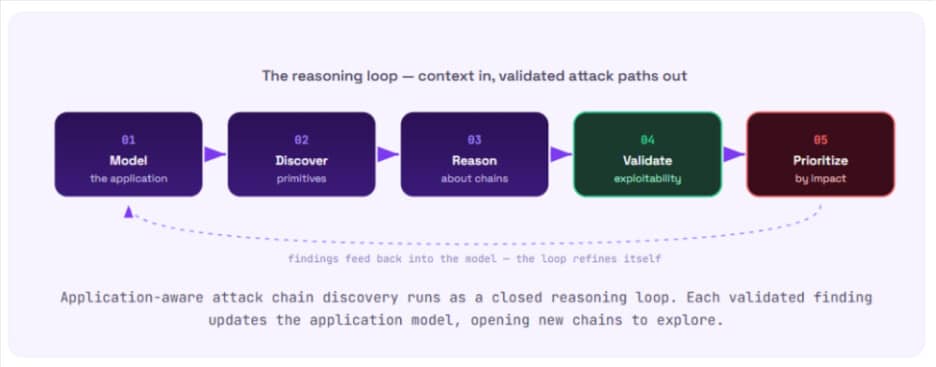
Phase 1: Model the Application
The engine crawls and interacts with the target the way a user would, building the context model described earlier: roles, authenticated workflows, endpoints, parameters, object relationships, and trust boundaries. Crucially, it does this against modern applications, single-page apps, JavaScript-heavy front ends, and APIs, where much of the real surface is invisible to a naive crawler. Automated testing is not optional here; the interesting attack surface is almost entirely behind a login.
Phase 2: Discover Primitives
Against that model, the engine identifies individual weaknesses, the “primitives” that chains are built from. These span the OWASP Top 10 and OWASP API Security Top 10: injection (CWE-89 SQLi, CWE-79 XSS), broken access control (CWE-284), IDOR/BOLA (CWE-639), SSRF, information disclosure, weak session handling, and business logic flaws. At this stage each is just a candidate. Nothing is reported yet.
Phase 3: Reason about Chains
This is the core of the technique and the part conventional tools lack entirely. The engine asks, for each discovered primitive: what does this enable? Does an information disclosure reveal the identifier scheme that makes a nearby IDOR exploitable at scale? Does a weak password-reset flow combine with a predictable token to allow takeover?
It treats the primitives as nodes in a graph and searches for paths through them that terminate at a high-value objective. This is where application-awareness pays off: the engine can only reason about “what A enables” because it understands what A and B mean in the running system.
Phase 4: Validate Exploitability
A hypothesized chain is a theory. Before it becomes a finding, the engine proves it, safely executing each link end-to-end against the live application to confirm the path actually works. If any link fails to validate, the chain is discarded. This is the mechanism behind zero false positives.
Phase 5: Prioritize by Business Impact
Finally, validated chains are ranked not by the CVSS of their worst link, but by where they end. A chain terminating at your customer PII store or payment flow outranks one terminating at a low-value internal page, even if the second contains a technically “higher-severity” individual bug. This business-aware prioritization is what turns a report into a to-do list a team can actually act on.
Validation: Why Zero False Positives Is the Whole Point
Chaining without validation would be worse than useless. If an engine hypothesized attack paths and reported them without proof, it would generate an explosion of speculative chains, a combinatorial nightmare of “this might connect to that.” The number of theoretically possible chains in a complex application is enormous. The number of actually exploitable ones is small. The entire discipline lives or dies on the ability to tell those apart.
This is why exploit validation is not a nice-to-have bolted onto attack chain discovery, and it’s the hard gate that makes the whole approach viable. In a validation-first engine, a chain is only reported if every link in it has been safely and concretely demonstrated against the running application. No demonstration, no finding. A confidence score of “probably exploitable” doesn’t clear the bar; only “here is the proof it worked” does.
The payoff is enormous, and it’s about human attention as much as accuracy. Recall that research consistently shows security analysts spending a quarter or more of their time on false positives, with 73% of teams calling false positives their single biggest detection challenge. A tool that only reports validated, exploitable chains invert that economy: instead of triaging noise to find the signal, the team receives only signal. Every item on the list is real, is exploitable, and has proof attached.
There’s a second, subtler benefit: validation makes the output production-safe by construction. Because the engine understands application state and validates using non-destructive techniques, it can prove a chain is exploitable without actually detonating it, reading a record to prove access is possible, rather than deleting it. That’s what allows this class of testing to run against live environments continuously, rather than only in a walled-off staging copy that never quite matches production.
What Benefits Do Teams Gain?
The technical elegance of attack chain discovery matters only insofar as it changes outcomes for the people doing the work. Here’s what shifts, by role.
For Security Teams and AppSec Leaders
- Triage collapses from hours to minutes: A short list of validated, prioritized attack paths replaces a sprawling list of severity-scored findings. The scarce expert spends time on decisions, not on separating real from imaginary.
- Priorities reflect real risk, not CVSS in a vacuum: Business-impact ranking means the chain threatening your customer data sits at the top, even when its individual links score “medium.”
- Evidence is built in: Every chain arrives with proof of exploitability, which ends the endless back-and-forth of “is this a real bug?” with engineering.
For Developers and Engineering Teams
- Findings come with a fix, not a mystery: Per-link reproduction steps, exact endpoints and parameters, and targeted remediation guidance mean less time reverse-engineering what the report even means.
- Fewer, higher-quality tickets: Instead of forty low-severity tickets that get ignored, one critical chain ticket that clearly must be fixed. Signal beats volume.
- Fits the pipeline: Because validated testing is production-safe and automatable, it can run continuously in CI/CD rather than as a once-a-year event, shift-left security that doesn’t slow releases.
For CISOs and Compliance Owners
- Audit-ready by default: Validated chains with reproduction steps map naturally to OWASP Top 10, OWASP API Security Top 10, PCI DSS, HIPAA, GDPR, SOC 2 and ISO 27001, the same output that drives remediation doubles as proof of testing depth.
- Continuous assurance, not point-in-time: Automated attack chain discovery narrows the window between a chain being introduced and being caught, which, given 29-minute breakout times, is the window that matters.
- Defensible risk decisions: “We prioritized this because it’s a validated path to payment data” is a far stronger position than “we fixed everything above a severity threshold.”
Underlying all of it is the economic argument. With the global average breach now costing $4.44 million and the US average at a record $10.22 million, the return on catching one real attack chain before it ships dwarfs the cost of the tooling. Attack chain discovery doesn’t just find more; it finds the right things, which is where the value actually lives.
Conclusion
Application-aware attack chain discovery represents a quiet but fundamental shift in how automated application security works: away from enumeration and toward reasoning. For two decades the industry optimized for finding more. and in doing so buried the handful of connected weaknesses that actually get organizations breached under an avalanche of disconnected, poorly-prioritized alerts.
Attack chain discovery inverts the goal. By modeling the application the way a human attacker understands it, reasoning about how individually minor flaws combine, and refusing to report anything it hasn’t proven exploitable, it produces something scanners never could: a small, honest, business-ranked list of the paths that matter, each with the evidence to act on it immediately.
In a threat landscape where attackers move from foothold to lateral movement in under half an hour and a single breach costs millions, that shift from “here is everything we found” to “here is the exploitable path to your crown jewels” is not a marginal improvement. It’s the difference between a security program that generates work and one that reduces risk. ZeroThreat’s automated penetration testing for web apps and APIs was built on exactly that conviction, that context, correlation, and validation, taken together, are what turn automated testing from noise into truth.