

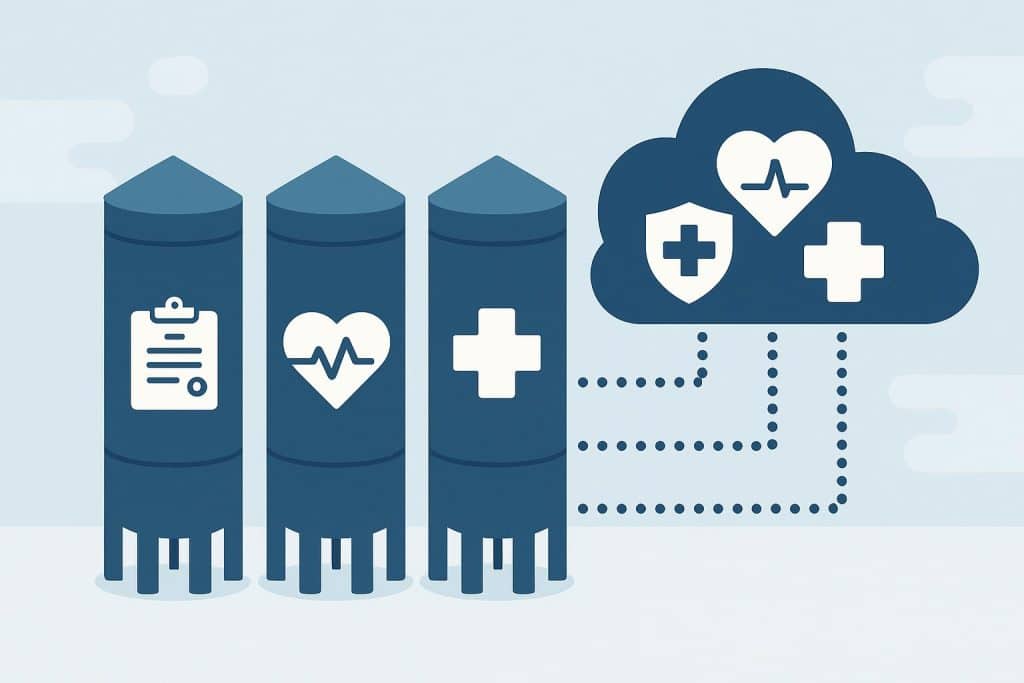
Clinicians have to make crucial decisions incompletely every day. The patient’s lab results are stored in a different system, his prescription is in another, and his hospital records are in yet another. No one has the complete picture, and that divide is driving costs through inefficiencies, missed reimbursements, and suboptimal patient outcomes.
This is directly addressed in the form of a Healthcare Data Aggregation Platform. It will consolidate fragmented patient information from all sources into a single, up-to-date view, enabling care teams to be on the same page. It is helpful to know how far the damage from siloed data extends before a fix is implemented.
What is Siloed Data in Healthcare?
Siloed data refers to patient information stored in systems that don’t communicate, creating gaps in the patient’s complete medical picture and complicating clinical decisions. It is not only a technical inconvenience but also a structural failure that affects all levels of care provision, including individual clinical decisions and population health outcomes.
Why It Happens
Healthcare organizations have historically adopted systems one at a time, an EHR here, a lab platform there, a claims system somewhere else. Many legacy healthcare systems were built independently, with proprietary formats, and still lack seamless interoperability.
- EHRs, HIEs, pharmacy systems, and claims platforms all operate independently.
- Patient records get duplicated, fragmented, or simply lost in translation
- Providers end up with partial histories and no reliable way to fill the gaps
The Real Costs of Siloed & Fragmented Data
This is that such data aggregation in healthcare is not a purely technical argument, but a financial and clinical one. Injury to siloed systems is cumulative and increases over time.
Redundant Testing and Wasted Spend
Without a unified patient record, duplicate diagnostic tests are ordered more often than organizations would like. Duplicate diagnostic tests are common when prior imaging or lab results are not visible across systems, leading to avoidable costs across patient populations.
Missed Risk, Delayed Intervention
Risk stratification is only effective when you have complete information. High-risk patients are at risk when claims and clinical data are in separate systems. Patients may remain unidentified longer, increasing the likelihood of costly interventions and delayed care.
Inaccurate Quality Reporting
HEDIS scores, STAR ratings, and HCC coding are all dependent on clean, complete, and accessible data. Poor submissions are characterized by fragmented pipelines, which directly affect reimbursement rates and quality rankings.
Operational Drag
When clinical personnel use manual methods to reconcile records, hunt down lab results, or re-enter data across different systems, it is not only inefficient but also a morale and retention problem. Manual reconciliation of fragmented records increases labor costs, slows workflows, and adds administrative burden for clinical staff.
How Health Data Aggregation Fixes It
The health data aggregation process involves retrieving data from all the available sources: EHRs, labs, claims, HIEs, pharmacy systems, SDOH, and patient-reported outcomes, standardizing it, and providing a longitudinal record of patient data that is precise and up-to-date.
A well-built healthcare data platform handles this across four core functions:
- Ingestion: Collects both structured data (like lab results and claims) and unstructured data (like clinical notes and device readings) from all sources.
- Normalization: Converts irregular formats into a single data model to ensure all initial sources use the same language.
- Patient Matching: An Enterprise Master Patient Index (eMPI) is used to match records in systems without duplicates.
- Real-Time Delivery: Surfaces insights not only in fixed dashboards but also in clinical workflows.
The result is a unified longitudinal patient record, accessible across care settings and actionable within clinical workflows.
What to Look for in a Healthcare Data Aggregation Platform
Not every aggregation solution is built the same. When evaluating a Healthcare Data Aggregation Platform, these capabilities separate functional platforms from genuinely useful ones:
- Broad source connectivity EHRs, HIEs, labs, claims, SDOH, and patient-reported data
- Standards-based architecture using FHIR, enabling secure data exchange across existing systems.NLP and AI to extract insights from unstructured clinical notes
- Real-time and batch ingestion support
- Accurate patient matching across systems and facilities
- Scalable infrastructure that handles large patient populations without degrading performance
Wrap Up
Siloed healthcare data is a critical barrier to effective care and operational efficiency, impacting both patient outcomes and costs. Every disconnected system is a potential gap in a patient’s care journey. Data aggregation in healthcare closes those gaps by creating a single, accurate, real-time view of every patient across all touchpoints. For organizations operating under value-based care, such a data foundation is no longer optional.
See What a Unified Data Platform Actually Looks Like
Persivia offers a purpose-built digital health platform that connects to over 3,000 data sources, including EHRs, HIEs, claims systems, labs, SDOH, and patient-reported outcomes, and normalizes everything into a single longitudinal patient record. Recognized by Gartner as a Representative Vendor in its Market Guide for Health Data Management Platforms, this solution uses AI, machine learning, and NLP to turn raw Health Data Aggregation into real-time, actionable insights at the point of care, not just in a report. With 70+ EMR integrations and more than 100 million patient records managed, it provides the infrastructure healthcare organizations need to significantly reduce data silos and improve patient care coordination.