

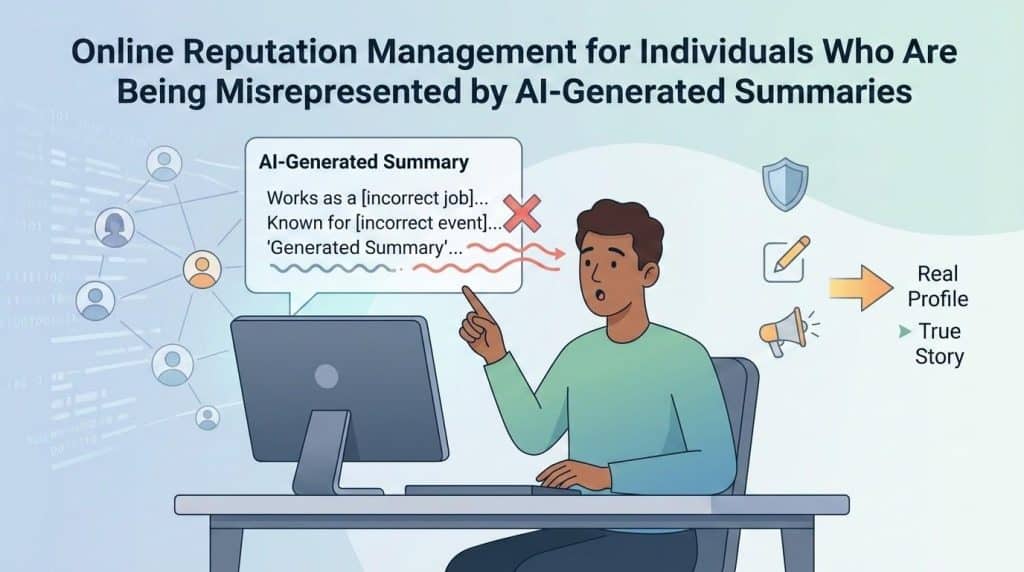
Inaccurate AI-generated summaries are quietly reshaping how professionals are perceived online, often reducing complex achievements to misleading fragments. As these automated overviews proliferate across search platforms and content aggregators, individuals face escalating risks to their credibility and opportunities. This guide covers detection methods, corrective content strategies, platform response protocols, and prevention frameworks for online reputation management for individuals who need to restore and protect their digital authority.
Understanding How AI Summaries Create Misrepresentation
AI summarization tools like ChatGPT, Claude, and Perplexity now generate over 40% of featured snippets in Google search results, according to a 2024 Search Engine Journal study. These systems pull data from multiple sources without proper verification, which creates serious challenges when individuals discover false information about themselves in search results.
Google SGE systems sometimes retrieve incorrect data from training sources. AI models frequently mix up people who share similar names. Training datasets also carry historical inaccuracies that repeat across platforms.
Three specific error patterns drive most of the damage:
- Entity confusion occurs when systems blend professionals with comparable names into a single profile
- Context stripping removes important details from legal cases that would clarify outcomes
- Temporal errors present old negative events as recent developments in professional histories
A physician discovered that a 2012 malpractice settlement appeared as current information in Google’s AI Overview, raising immediate concerns about her standing. That kind of displacement is not unusual. It illustrates exactly how AI-generated summaries can damage an individual’s reputation through misplaced or outdated details.
AI summaries misrepresent individuals through documented mechanisms that appear in roughly 1 of every 5 generated responses, according to a 2024 MIT CSAIL analysis. These tools fabricate professional credentials, invent job titles or degrees, and mix criminal records between unrelated people with similar names. Models also attribute bankruptcy filings to the wrong person when processing common names, and sentiment reversal turns negative coverage into neutral-sounding summaries.
Research from the University of Washington confirms that factual errors appear regularly in these outputs and spread quickly through search results.
Conducting an Immediate Damage Assessment
Conduct a five-point damage assessment within 48 hours of discovering AI-generated misrepresentation. Use BrandYourself’s free scan and Google Alerts to get started. Before taking any corrective action, gather evidence across multiple platforms and document each instance with screenshots and timestamps.
Examine how false information appears across different search contexts, including both desktop and mobile results. Then organize findings by source type and severity. That structure supports better decisions about what to prioritize.
The five assessment criteria are:
- Search visibility: Count how many AI summaries appear in the top 10 results for your name and common variations
- Error severity: Rate each misrepresentation on a scale of 1 to 5 based on potential harm; higher scores warrant faster action
- Source authority: Identify whether errors originate from government sites, news outlets, or reference platforms like Wikipedia; content from high-authority domains tends to persist longer
- Amplification risk: Track social media shares and engagement on incorrect content to understand how quickly it may spread
- Business impact: Monitor changes in inquiry rates using analytics tools; drops in contact form submissions often signal that negative results are affecting opportunities
A template spreadsheet can organize these five criteria into a single scoring system with weighted formulas that produce an overall reputation risk score between 1 and 100. Review the completed assessment every two weeks during active remediation to measure whether your strategy is reducing the visibility of problematic summaries.
Monitoring and Detection Tools for AI Reputation Damage
Set up monitoring across eight specific platforms using Mention, Brand24, and Talkwalker Alerts. These services track mentions across news sites, forums, and AI content generators and can surface reputational damage within 4 hours of publication.
Build a monitoring matrix that combines:
- Google search operators for exact name matches
- Google Alerts for name variations
- Mention for AI-generated content sources
- Brand24 for sentiment scoring
- Social media monitoring across LinkedIn, Twitter, and Facebook
Configuring Google Alerts
Configure seven specific Google Alerts using exact phrases, name variations, and exclusion operators. This takes under 30 minutes and significantly improves signal quality. For example:
"John Smith" attorneyfor professional mentions"John A. Smith" lawyer -inurl:facebookto reduce noise"John Smith" malpracticeset to daily digest"John Smith" [city]set to weekly summary
Expand monitoring beyond Google. Enable Mention to scan AI content sources and add Talkwalker for dark web mentions. Adjust alert frequency based on risk level. Daily digests work well for high-risk phrases; weekly summaries suit broader name searches.
Creating Corrective Content That Outranks AI Summaries
Publish three pieces of authoritative corrective content on medium-authority domains within 14 days to dilute AI-generated misinformation in search results. The goal is to establish accurate information that ranks above misleading summaries.
Start with your own authoritative sources:
Personal website about page: Include verifiable credentials, employment dates, specific accomplishments, and references that search engines can index. Every section should provide clear documentation that contradicts any false claims.
LinkedIn article: Address the specific misrepresentations appearing in search results directly. Include data, timelines, and factual details that clarify your actual professional record. LinkedIn offers good visibility, and its content can influence future AI training data.
Wikipedia corrections: Submit requests through the article Talk page, following Wikipedia’s reliable sources policy. Provide published references with page numbers and publication dates. Editors respond better when requests focus on verifiability rather than personal grievance.
Google Business Profile: Create or update a profile using verified information that matches official records. This appears in local search results and establishes consistent details across platforms.
Backlinks from .edu or .gov domains: These signal credibility to search engines and strengthen personal SEO. Focus on genuine institutional relationships rather than manufactured links.
For keyword placement, use phrases like “online reputation management” and “individual reputation” naturally in headings and opening paragraphs. Meta descriptions should incorporate terms like “reputation repair” and “AI-generated summaries” and run between 150 and 160 characters.
Platform-Specific Response Strategies
Google offers two primary routes. EU residents can submit removal requests under the right to be forgotten when AI summaries contain inaccurate personal details that cause harm. Outside the EU, individuals can use Google Search Console to request factual corrections when indexed pages contain clear errors from automated systems.
Sample template: “I am requesting removal or correction of search result summaries that inaccurately describe [specific fact]. The AI-generated description states [incorrect text], which contradicts [source document or official record]. This misrepresentation affects my professional standing and personal privacy rights.”
Update your own profile sections with verified details first, then request that LinkedIn review any automated summaries that conflict with your primary profile data. Publishing a correction article on LinkedIn can also help establish an accurate record for future AI training sets.
Sample template: “My profile contains accurate professional history, yet automated summaries display incorrect information about [specific claim]. I request review and removal of the summary that states [error]. Supporting documentation is attached showing the correct details from [source].”
Wikipedia
Submit correction requests through the article’s Talk page with links to reliable published sources. Provide page numbers and publication dates. Neutral language and strong sourcing will carry more weight than a personal appeal.
Sample template: “The current article states [AI-generated claim] without supporting citations. Reliable sources, including [publication name, date, page] confirm that [correct fact]. I request the removal of the unsourced statement to maintain article accuracy.”
Review Sites
Contact the platform directly with evidence showing that the aggregated summary does not reflect verified reviews. Many review platforms allow responses to appear alongside automated summaries. Use that feature to provide context and direct readers to the primary review text.
News Sites
Contact the editor or corrections desk with specific documentation showing where the automated summary diverges from the original reporting. Include the article URL, the exact AI-generated text, and the correct passage from the source. News organizations generally respond well when the discrepancy is clear and well-documented.
Response timelines vary significantly by platform. Google requests may take several weeks. LinkedIn profile edits often process within days. Wikipedia depends on editor availability and source quality. Track all correspondence and follow up when requests receive no response within stated timeframes.
Legal Options for Online Reputation Management for Individuals
Four legal pathways are available when platform-level requests fail.
GDPR Article 17, the right to be forgotten, applies to EU residents and has a 67% success rate for qualifying requests, according to 2023 ICO data. The process requires personal identification details, specific URLs showing the problematic content, and a clear explanation of why the information qualifies for deletion. Search engines typically respond within 30 days.
Initial legal consultations range from $500 to $5,000, depending on case complexity. Most individuals begin with self-filed requests before engaging attorneys. The process works best when combined with documentation of how false information affects professional opportunities and personal relationships.
Ethical considerations include balancing individual privacy rights against public interest exceptions. News organizations and public figures may face different standards than private citizens. Content removal is most defensible when the material serves no legitimate public function.
Building Long-Term Reputation That AI Cannot Easily Distort
Implement a 12-month program that generates 50 or more original pieces of content across 8 platforms to establish an authoritative presence that counters AI misinformation. Divide the effort into four quarters.
Q1: Launch a personal website with 10 cornerstone articles establishing factual information about your professional background. Publish two to three pieces weekly to build consistent momentum and provide search engines with indexed content to prioritize.
Q2: Establish thought leadership through LinkedIn posts and contributions to industry publications. This creates a broader online presence, diluting the impact of digital misrepresentation across multiple channels.
Q3: Secure five speaking engagements and podcast appearances. These verbal platforms entirely bypass AI summarization errors. Document them with transcripts and recordings to create lasting content assets.
Q4: Build media relationships that result in three earned media placements in relevant outlets. Companies like NetReputation have written extensively about how third-party credibility signals influence both search rankings and AI-generated summaries, reinforcing why earned media matters at this stage. Track progress by monitoring domain authority improvements and search rankings for key identity-related terms.
Prevention: A Quarterly Reputation Audit Protocol
A quarterly reputation audit protocol with six verification checkpoints can prevent AI-generated misinformation from impacting search visibility. The method relies on consistent monitoring rather than reactive damage control.
Monthly Google searches of name variations in incognito mode reveal what others actually see. Include middle names, nicknames, and professional titles. Regular checks catch new content before it gains traction.
Quarterly reviews of Wikipedia entries and data broker profiles surface outdated or inaccurate information that AI tools may reference. Early corrections prevent errors from spreading.
The full prevention checklist:
- Conduct monthly name searches in private browsing mode
- Review Wikipedia and data broker profiles every three months
- Perform personal SEO audits twice a year using tools like Semrush or Ahrefs
- Check background check service results annually through providers like BeenVerified or Intelius
- Publish original content on a regular schedule to establish accurate information
- Set custom alerts to monitor AI tool outputs mentioning your name
Budget between $800 and $1,500 annually for monitoring tools, audit services, and content creation. Monthly searches take minimal time. Quarterly and bi-annual tasks require more attention but occur less frequently. Annual background service reviews complete the cycle.