

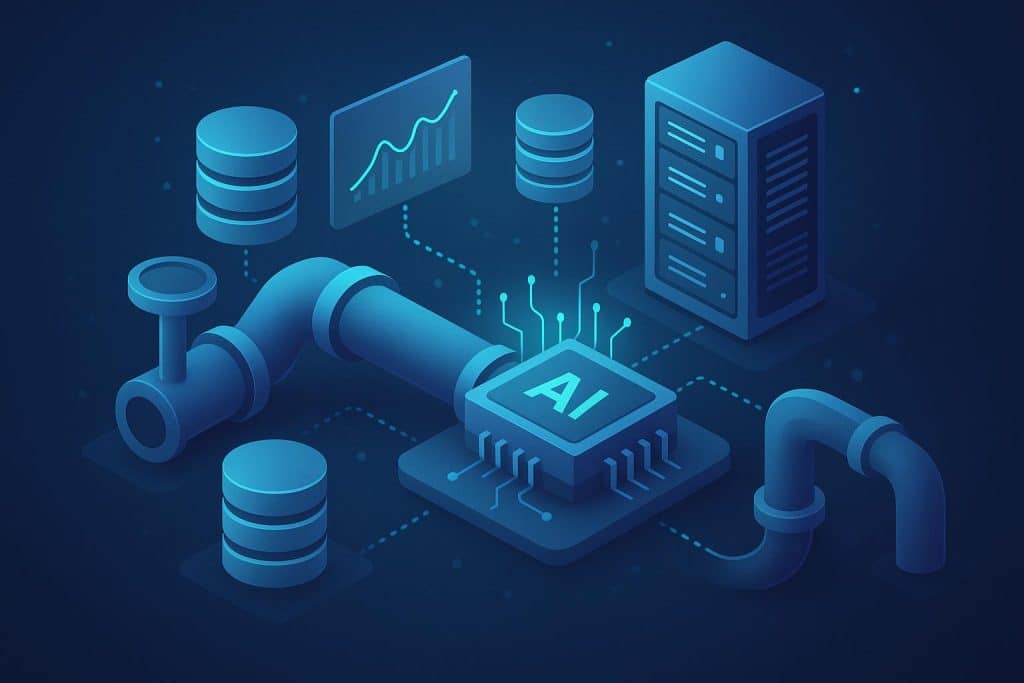
At present corporations dedicate 40% of engineering resources to data pipelines but they receive continuously smaller benefits. Teams allocate more resources to infrastructure maintenance rather than analytic discovery. This situation does not balance out. The market will not sustain these conditions much longer.
The fundamental problem? Data pipelines get treated as immobile construction components that require human monitoring. The current state of affairs requires intelligent systems that function independently to heal themselves after adapting and optimizing their operations.
The Maintenance Trap
Old-fashioned data pipelines demand unceasing human supervision. Every schema change caused transformation failures. All source system alterations broke data extraction processes. Changed destination environments disrupt the data loading operations. Engineering teams devoted lengthy continuous days toward sustaining autonomous operations. Maintenance demands expand exponentially based on the number of pipelines. Ten data pipelines require periodic maintenance. Fifty data pipelines take up vast portions of maintenance time. Two hundred pipelines need special teams whose sole role deals with upkeep. Intelligent infrastructure deployments help organizations decrease pipeline maintenance time by 90%. Engineering teams devote themselves to high-level initiatives instead of repairing connection issues.
Noca.ai enables this through self-maintaining capabilities. The platform monitors data pipelines continuously, detects changes in source systems automatically, adjusts transformations appropriately, validates data quality throughout, and resolves most issues without human involvement.
Quality at Scale
Manual monitoring systems fail to match ongoing data expansion in today’s operational environment. Data engineers operate sample-based testing looking for potential service breaks. Hidden issues navigate through our detection methods. Our information processing systems downstream operate on defective data. Flawed data impacts decision-making processes. Business results experience direct decline as a consequence. Data pipelines with intelligence systematically apply quality to each stream that passes through them. Comprehensive validation checks every record in the pipeline. Anomaly detection systems generate immediate alert notifications. Automatic surveillance systems detect emerging indicators which signal decreased quality. Detection functions become detection functions become detection functions become detection functions become detection functions become systems which enable prevention.
Think about financial reporting pipelines. Automated intelligent systems verify transaction data by testing historical trends as well as ensuring ongoing regulatory compliance and immediate suspicious entry detection. Business processes catch quality issues before they impact the key reports.
This systematic approach delivers measurable results:
- Data accuracy improves to 99.9%+
- Quality incidents decrease 95%
- Downstream system confidence increases
- Decision quality improves measurably
Real-Time Operations
When data changed slowly batch processing reigned supreme. That period has come to an end. Transactions across the market occur within milliseconds. Customers behaviors constantly change in patterns. Inventory levels show constant variations. Real-time pricing modifications occur at the moment. Organizations which support batch data pipelines at night operate with yesterday’s data for their present decisions. Actual optimizations based on existing situations happen instantly for their competitors because they have streaming infrastructure. The competitive separation increases quickly. Dynamic pricing adjustments and instant fraud detection alongside immediate inventory optimization and personalized customer experiences become possible with real-time pipelines. A batch processor will not succeed.
The complexity of streaming is handled by AI agent platforms automatically. Noca.ai orchestrates event sequencing together with exact-once execution and consistent state maintenance and efficient backpressure management and dynamic infrastructure scaling.
Adaptive Transformation
Previous data pipelines transformed data similarly irrespective of particular data features. Every record underwent similar processing steps. All situations applied the identical predefined rules. All pattern changes remain unaddressed because of rigid rules. Rigidities perpetuated existing operational difficulties. Distribution changes caused Transformations to lose their effectiveness. Quality of outputs dropped to lower levels. Manual intervention resolved logic problems. New distribution changes triggered repeating problems.
Wise pipelines modify transformation procedures when data features change. Their detection systems recognize pattern changes across the dataset. Their operational team adjusts data processing systems accordingly. Their systems automatically preserve consistent output quality. The current analytics pipeline for customers detects changes in seasonal trends and automatically recalibrates its segmentation logic. Marketing teams receive ongoing relevant data interpretations without requirement for instruction from staff members.
Orchestration Intelligence
Enterprise operations need many data pipelines to work together smoothly. Analytics pipelines receive data from customer pipelines. Reporting pipelines begin their work based on data from analytics pipelines. Operational dashboards get updated through reporting pipelines. Optimization pipelines receive information from dashboards. Extensive custom coding created the coordination requirements in traditional operations. The system hardwired dependencies into the code. Rigid execution sequences were developed as a result. Incremental changes force complexity growth in an exponential manner.
Intelligent orchestration performs dependency management in an automated manner. Systems have an understanding of how one pipeline feeds into another. They use dynamic methods to improve execution sequence flows. They stop breakdowns from spreading by managing failures with elegance. Systems that follow detect upstream delays automatically reschedule their tasks accordingly. Dependent pipelines remain paused because of quality issues until they get solved. Systems distribute resources optimally among various demands during high-demand situations.
Noca.ai offers this orchestration functionality because of its coordinated intelligent AI agents which learn pipeline relations and manage execution smartly alongside ongoing resource optimization.
Cost Optimization
Traditional data pipelines consumed fixed infrastructure regardless of actual processing needs. Peak capacity provisioned for maximum theoretical load. Resources sat idle during normal operations. Costs remained constant while utilization fluctuated dramatically. This inefficiency became unsustainable as data volumes exploded. Infrastructure expenses grew faster than business value. Finance teams questioned pipeline ROI. Pressure mounted to reduce costs without sacrificing capability.
Intelligent infrastructure scales dynamically based on actual demand. Processing requirements increase? Capacity expands automatically. Load decreases? Resources scale down appropriately. Costs align with value delivered. Organizations implementing intelligent data pipelines report 65% reduction in infrastructure spending while handling 3x data volume growth.
The Governance Imperative
Data pipelines moving sensitive information require robust governance. Who accessed what data? Which transformations applied? Where did information flow? How do you prove regulatory compliance? Legacy approaches struggled with governance. Audit trails were incomplete. Access controls lacked granularity. Compliance verification required manual investigation. Regulatory risks accumulated. Modern platforms embed governance comprehensively. Every data access gets logged. All transformations document lineage. Access controls enforce least-privilege principles. Compliance verification happens automatically.
Noca.ai implements governance through TRAPS principles Trusted, Responsible, Auditable, Private, Secure. Data pipelines operate with necessary autonomy while maintaining complete accountability and regulatory compliance.
Conversational Construction
Specialized skills were essential for constructing common data pipelines manually. Software engineers built extraction programs combined with transformation rules and loading setup with error management and monitoring solutions. Building projects required multiple weeks or many months. Conversational pipeline creation becomes possible through intelligent platforms. Express the target results through plain English statements. The system produces complete implementations including every part of extraction, transformation, loading, quality checks, error handling, monitoring and optimization. Extract customer transactions from our payment processor, enrich with product catalog information, calculate customer lifetime value, and load results into our analytics database for the marketing team. A production-ready pipeline forms when proper governance and monitoring are implemented from that description. Code writing disappears. Deployment stays effortless. Configuration requirements disappear.
The democratization process carries extreme importance. Analytics pipelines become real through marketing teams’ direct construction work. Finance teams run their own reporting pipelines independently. Operations teams establish their monitoring pipelines independently of IT support. Engineers tackle genuine complex problems.
Conclusion: Infrastructure Intelligence
Data pipeline landscapes changed for good. Traditional manual maintenance strategies work as poorly as intelligent self-adaptive systems that independently heal their own functioning elements to perform better through optimization.
Organizations face clear choices. Continue maintaining brittle legacy infrastructure or deploy intelligent data pipelines that require minimal oversight while delivering superior outcomes. The technology exists today. AI agent platforms provide enterprise-grade intelligent pipeline capabilities with proper governance and security. The competitive advantages compound rapidly.
Markets reward organizations that embrace intelligent infrastructure. They penalize those clinging to manual approaches until forced evolution arrives too late.