

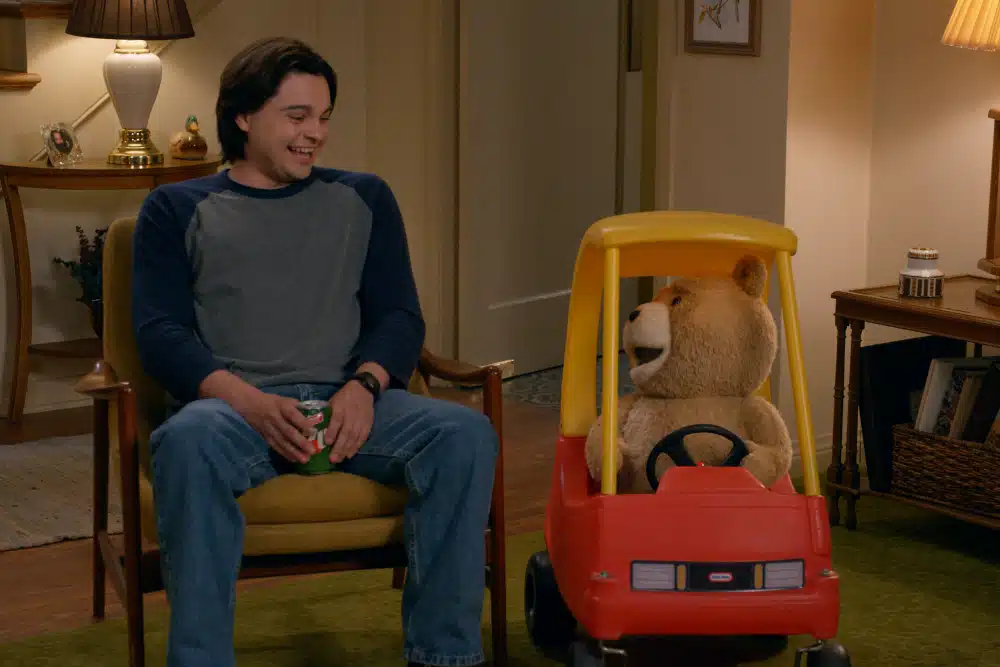
Remember when a foul-mouthed bear first shocked audiences? While the movies relied on spectacle, Ted Season Two proves the franchise found its true heart in 1993. Following a record-breaking debut, this prequel format allows for deeper family storytelling than a third film could ever manage. With Max Burkholder as young John Bennett capturing the perfect Wahlberg energy, fans are now eagerly tracking the series release date to see where the nostalgic chaos goes next.
The Digital Labor of Laughs: Why Your Favorite Bostonian Bear Takes So Long to Return
Creating a sitcom with a main character who doesn’t physically exist requires a production process closer to a blockbuster movie than a standard TV comedy. When the human actors film scenes, they are effectively using a “Ghost Method,” interacting with empty space while imagining a two-foot-tall bear. To bridge the gap between imagination and reality, the production team follows a rigorous visual effects (VFX) pipeline:
- The Stuffie Pass: A physical plush toy is briefly placed on set so camera operators can lock in the focus and lighting, then removed before the cameras roll.
- Performance Capture: Seth MacFarlane acts out the scene on set—often wearing a motion-capture suit—to provide the specific body language data for the animators.
- Digital Integration: Artists manually insert the CGI character, ensuring his digital shadow falls exactly where a real object’s would.
This meticulous approach helps explain why fans have to wait longer for Ted: Season Two compared to typical shows. Unlike Family Guy, where drawings are simpler to manipulate, every single frame of this series requires complex digital painting to render individual fur strands that react to the room’s light. It is a slow, expensive labor of love, but this technical precision is essential for selling the illusion before the story pivots to the cultural landscape of the 1990s.
Navigating 1993: How Season Two Trades Crude Jokes for 90s Family Chaos
While the visual effects team perfects the fur, the writers are busy constructing a time machine back to 1993. Season Two moves beyond simple shock value to explore the Bennett family dynamic, specifically focusing on John’s junior year. As John faces the awkward transition to upperclassman status, Ted acts as his unfiltered “id”—the voice suggesting every bad idea—while his cousin Blaire steps in as the voice of reason. Blaire’s character development is crucial here; she provides the modern perspective that makes the show’s retro setting palatable for today’s audience, grounding the crude humor with genuine heart.
This era-specific setting does more than just provide funny costumes; 90s pop culture references serve as the framework for the characters’ emotional growth. Since the show thrives on cultural commentary, fans can expect the upcoming season to tackle major 1993 milestones that likely influenced the Bennetts’ world:
- Jurassic Park: The blockbuster that defined the summer.
- Beavis and Butt-Head: The MTV phenomenon that parents hated.
- Doom: The video game that changed computing.
- Sleepless in Seattle: Exploring 90s romance tropes.
The Peacock Strategy: How to Stream Ted Season Two and Why It Redefines the Modern Sitcom
Recognizing Peacock’s “library” strategy explains the wait for the new season: digital artistry takes time but ensures lasting value. The episodic format offers a superior education in MacFarlane’s humor, letting character dynamics breathe in ways the films couldn’t. If you’re asking is the series worth watching, the depth makes it a clear “yes.” Rather than just searching for clips, binge the first season now so you are fully ready for the Bennett family’s return.