

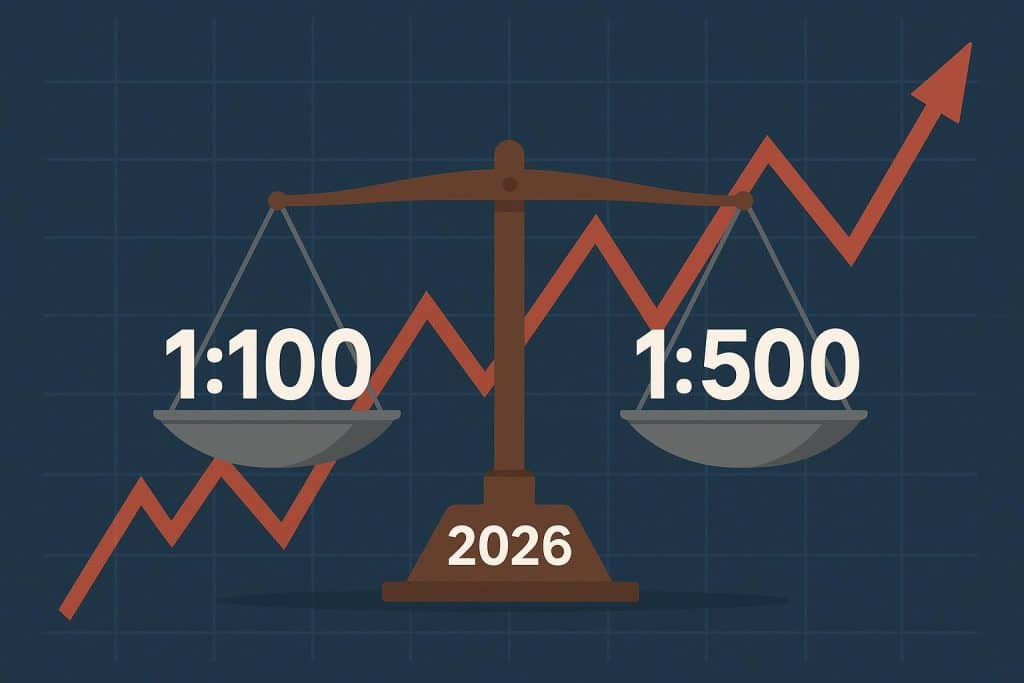
Leverage is one of the first things new traders notice when opening a forex account. Brokers advertise numbers like 1:100, 1:200, or even 1:500, and for beginners, it can sound like free money.
More leverage means more profit… right?
Not exactly.
In 2026, leverage remains one of the biggest reasons beginners either grow steadily — or blow their accounts within weeks. The difference between 1:100 and 1:500 leverage isn’t just about profit potential. It directly affects risk, emotions, margin usage, and survival.
Let’s break this down in simple terms so you can understand which leverage actually makes sense when you’re just starting out.
What Does Leverage Really Mean?
Leverage allows you to control a larger trade size using a smaller amount of capital.
Here’s the basic idea:
- 1:100 leverage → You control $100 for every $1 you have
- 1:500 leverage → You control $500 for every $1 you have
If you deposit $100:
- With 1:100, you can control up to $10,000
- With 1:500, you can control up to $50,000
This doesn’t mean you should trade that full amount, but it explains why leverage feels powerful.
The key point many beginners miss is this:
Leverage increases speed, not skill.
It magnifies profits and losses equally.
Why Beginners Are Drawn to 1:500 Leverage
Most new traders choose high leverage for three main reasons:
1. Small Accounts Feel Limited
When someone starts with $50–$200, 1:100 leverage can feel restrictive. Trades look “too small” and profits seem slow.
2. Social Media Distortion
You constantly see screenshots of huge profits on tiny accounts — usually using very high leverage with extreme risk.
3. Misunderstanding Risk
Many beginners believe leverage itself is dangerous. In reality, position size is the real risk, but leverage makes it easier to oversize trades accidentally.
High leverage doesn’t force bad trading, but it enables it.
The Real Difference Between 1:100 and 1:500
Let’s compare how both affect real trading behavior.
Margin Usage
With 1:500 leverage, margin requirements are very low. This means you can open large positions with minimal capital.
That sounds good – until price moves slightly against you.
A small move can wipe out a large portion of your account before you even have time to react.
With 1:100 leverage, margin requirements are higher, which naturally limits how big your trades can be.
This acts like a built-in safety barrier.
Emotional Pressure
High leverage creates emotional chaos.
When price moves fast:
- Profits jump quickly
- Losses escalate instantly
- Decisions become impulsive
Beginners start closing trades too early, revenge trading, or widening stop losses just to “survive.”
Lower leverage slows everything down.
That extra breathing room helps beginners learn patience — something no indicator can replace.
Risk Per Trade
Professional traders rarely risk more than 1–2% per trade, regardless of leverage.
But with 1:500 leverage, risking 10–20% can happen unintentionally.
For example:
- A slightly larger lot size
- A tighter stop loss
- One emotional click
And suddenly one losing trade becomes catastrophic.
With 1:100 leverage, mistakes still hurt — but they usually don’t end the account.
Is 1:500 Leverage Ever Useful?
Yes, but usually not for beginners.
High leverage can be useful for:
- Advanced traders with strict risk control
- Scalpers who need low margin usage
- Traders running multiple small positions
- Hedging strategies
The problem isn’t the leverage number.
The problem is giving extreme leverage to someone who hasn’t mastered:
- Position sizing
- Stop-loss placement
- Risk-to-reward discipline
- Emotional control
That combination is dangerous.
Why Many Professionals Prefer Lower Leverage
Here’s something surprising:
Many consistently profitable traders don’t even use their maximum leverage.
Even if their broker offers 1:500, they trade as if they’re using 1:50 or 1:100.
Why?
Because:
- Survival matters more than speed
- Drawdowns are easier to recover from
- Strategy performance stays consistent
- Psychology stays stable
A trader who lasts five years will always outperform one who aims to double accounts every month.
Which Leverage Is Better for Beginners in 2026?
For most beginners, 1:100 leverage is the smarter choice.
Here’s why:
✅ Better risk control
✅ Slower account swings
✅ Lower emotional stress
✅ Less chance of accidental over-trading
✅ More realistic learning environment
It allows you to:
- Focus on execution
- Respect stop losses
- Understand market movement
- Build discipline before speed
High leverage doesn’t teach trading — it tests it.
And beginners are still learning.
What Actually Matters More Than Leverage
Leverage is secondary.
These factors matter far more:
- Lot size
- Stop-loss distance
- Risk percentage per trade
- Consistency
- Emotional discipline
You can blow an account with 1:50 leverage if you trade irresponsibly.
You can also trade safely with 1:500 if you’re disciplined — but that usually comes later.
A Practical Beginner Setup for 2026
If you’re new to forex, a balanced approach looks like this:
- Leverage: 1:100
- Risk per trade: 1% maximum
- Stop loss: Always predefined
- Focus: Skill building, not fast growth
- Goal: Consistency over excitement
Once your strategy is stable and emotions are controlled, leverage becomes a tool – not a temptation.
Final Verdict
So, should beginners use 1:100 or 1:500 leverage in 2026?
For most traders starting out:
1:100 leverage is the safer, smarter, and more sustainable choice.
It doesn’t limit profit — it protects capital.
High leverage isn’t bad, but using it too early is like driving a supercar before learning how to brake.
Master control first.
Speed can come later.