

An Indian warehouse can have the latest equipment and still lose valuable time simply moving goods from one place to another. As order volumes rise and fall, inventory patterns change, and fulfillment expectations grow, warehouses need material movement systems that can keep up instead of relying on fixed routines.
Mobile robots are becoming an important part of this change. They can support transportation, picking, inventory movement, and scalability while taking repetitive travel off employees’ hands.
Addverb’s whitepaper, AMRs vs AGVs – Which One Is Right For Your Business?, explains that AGVs follow predefined routes, while AMRs can dynamically plan their paths, respond to obstacles, and adapt to changing warehouse layouts.
According to Research and Markets, with a compound annual growth rate (CAGR) of nearly 15% between 2023 and 2028, the warehouse automation market is projected to reach USD 44 billion by 2028. Consequently, facilities that fail to transition from static infrastructure to dynamic automation risk falling behind in operational efficiency and speed.
Redefining Material Movement Within Warehouses
In many Indian warehouses, employees still spend a large part of their day walking, driving, pushing, or carrying goods between different areas. When the same trips happen hundreds or thousands of times, that time quickly adds up.
Mobile robots take on much of this repetitive movement, transporting pallets, cartons, and inventory between warehouse zones. Their ability to navigate changing conditions also makes them useful when priorities shift during the day.
- Material transportation: Move goods between operational zones with less manual travel.
- Flexible routing: Adjust movement when obstacles, priorities, or layouts change.
- Continuous movement: Keep materials moving between different warehouse activities.
Sensor fusion (LIDAR, vision cameras, SLAM) is now achieving commercial adoption, and “sensor-fusion AMRs” are expected to exhibit 70% growth rates.
Additionally, AMR fleets benefit from fleet management systems that coordinate multiple units in real time, optimising overall throughput, not just single-robot efficiency.
Improving Collaboration Between Human Workers and Automation Systems
Warehouse automation does not have to mean taking people out of the process. In many cases, its biggest benefit is taking repetitive work off their hands. Employees can then spend more time on decisions, exceptions, quality checks, and tasks that need experience and judgment.
Mobile robots support this approach by working alongside warehouse employees and reducing the physical effort involved in repeated material handling. Instead of spending hours transporting goods, workers can focus on activities that directly contribute to order fulfilment.
- Picking support: Coordinate robot movement with picker activity so employees can focus on order processing.
- Repetitive tasks: Handle routine movement while employees manage decisions and exceptions.
According to a study published in Transportation Science, an AMR-assisted warehouse handling 16,000 orders per day was evaluated to demonstrate that optimised AMR scheduling can improve warehouse throughput by coordinating robot and picker activities.
Enabling More Flexible Warehouse Automation Strategies
Fixed automation can work extremely well when warehouse processes stay the same. The difficulty comes when the business changes. New products, seasonal demand, changing order patterns, or a different warehouse layout can make fixed-path systems harder to adjust.
Mobile robots offer a more flexible approach. They can support changing processes without requiring major changes to existing infrastructure, making it easier to scale automation as business requirements evolve.
This flexibility matters because today’s Indian warehouse may not look like tomorrow’s. A system that can change its movement strategy gives businesses more room to respond when demand, products, or workflows change. According to SellersCommerce Warehouse Automation Statistics 2026, autonomous mobile robots (AMRs) deliver payback in under 24 months and ROI above 250% in live deployments.
Enhancing Warehouse Visibility and Operational Coordination
A robot moving through a warehouse in India is doing more than carrying a load. When it is connected to warehouse software and operational systems, its movement can become part of a much larger flow of information. That gives warehouse teams a clearer view of what is happening and where work may be slowing down.
Mobile robots can contribute to this connected operation by working with warehouse software and fleet management systems. Instead of treating transportation as a separate activity, businesses can coordinate robot movement with inventory and other warehouse processes.
- Process monitoring: Identify slowdowns and delays across material movement.
- Workflow coordination: Align robotic movement with wider warehouse activities.
- Operational data: Use movement information to support better decisions.
AMRs are expected to constitute 80% of industrial robots by 2027, and their number in factories is expected to reach 15 million by 2030.
Where Automation Creates the Most Value
The real value of warehouse automation appears when different technologies work together instead of operating as separate systems in an Indian warehouse. An automatic storage and retrieval system can manage storage and retrieval while mobile movement technologies connect those activities with other parts of the warehouse.
This creates a more connected flow between storage, transportation, picking, and inventory movement.
| Warehouse Activity | Role of Automation |
| Transportation | Reduces repetitive movement between zones |
| Picking support | Helps coordinate robot and picker activities |
| Inventory movement | Enables flexible transfers between warehouse areas |
| Storage | Connects automated storage with material movement |
| Scaling | Allows automation to expand as requirements change |
How Addverb Helps Build More Flexible Warehouse Operations
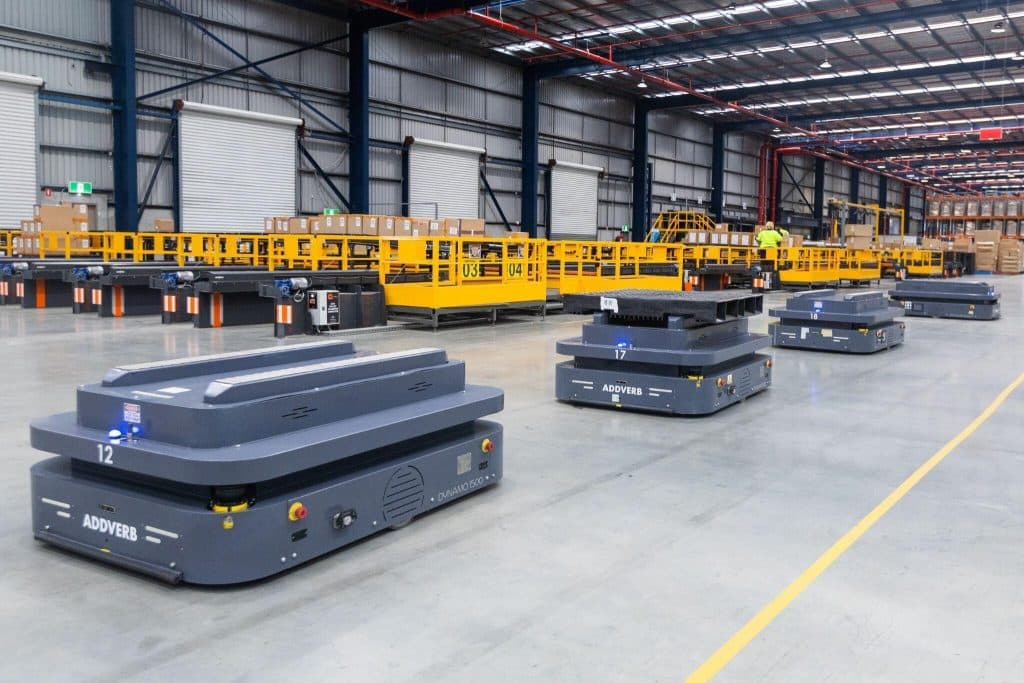
Addverb provides top automation solutions designed to automate material movement and improve warehouse efficiency across different operational environments. Its AMR, Dynamo, is designed to transport goods across warehouse areas while adapting to changing routes and operational requirements. Dynamo can support use cases such as material transportation, picking, tugging, and tunneling, depending on business requirements.
Addverb also brings mobile robotics into a broader automation ecosystem. Its warehouse software solutions can support inventory management, warehouse control, execution, and fleet management, helping coordinate robotic movement with wider warehouse operations. This allows businesses to build more connected material movement workflows instead of treating robots as standalone equipment.
Conclusion
Warehouse operations are changing because moving goods is no longer just a point-to-point task. Modern facilities need automation that can respond to changing demand, support employees, and work across different processes without turning every operational change into a major infrastructure project.
The shift is about more than simply adding robots to a warehouse. It is about building a material movement strategy that can keep pace with the business. From transportation and picking support to better visibility and scalable automation, Addverb’s solutions can help warehouses in India to create workflows that are ready for whatever comes next.