

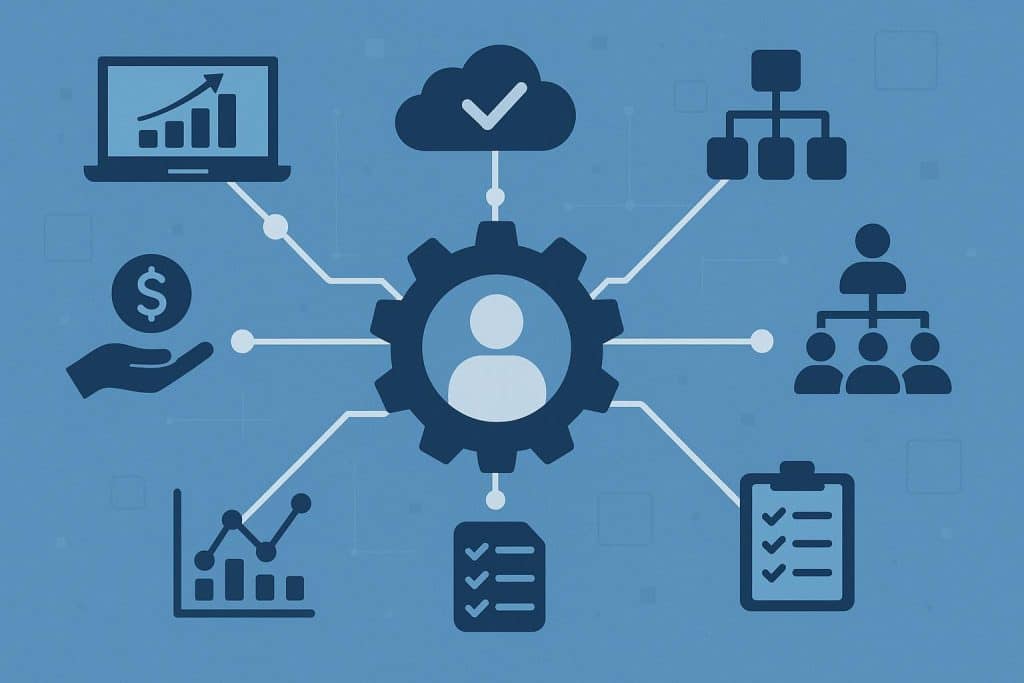
Modern organizations no longer manage people through isolated HR activities or disconnected administrative tools. Workforce governance now sits at the intersection of data, compliance, finance, operations, and long-term strategy. As businesses expand across regions and regulatory environments, people management becomes a systems problem rather than a paperwork function. Leadership teams increasingly expect measurable visibility, process discipline, and predictive insight from their workforce frameworks.
This shift has accelerated the adoption of staff management software that connects employee lifecycle data with broader enterprise systems and operational controls. Instead of treating HR as a support department, companies now design integrated human capital environments where workforce planning, payroll governance, compliance monitoring, and performance analytics operate as one coordinated architecture. The result is tighter control, faster decisions, and fewer blind spots across organizational layers.
The Structural Shift from Administrative HR to System-Level Workforce Control
Traditional HR models focused on record keeping, payroll processing, and basic employee services. These functions were often supported by standalone tools that did not communicate well with finance, procurement, or project systems. As organizations grew, this fragmentation created reporting delays, compliance exposure, and inconsistent policy execution across departments. Workforce control remained reactive rather than strategic.
Integrated human capital platforms change this structure by placing workforce data inside a broader enterprise technology framework. Employee records, time data, cost centers, and performance indicators connect directly to operational and financial modules. This integration allows leadership to see workforce impact in real time rather than through delayed reports. It also reduces manual reconciliation work and lowers the risk of data mismatch across systems.
Control improves because processes become rule driven instead of person dependent. Approvals, role definitions, access rights, and policy triggers are embedded into workflows. Governance shifts from supervision to system design. When platforms are configured properly, compliance becomes automated behavior rather than enforced correction.
Core Capabilities That Define Integrated Human Capital Platforms
Integrated workforce platforms are not defined by one feature but by coordinated capability layers. These systems typically combine employee lifecycle management, payroll governance, time and attendance tracking, and policy-driven workflow automation. The emphasis is on end to end visibility rather than isolated task completion. Each module contributes to a unified control environment.
Data consistency is one of the most important outcomes. When hiring, compensation, scheduling, and evaluation data live within one platform, reporting accuracy increases. Leaders can analyze workforce cost, productivity indicators, and compliance metrics without stitching together multiple spreadsheets. Decision cycles become shorter and more evidence-based.
Another defining trait is configurability. Mature platforms allow organizations to adapt rules, approval chains, grading structures, and compliance requirements without rebuilding the system. This flexibility matters in industries with changing labor regulations or multi-country operations. Control is maintained through parameter design rather than constant manual intervention.
Unified Employee Lifecycle Visibility
Integrated platforms map the full employee journey from recruitment through separation within one data model. This continuity prevents information loss between stages and reduces duplicate records. It also supports better workforce planning because historical and current data remain connected. Leaders gain a longitudinal view rather than fragmented snapshots.
Lifecycle visibility improves risk control as well. Certification tracking, probation monitoring, and contract timelines can trigger alerts automatically. Instead of relying on managers to remember deadlines, the system enforces them. This reduces regulatory exposure and administrative oversight gaps.
From a governance perspective, lifecycle integration turns HR events into auditable system events. Every change is logged, traceable, and reportable. That audit trail strengthens both internal control and external compliance readiness.
Workflow Automation and Policy Enforcement
Manual approvals are one of the weakest links in workforce governance. They are slow, inconsistent, and difficult to audit. Integrated platforms replace informal approvals with structured digital workflows. Requests move through predefined paths based on role, value, and risk category. This creates consistency across departments and locations.
Policy enforcement becomes embedded rather than advisory. Leave rules, overtime limits, benefit eligibility, and compensation bands can be system-enforced. Exceptions require documented overrides instead of silent deviations. This protects organizations from uneven policy application and favoritism claims.
Automation also reduces operational friction. Employees and managers interact with standardized request flows instead of emails and forms. The experience becomes faster while control becomes tighter. Efficiency and governance improve at the same time rather than trading off.
Real Time Analytics and Workforce Intelligence
Control depends on visibility, and visibility depends on timely analytics. Integrated platforms generate dashboards that connect workforce metrics with operational and financial data. Headcount cost, utilization ratios, overtime exposure, and attrition trends become continuously measurable. Leaders move from retrospective reporting to live monitoring.
Predictive indicators are increasingly built into advanced platforms. Patterns in absenteeism, turnover, and performance ratings can signal emerging risks. Organizations can intervene earlier rather than reacting after damage occurs. This is especially important in regulated or safety-critical sectors.
Analytics also supports scenario modeling. Management can test hiring plans, compensation adjustments, and staffing shifts before implementing them. Workforce control becomes a planning exercise supported by simulation rather than intuition alone.
Integration with Broader Enterprise Systems and Controls
Human capital platforms are most powerful when connected with finance, project management, asset management, and procurement systems. Workforce cost is one of the largest expense categories in most organizations. When employee data connects directly with accounting structures, cost tracking becomes more precise. Budget control improves because labor impact is visible at source.
Project-driven organizations benefit from linking workforce data with project modules. Time allocation, skill mapping, and role assignments can be tracked against deliverables. This creates accountability and improves resource planning accuracy. Workforce control extends into project performance rather than staying inside HR boundaries.
Final Thoughts on Platform-Driven Workforce Governance
Integrated human capital platforms are reshaping how organizations design workforce control by embedding policy, analytics, and automation into system architecture rather than relying on manual supervision. Governance becomes programmable, measurable, and scalable. This shift supports better compliance, clearer visibility, and faster executive decision making across complex enterprises.
Organizations evaluating best HCM solutions in the UAE increasingly compare platforms based on integration depth, governance capability, and enterprise alignment rather than standalone HR features. Enterprise platform providers such as ePROMIS, which operate across ERP, finance, and operational domains, illustrate how workforce management is now positioned within broader business system ecosystems rather than isolated HR technology stacks.