

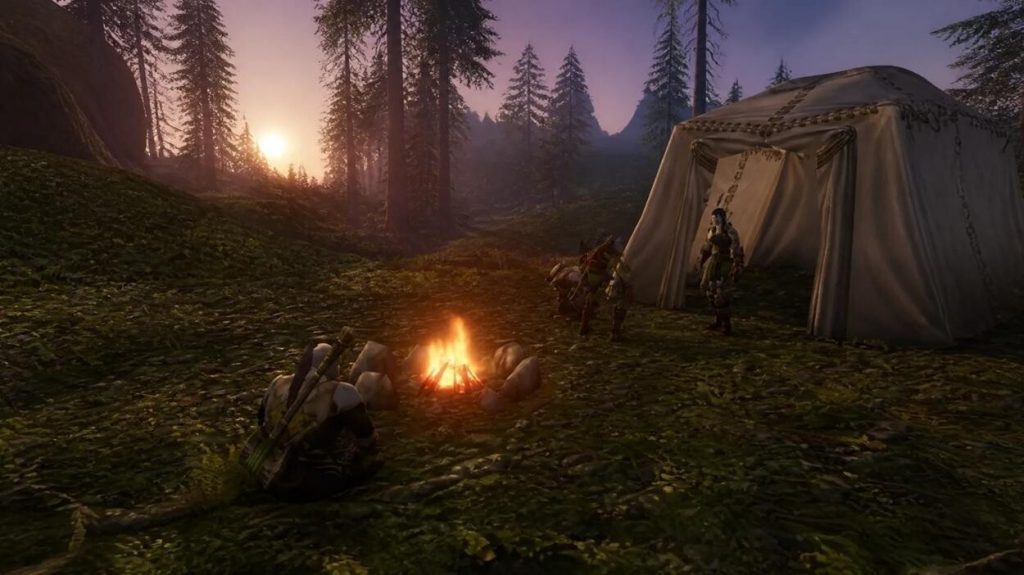
World of Warcraft: Forever is changing Azeroth’s landscape by moving away from hard mechanics and introducing the Legacy System. The most exciting features added in the game are the Camping System. It is designed to turn the quiet moments between monster pulls and quests into a highly valuable stop. The Camping mechanic changes the old Cooking Fire and turns it into a new gameplay system. Instead of just being a tool to cook raw meat, the campfire is now the foundation of a shared, resting hub that gives powerful one-hour buffs, equipment repairs, access to vendors, and advanced crafting workstations.
This guide shows a big picture of how campfires work, the new rules of campsite buffs, and the detailed tiers of profession-based objects that make every stop a big boost to our adventure.
Campfires: Foundation of Camping
The heart of the new system is the Basic Campfire, which is used by anyone who has learned the Cooking profession and has the necessary Simple Wood, Flint, and Tinder. Once the campfire is placed in the outdoor world, the Basic Campfire creates a temporary campsite. To get the benefits of a campsite, we must physically stop and interact with the environment. We cannot simply run past a campfire to receive its benefits. Characters must sit near the fire or take part in crafting for sixty seconds to become fully rested.
When we get that one minute of rest, the small buff timer disappears, and the player is rewarded with a full one-hour buff duration of all the buffs related to the objects placed at the camp. Groups can coordinate their buffs, rest up, and then carry those powerful enhancements into dungeons or questing areas.
The Tier System
The basic Campfire, which is the entry-level Tier 1 version, can hold up to three campsite objects at once and has 1 cooking skill. It is designed to make camps a group effort rather than something one player can build alone, since each player can only add one camping feature to any given campsite every hour. That means a well-stocked camp needs several players contributing their own profession objects.
Cooking is what unlocks the upgraded version of campfire tiers, which increases how many objects a single campsite can support. The second tier, which is the Journeyman Campfire, has an object slot size of 5 and 90 cooking skill. And by the time we reach the third tier, the Expert Campfire, the object slot size increases to 10, with 200 cooking skill.
This tier system clearly signals that camping is not a solo activity, but a group activity that is not only limited to leveling up. Strong objects can be placed above weak ones already in the campsite’s slots, allowing the camp’s quality to improve with time. Players who gather a large amount of WoW Forever Gold might feel they can skip the difficulties of leveling up by simply purchasing the best gear and weapons from the auction house, but completely ignoring the Camping system is a massive mistake. The buffs provided by these camping stops increase with time and give utility that plain stats and gear cannot give. This makes campsites and the professional objects equally important.
Profession Object Tiers
Every primary and secondary profession in World of Warcraft: Forever has three tiers of camping objects. The Tier 1 objects are learned at a skill level of 20 from a camping NPC or profession trainer. Tier 2 objects become available at skill level 140, giving us advanced utility or crafting stations. Tier 3 objects require a skill level of 200 and often require having blueprint recipes that drop from specific high-level dungeon bosses.
At Tier 2 and Tier 3, players need reagents; those who lack Legacy perks that reduce the material costs will find constructing the advanced workstations expensive, so many players buy WoW Forever Gold to have proper financial support to supply the group with the required reagents during high-level zones. For every profession, three camp objects are unlocked with increasing tiers. Tier 1 objects give a stat buff, but tier 2 and tier 3 keep that buff and add a workspace or utility. The professions are: Alchemy, Blacksmithing, Engineering, Herbalism, Enchanting, Mining, Skinning, Leatherworking, Tailoring, Fishing, and First Aid.
As the skill level increases for each profession, different camp objects are unlocked. For example, for Alchemy, at tier 1, we can create a Mana Well; at tier 2, we get a Fermenter, and at tier 3, an Alchemy Laboratory is provided. Whereas for Blacksmithing, we get a Sharpening Wheel at Tier 1, a functional Anvil at Tier 2, and a Master Forge at Tier 3.

How the Buffs Work
An important mechanic of the Camping system is buffs. To get the buffs, we must stop and engage with the campfire. We get the buffs from the camp objects from the professions. Campsite buffs are designed not to stack with their equivalent class buffs. We can’t get two buffs similar in effect at once.
For example, a Tailor can place a Faction Banner that increases Spirit, but this will not stack with a Priest’s Divine Spirit. Similarly, the First Aid Kit provides a Stamina buff that is completely useless if we have Power Word: Fortitude active, and the Incense Candle of Herbalist will also not stack with a Mage’s Arcane Intellect. Hence, constructing a perfect campsite is not about just placing the highest-tier object, but properly filling the gaps in the class composition of the party.
The Legacy System
Camping is not an isolated part; it is connected to the new Legacy System of the game. It is a progression track where we earn Legacy Points from completing challenges and then spend them on permanent benefits. Many of the known Legacy benefits directly improve camping. Permanence increases the duration of the benefits we get from resting at a camp by 50 percent for every rank, which means a full rank can stretch that one-hour rank benefit buff even further. Field Guide reduces the cooldown on adding camp feature. It is useful for players who often switch campsites instead of picking one place. With the Reagent Economy, these three benefits make the camping system an important investment with the Legacy System.
Conclusion
Camping in WoW Forever is a real, cooperative system that changes how we interact with the world and with each other. It transforms the cooking system and makes it slow, strategic, and communicative. By understanding the cooldowns, buffs, and profession objects, we move a step ahead to complete the Legacy challenges and survive the dangers of Azeroth.