

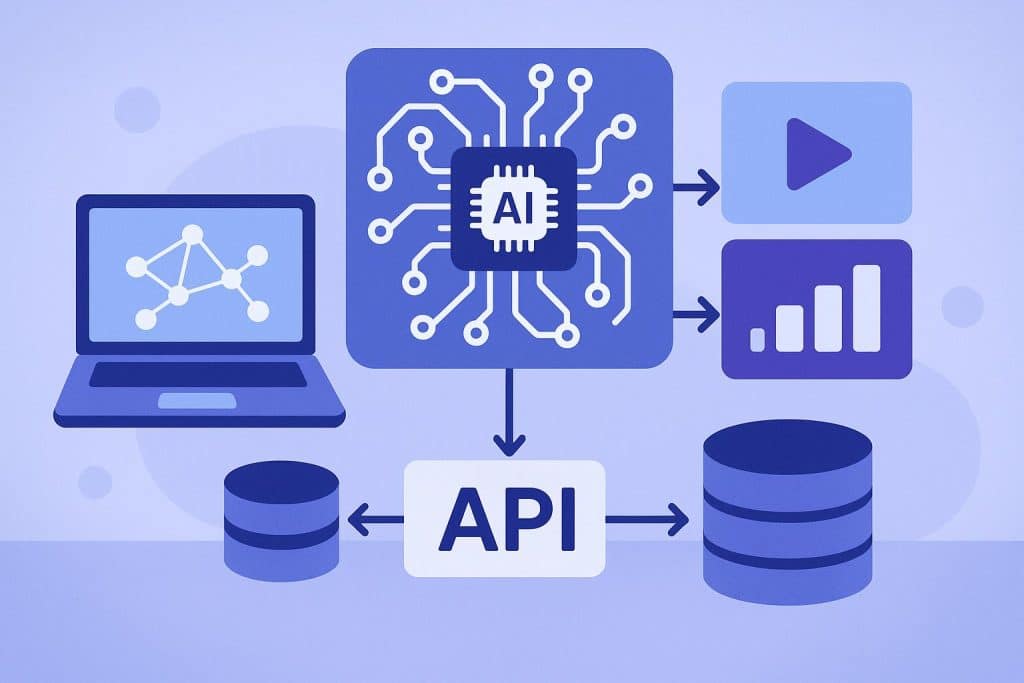
AI development has moved past experimenting with individual models. For most development teams, the harder part starts when an AI feature has to become part of a real application. A prototype might run on one text model, while the finished product needs image generation, video creation, speech processing, or several models covering different stages of the same workflow.
Handling all of that separately piles on engineering work nobody planned for. Every provider comes with its own authentication method, request structure, SDK, response format, usage limits and error-handling behavior. Add enough integrations and the infrastructure around the models starts demanding as much attention as the application itself.
Unified AI inference platforms exist for that reason. Rather than making developers build an independent integration for every model provider, they offer one common interface through which applications reach different AI capabilities.
What Is an AI Inference API?
An inference API sits between an application and an artificial intelligence model. Instead of hosting and running the model directly, a development team sends a request through the API and gets the model’s output back.
An application might send a text prompt to a language model and receive generated text. Image, video and audio generation work along the same lines. The catch is that each model category carries its own technical requirements, which is what makes multiple integrations difficult to maintain.
A unified inference API standardizes that interaction. Atlas Cloud is one example, providing access to more than 400 AI models covering text, image, video and audio generation through a single interface. Its API is designed to be compatible with the OpenAI API format, which cuts down the application-level work involved in adding AI capabilities.
For teams exploring modern generative video capabilities, models such as Seedance 2.5 can be accessed as part of this broader AI model ecosystem. The number of available models is not really the point for developers. What counts is being able to approach different models through one consistent development workflow.
Why Multiple AI Integrations Can Become Difficult
Several AI providers means a collection of small technical problems, and small problems add up over time.
Take authentication. Credentials for multiple services have to be stored and rotated. Request formats vary too. One provider expects a particular JSON structure, while another handles prompts, images or other inputs its own way.
Response handling is the next hurdle. Two models can perform comparable tasks and still return differently structured output, so the application needs extra logic to interpret and normalize what comes back.
Then there is the maintenance burden. When an application depends on several external APIs, a change at any one provider can ripple through application code, documentation, testing procedures and monitoring systems.
A unified interface does not make all of those engineering considerations disappear. It does cut the number of separate integrations a team has to keep alive.
A Common Interface for Different Model Types
Bringing multiple AI modalities into one development environment is among the more useful ideas behind platforms such as Atlas Cloud.
Text generation covers chatbots, document processing, summarization, coding assistants and other language-based features. Image generation feeds visual content workflows, product concepts, illustrations and creative applications. Video and audio models open up further possibilities, including automated media production and multimedia applications.
Those capabilities usually come from different models with different technical characteristics, so a development team often has to evaluate several options before settling on one for a particular feature.
A unified inference platform makes that evaluation more practical, because the application does not need an entirely separate provider integration each time the underlying model changes. Developers can concentrate on the behavior they need from a model instead of rebuilding the API infrastructure around it.
Model Choice Still Matters
A unified API does not mean every AI model behaves the same way. Model selection stays an important part of application design.
Models differ in strengths, input requirements, output formats, latency characteristics and how well they suit a particular workload. Something that generates short text nicely may be entirely wrong for a video-generation workflow.
Developers looking into modern generative video will also encounter models such as Wan 3.0. Understanding the characteristics of individual models still matters, even when a common API layer is what you use to reach them.
The split is worth holding onto: the unified interface simplifies integration, while model evaluation decides whether a given model actually fits the application’s requirements.
OpenAI-Compatible APIs and Developer Workflows
API compatibility also affects how fast a technical team can test an AI service.
Developers who already know the OpenAI API structure tend to slot a compatible interface into existing projects without much friction. API keys, requests, prompts and structured responses are familiar concepts that fit established development patterns.
Compatibility helps during experimentation as well. Teams usually want to compare models without redesigning an entire application around each provider, and a consistent interface keeps the application’s business logic separate from the specific AI model in use.
That separation pays off over the long run. Instead of scattering provider-specific assumptions throughout an application, developers build an abstraction around inference and change model configurations as requirements evolve.
Scaling AI Features Requires More Than a Model
Taking an AI feature from prototype into production brings its own list of concerns.
Reliability heads it. An application needs predictable handling for failed requests, temporary service problems, unexpected responses and other operational issues. Monitoring and logging matter just as much, because you need to see how AI requests behave under real workloads.
Scalability comes next. A successful application generates far more inference traffic than an early prototype ever did. The infrastructure around those requests has to absorb changing workloads without anyone manually managing every underlying model deployment.
A centralized inference layer gives you an architectural boundary between the application and external model infrastructure. The application talks to one API layer, and the inference platform handles access to the models sitting behind it.
Practical Considerations for Technical Teams
Judge any inference platform against what your particular application requires.
Model availability comes first. Work out whether the models and modalities you need are actually supported. API compatibility is second, along with how cleanly the service fits the existing technology stack.
Documentation deserves the same weight. Clear API references, examples, authentication guidance and error-handling information make a visible difference to development time.
Operational requirements round it out: reliability, scalability, observability, security practices, and how model changes are managed. These are easy to overlook during experimentation and hard to ignore once an AI feature is part of a production system.
The Role of Unified Inference in AI Development
AI development is turning into a matter of combining multiple models rather than relying on one system for every task. An application might use one model for language generation, another for images, and separate systems for video or audio.
That creates an architectural challenge: teams need access to a growing ecosystem of models without letting provider-specific complexity take over the application.
Unified inference APIs answer it by creating a common layer between applications and models. Atlas Cloud follows that approach, bringing more than 400 AI models across text, image, video and audio generation into a single OpenAI-compatible API environment.
The value for technical teams is architectural flexibility. More time goes into designing useful AI-powered features, less into maintaining a collection of unrelated integrations. Getting it right still depends on careful model selection, testing, monitoring, security and production engineering.
As AI models keep diversifying, reaching different capabilities through consistent technical interfaces will stay high on the list of considerations for teams building software around generative AI.