

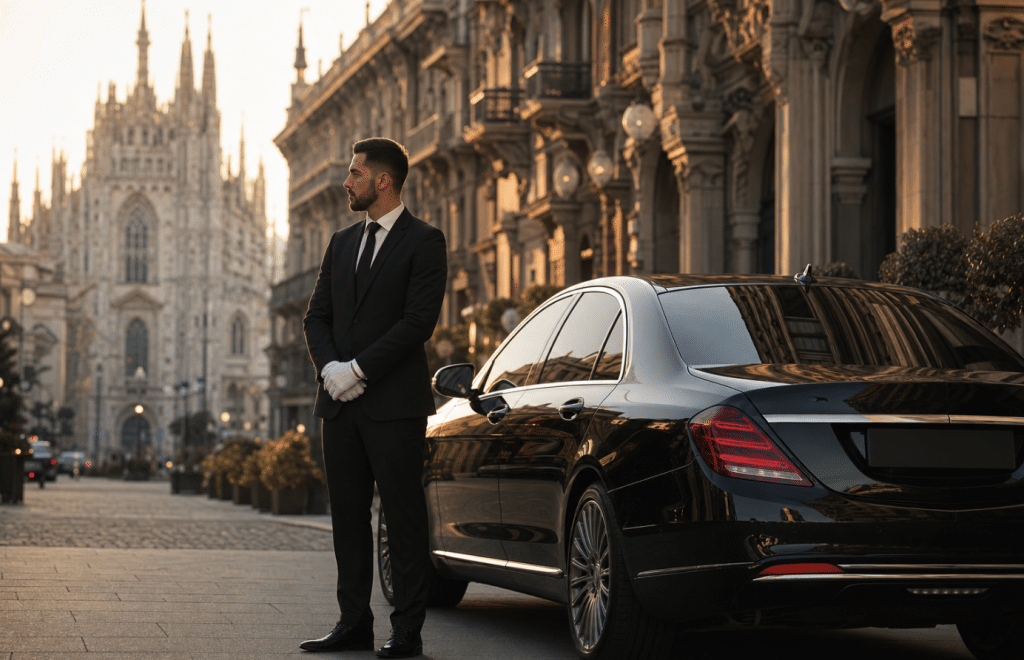
Should you book a chauffeur-driven car for your days in Milan, or just rely on taxis and an app? It depends on how complicated your schedule is. For a single short hop, a taxi is fine. For multi-stop business days, events with tight access windows, or arrivals with luggage and shifting flight times, a pre-booked private driver can buy back time. This guide explains when that trade-off makes sense, and what to confirm before you book.
If you’re deciding in 30 seconds
- Book a chauffeur if your day has several stops, fixed meetings that might overrun, an airport arrival with luggage, or an event with managed access and a late return.
- Skip it if you need one short ride with relaxed timing in an area where taxis or apps are easy to find.
- Ask before booking: what the price includes, the waiting and change policy, whether the vehicle is authorised to enter restricted zones near your destination, and what happens if a car becomes unavailable.
What car rental with chauffeur means in Milan
A chauffeur-driven car rental is a pre-booked, door-to-door transport service with a professional driver and a planned itinerary. In Italy it falls under a specific legal category: NCC, short for Noleggio con Conducente (hire with driver). Unlike a taxi, an NCC service is built around reservation rather than street pickups, with the trip agreed in advance. The framework comes from Italian Law No. 21 of 15 January 1992, which still governs Italy’s non-scheduled public transport—taxis and NCC alike.
The distinction is not bureaucratic trivia. It shapes how you book and where the driver can meet you. NCC is also a well-established segment in Italy: by one published estimate it accounts for far more licences nationally than the taxi sector, though figures like that should be read as a single explainer’s estimate rather than a hard count. What matters for a traveller is simpler. In a city where agendas shift during the day and venues often sit inside restricted zones, a pre-planned model creates room to adapt.
How it differs from a taxi
A taxi is built for spontaneity: you hail it or join a rank, the meter runs, and the relationship ends when you step out. That suits an unplanned single ride. It works less well when you need a vehicle to wait through a two-hour meeting, collect you at a side entrance, or string together four stops without renegotiating each leg. The defining feature of NCC is the booking model itself—reserved in advance and tied to an itinerary you set—rather than the chance availability of a passing cab. Exactly how waiting, multiple stops and pricing are handled can vary by operator, so it is worth confirming those terms directly.
How it differs from ride-hailing
Ride-hailing apps are strong on convenience. The relevant question for a complex day is whether a service can be reserved for a precise pickup window, hold position between stops, and follow a fixed sequence you defined beforehand—what a pre-booked NCC service is designed to do. So the test is not which is cheaper for one trip, but which matches the shape of your day. If you only need one quick ride and timing is loose, an app or a taxi may be all you need.
Where flexibility actually saves time in Milan
Flexibility sounds like a slogan until you map it onto a real day. Three scenarios show where it pays off.
Business days with moving agendas
A Milan business day rarely runs on rails. A meeting overruns, a client suggests lunch across town, an afternoon venue changes at the last minute. With a dedicated driver you can fold those changes into the plan instead of competing for a cab each time. The classic chain—hotel, office, client, restaurant, back to the airport—becomes a single arrangement rather than five separate problems. If your day includes an airport arrival, several meetings and an evening return, it helps to compare how different booking models handle hourly hire versus point-to-point legs; this overview of car rental with chauffeur in Milan is a useful starting point for understanding how those structures fit a schedule that is likely to shift.
Events and fashion or design weeks
During Salone del Mobile, Fashion Week and the major trade fairs, Milan’s mobility tightens sharply. Guests arrive in waves, windows are short, and venue access is tightly managed. Coordinated arrivals, staggered pickups and a planned late-night return are far easier with a driver who already has the address, the entrance and the contact name. Booking ahead matters here: for these peak periods, reserving well in advance is often what separates having a car from improvising.
Leisure travel with multiple stops
Visitors who want shopping districts, a museum, and a day trip toward Lake Como in the same visit lose a surprising amount of time to logistics: finding rides, handling luggage, waiting in queues. A chauffeur arrangement reduces that dead time, because the same vehicle stays with you across the day. If you are planning a multi-day route or a tour outside the city, ask the operator directly how multi-stop and multi-day bookings work, and how luggage is managed between stops, rather than assuming a standard policy.
The hidden constraints that complicate simple transfers
Milan’s transfers look easy on a map and behave differently on the road. Several constraints deserve attention.
Congestion and peak demand. Distance is a poor predictor of time here. A short crossing during rush hour can take longer than a longer route at midday, so building buffer time into pickups generally matters more than shaving kilometres.
Restricted traffic zones. Many Italian city centres use a ZTL, a Zona a Traffico Limitato, where vehicle access is limited to reduce pollution and protect pedestrian areas. Entrances and exits can be monitored by cameras that read plates and forward violations automatically; fines for unauthorised entry generally run from roughly €80 to €332, with a 30% discount for prompt payment within five days. Picture a concrete case: you land at Malpensa, your hotel sits inside a ZTL, and your first meeting is in another restricted street. Whether the car can drop you at the door, or leaves you a few hundred metres away at the nearest legal kerb, depends on the vehicle’s authorisation—so check that detail before you book.
Luggage and group size. Vehicle choice is a scheduling decision, not only a comfort one. Some Milan fleets, for example, list categories such as an executive sedan for up to three passengers with around two suitcases, a luxury van for groups of about seven, and a minibus for larger parties in the range of eight to sixteen. Treat those numbers as one operator’s listing rather than a universal rule—but the principle holds: three travellers with three large suitcases will not sit comfortably in a standard sedan, and discovering that at the kerb wastes the time you booked the car to save.
Airport scale. Milan’s airports are busy. Malpensa alone exceeded 26 million passengers in 2023, with around 87% on international flights; Bergamo handled 4.8 million passengers across June to August 2025. High volumes can translate into variability at arrivals, so ask about the waiting policy and whether flight status is monitored before you book an airport pickup.
Designing a flexible itinerary for multi-stop days
Flexibility is mostly a function of good briefing. Start by separating fixed appointments from movable stops, so the driver knows what cannot slip. Then build realistic pickup windows with contingency time rather than back-to-back optimism.
Share the essentials up front: flight or train numbers, the exact hotel entrance, an on-site contact for each meeting, any language needs, and whether child seats are required. Decide early between a one-way structure and hourly hire, and ask which model gives clearer cost control for a day that wanders. Other useful questions are whether you receive a direct contact for the driver before pickup, how early the car aims to arrive at each stop, and how mid-day changes get confirmed—worth establishing in advance, since these terms differ between operators. Finally, agree communication rules: who is authorised to change the plan, the preferred channel, and how each change is confirmed.
Corporate transfers: what travel managers should ask for
For finance and travel teams, the value is operational, not glamorous. Treat the booking as due diligence. Does the operator provide invoice-ready documentation with proper VAT details? Can billing be consolidated across several trips or tagged to a cost centre? Set clear service-level expectations too: punctuality, meet-and-greet at arrivals, discretion, and a presentable driver.
It is also fair to ask how passenger details and itineraries are handled, since corporate travel often involves sensitive movements, and to ask what happens if a vehicle becomes unavailable. Where operators advertise round-the-clock availability, English-speaking licensed drivers, or recently renewed fleets, treat those as claims to verify against your own requirements—confirm them in writing rather than taking them at face value.
Event mobility without overplanning
Moving people smoothly through an event comes down to a handful of details: multiple entrances, side pickups, and tight time windows. Staggered pickups prevent bottlenecks; VIP arrivals need a clean handover; queues need managing. A single mobility contact, fed real-time updates, beats a dozen separate threads. Waiting and re-positioning policies matter most during long events, so ask how a provider handles a driver holding position or circling back. Post-event departures are the classic pressure point, when everyone leaves at once, and a pre-booked car removes much of the scramble.
A practical checklist for choosing a provider
- Pricing. Ask what is included—tolls, parking, fuel, waiting—and what triggers extra charges. Some operators publish a fixed all-in price; others bill extras separately. Get the answer in writing before you book.
- Change and cancellation terms. Flexibility is defined by these clauses, not by marketing language. Read them before you commit.
- Vehicle fit. Match passengers and luggage honestly: a sedan for a couple of travellers with light bags, a van for a group of around seven, a minibus for larger parties. Ask the operator to confirm the exact capacity of the category you are booking.
- Waiting and flight monitoring. For airport pickups, ask whether wait time is included, how long the free window lasts, and whether the operator tracks your flight. These policies vary, and the details matter on a delayed arrival.
- Driver standards. Ask about language, valid licensing, local knowledge and discretion rather than assuming them—they all affect how smoothly a complex day runs.
- Reliability. Confirm support hours, the confirmation process, and what happens if a car or driver becomes unavailable.
- Legitimacy. A genuine NCC operation has clear company details and valid licensing. It is a basic check, not legal advice.
When a chauffeur is the right call, and when it isn’t
The honest framework is cost versus time saved versus stress removed. A chauffeur-driven rental is the strong choice for multi-stop agendas, premium service expectations, events, and arrivals with luggage or tight connections. It can be overkill for a single short ride with relaxed timing in an area where taxis are easy to find. Decide on the shape of your day, not on the headline price of one leg.
Flexibility, ultimately, is the product of three concrete things: planning, written policies, and reliable dispatch. Brief your provider properly, compare offers on terms rather than on the cheapest quote, and the car becomes part of the schedule instead of a variable you have to manage. Milan has specialised NCC operators built for corporate travel, events and tailored itineraries; the work that makes the difference happens before the engine starts.