

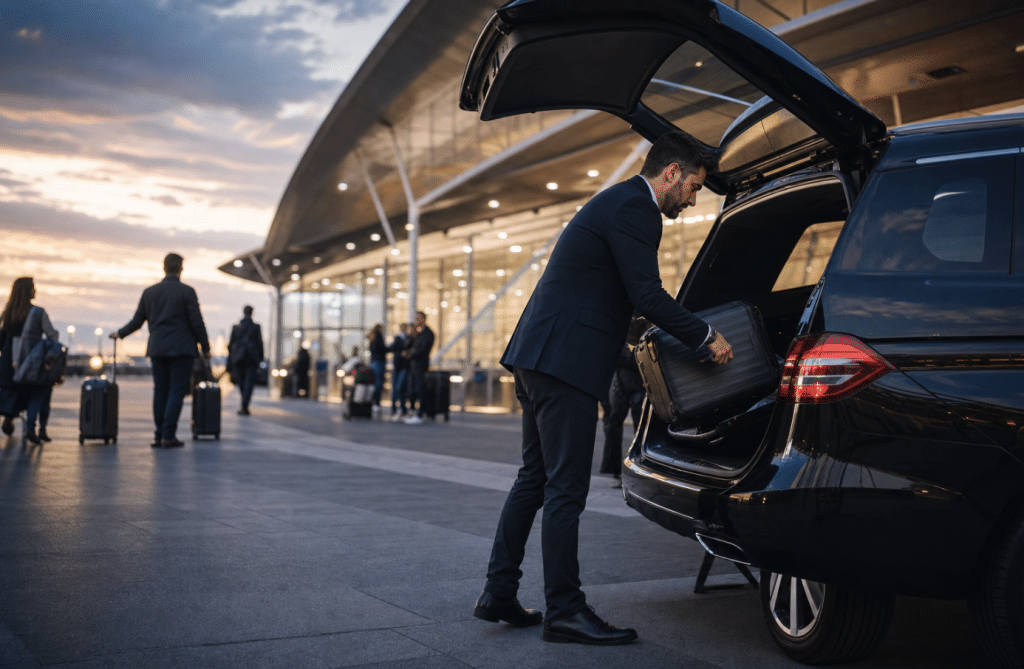
Is there Uber at Turin Airport, and is it the smartest way into the city? Yes—Uber operates at Turin-Caselle (TRN): you can request a pickup through the app and schedule one in advance with Uber Reserve up to 90 days ahead. But ride-hailing is one option among several, and for luggage-heavy or time-sensitive arrivals it is not automatically the lowest-friction choice.
Here is the short version before the detail. Uber is available at TRN, with vehicle options that include Black for one to four passengers and Van for up to six, and you can also request a taxi through the app around the clock. Scheduled buses run on fixed timetables with published fares. A pre-booked private car tends to suit heavier loads and tighter schedules. The right pick depends on your group, your bags, and the hour you land.
This guide treats ground transport in Turin as a planning problem rather than a comfort upgrade: matching the vehicle to your bags and group, choosing a sensible pickup point in a city with restricted central streets, and building enough buffer for the parts of the trip you cannot control. The aim is fewer unknowns between the door of the plane and the door of your accommodation.
Getting from Turin Airport to the city: the options at a glance
Turin Airport sits roughly 16 kilometres north of the centre and has a single terminal, which keeps the arrival arithmetic simple. Before deciding how to travel, it helps to see the realistic choices side by side.
- Scheduled bus (ARRIVA Italia): runs every day of the year, with departures every 15 to 30 minutes, a journey time of 45 to 50 minutes to the city centre, and a one-way fare of €7.50 (plus €1.00 if bought on board). A sensible pick for solo travellers with light luggage and no fixed deadline.
- Direct bus (Flibco): operates every day from 3:45 a.m. until midnight, every 30 minutes, covering the route in about 30 minutes. A faster public option when its hours line up with your flight.
- Uber: available at TRN, with ride options including Black (1–4 passengers) and Van (1–6 passengers); you can schedule a pickup with Uber Reserve up to 90 days in advance, and taxi requests are available 24/7 in the app. Availability can vary by time and location.
- Private shuttle: pre-booked, point-to-point, door-to-door, with the car reserved for you alone. Often chosen by groups, travellers with heavy or oversized luggage, families, and anyone heading to a central address.
What a private shuttle means in Turin (and what it doesn’t)
The phrase gets used loosely, so it helps to be precise. A private shuttle is a pre-booked, point-to-point transfer reserved for you or your group. It is not a shared shuttle, where you wait for and ride alongside strangers; not a taxi taken from a rank on arrival; and not a self-drive car rental. In Italy you may see this kind of service described as NCC—noleggio con conducente, chauffeur-driven hire. If your route or timing is genuinely awkward, you might pre-book a Turin private shuttle with a local operator so that the pickup, the meeting and the price are settled before you arrive rather than negotiated on the spot.
The practical difference for a visitor is about certainty, and how much of it you want to lock down in advance. Some pre-booked services advertise fixed rates based on distance with no hidden fees, and several will track your flight and adjust the pickup at no extra charge when you provide the flight details. Those are operator policies, not universal guarantees—so they are worth confirming for the specific service you choose, rather than assuming they apply across the board.
Typical use cases fall into four groups: arrivals from the airport or a train station to your address; departures in reverse; point-to-point hops within or beyond the city; and hourly hire, where the car and driver stay with you across several stops.
Arrivals: reaching your address with fewer unknowns
The single terminal at TRN keeps the meeting logic clean, but the variability tends to be on your side of the equation: flights can slip, and baggage can take time to appear. A useful planning heuristic is to remove as many of these unknowns as you can before you fly—particularly the part where you arrive tired and have to improvise transport.
Whatever you choose, treat the meeting moment as the thing to confirm in advance. With ride-hailing, the pickup is arranged through the app once you are on the ground. With a pre-booked transfer, the meeting arrangement is set when you book; many reputable operators advertise a meet-and-greet, often with a driver waiting in arrivals holding a sign with your name, plus some form of flight monitoring. Because these details vary by operator, agree exactly where the driver will meet you and how you will identify each other—and get that in your confirmation.
Arriving by train follows the same logic. Pick your drop-off by where you are actually sleeping or meeting, not by which fare looked cheapest, because a poorly chosen station can add a cross-city leg you did not budget for. A door-to-door transfer removes that last-mile guesswork.
Luggage and group size: choose capacity before comfort
As a planning rule rather than a claim about Turin demand, capacity is a safety and comfort decision, not a vanity one. A sedan comfortably handles one to four passengers with normal bags. Add a fourth adult plus full suitcases, or oversized luggage such as skis, and a larger vehicle makes more sense. For reference, Uber lists its Van option at TRN at one to six passengers, so a single larger car can keep a group together. Booking a vehicle that fits on headcount but not on luggage is the most common self-inflicted problem—people end up with bags on laps or a second car trailing behind.
Families should flag child seats and boosters when they book. Many operators offer them on request, but availability is rarely guaranteed on the spot, so confirm the requirement in writing and state the child’s age or seat type. Ask, and get it in the confirmation.
Departures: a buffer that matches Turin’s real conditions
Plan departures backwards from the moment you need to be airside or on the platform. Work back through check-in, security, the drive itself, and the access conditions at your pickup address. The hidden risk is rarely the motorway—it is the first and last few hundred metres.
Timing matters most at the edges of the day. The direct Flibco bus runs from 3:45 a.m. until midnight, every 30 minutes, with a journey of about 30 minutes; the scheduled ARRIVA Italia service runs all year with a 45-to-50-minute journey. For a flight before the direct service starts, or anything outside those windows with heavy bags, a pre-booked car removes the question of whether anything is running at all.
For hotel or apartment pickups, set a precise point. Share the exact address, a nearby entrance or corner a car can reach, and a phone number. Five minutes of clarity at booking saves real confusion at 5 a.m.
Local travel: when a shuttle beats trams and taxis
Inside the city, walking and trams win for short, central hops. A shuttle earns its place on awkward routes: a hillside restaurant in the Collina, a business park on the outskirts, a venue across the river, or a multi-stop day that would otherwise mean repeated waits and parking searches. Hourly hire can keep a museum-to-lunch-to-meeting itinerary fluid, with the same vehicle staying with you—useful when the day has several legs and no slack.
Accessibility is part of the same calculation. If someone in your party has limited mobility, is carrying heavy gear, or is on a schedule with no room to spare, door-to-door service in a known vehicle can be worth more than a marginally cheaper fare.
The logic extends beyond the city. Some private transfer services quote about 2 hours 5 minutes door to door for the roughly 145-kilometre Milan–Turin route, and may include a waiting-time allowance; that appeals to groups arriving at a Milan hub but staying in Turin, where one vehicle keeps everyone together against the simplicity of the train.
The Turin constraint travellers don’t anticipate
One local factor catches many visitors off guard: the ZTL, the limited traffic zone covering the central core. Turin’s central ZTL is active Monday to Friday from 7:30 to 10:30, and the same zone also carries environmental restrictions on certain vehicles. If your hotel sits inside that area, it is worth planning your pickup or drop-off around those hours rather than discovering the restriction on the day. Asking your driver or operator how they handle the central zone is a fair question to put before you book.
Destinations in the hills and surrounding valleys add a quieter cost: parking and navigation. A drive that looks short on the map can absorb extra time once you factor in finding and paying for parking. For those trips, having a driver who simply drops you and moves on is part of the appeal of a pre-arranged car.
A booking checklist so you get the service you think you booked
Before you confirm, supply the essentials and ask the questions that protect you. Treat the second list as questions only—policies differ by operator, so do not assume any of them is standard.
- Provide: exact pickup and drop-off addresses, flight or train number, passenger count, total luggage including oversized items like skis or strollers, and any child-seat needs.
- Confirm: the meeting point and how the driver will identify you, any waiting time included, language support, accepted payment methods, and a proper receipt if you are travelling for business.
- Ask about: whether the quoted price is final or variable; whether tolls and parking are part of it; how the operator handles a delayed flight, and whether any extra charge can apply; and what the cancellation and change terms are, and how close to pickup they apply.
These points matter precisely because they vary from one service to another. Some operators publish fixed rates with no hidden fees, some include flight monitoring and waiting time, and some offer free cancellation up to 24 hours before pickup—but none of that is guaranteed everywhere. Read the terms for the specific service you are booking, and look for the basics of a properly run hire: a licensed, insured vehicle and clear identification at the meeting point, both of which many reputable operators advertise.
Cost and value without the false savings
Compare on total cost, not the headline fare. The cheapest line item can become the most expensive outcome once you add a missed connection, a second vehicle for overflowing luggage, or parking fees. Ride-hailing and taxis can be excellent for spontaneous, light-luggage trips; a private shuttle tends to justify its premium when timing is critical or the load is heavy.
For groups and families the maths often shifts. Split across four or six people with bags, a single van can compete with multiple taxis or per-person fares while keeping everyone together. What you want from any quote is transparency: a price agreed in advance, clarity on whether tolls and parking are included, and no vague extras waiting at the end of the ride.
Signals of a well-run operator
Judge a provider by how it communicates. A prompt confirmation, a reachable contact channel, and clear coordination on the day are the best predictors of a smooth pickup. Beyond that, look for a fleet matched to your needs, drivers who share a language with you and meet you with a clear means of identification, and genuine local knowledge—of routing, of central-zone access hours, and of how the city moves around its busier dates. Give whichever service you choose the details on the checklist above, and the part of the trip that usually generates the most anxiety becomes the part you stop thinking about.
Quick answers for arriving travellers
Is there Uber at Turin Airport?
Yes. Uber operates at Turin-Caselle (TRN): you can request a pickup through the app, schedule one in advance with Uber Reserve up to 90 days ahead, and request a taxi through the app around the clock. Ride options include Black (1–4 passengers) and Van (1–6 passengers), with availability varying by time and location.
How far is Turin Airport from the city centre?
Turin Airport is about 16 kilometres north of the city and has a single terminal, which keeps arrival logistics straightforward.
What time do the airport buses run?
The direct Flibco service runs every day from 3:45 a.m. until midnight, every 30 minutes, with a journey of about 30 minutes. The scheduled ARRIVA Italia bus runs every day of the year, every 15 to 30 minutes, taking 45 to 50 minutes, at €7.50 one way (plus €1.00 on board).
Can a transfer drop me inside Turin’s ZTL?
Turin’s central ZTL is active Monday to Friday from 7:30 to 10:30 and also restricts certain vehicles on environmental grounds. If your accommodation is inside the zone, plan your pickup or drop-off around those hours and confirm with your operator how they handle restricted-area access.
Do private transfers provide child seats?
Many operators offer child seats and boosters on request, but availability is not guaranteed on the spot. Specify the child’s age or seat type when you book and confirm it in writing.