

![Image 1 of The 7 Best HR Software for UK Mid-Market Companies[a]](https://www.soup.io/wp-content/uploads/2026/05/image_1-4-1024x448.png "The 7 Best HR Software for UK Mid-Market Companies")
If you go back long enough in HR, you should remember the days when spreadsheets ruled HR departments, and they couldn’t even be shared. As we outgrew that era, mid-market companies in the UK quickly found themselves in a tricky spot. On the one hand, growth and expansion were the obvious goals. On the other, scaling in the UK meant taking on all new kinds of administrative regulatory burdens.
For local HR teams, those burdens can be crushing if you’re not well-equipped to deal with their modern requirements. Labor laws dictate everything from conflict resolution to payroll compliance, and that’s without adding the unholy maze of regulations that UK tax compliance comes with.
Enter HR software solutions that are aimed at mid-market companies in the UK. These systems, when done right, are designed to handle everyday HR needs from every conceivable angle. However, what makes them true lifesavers are the fact that the best ones cater to scaling too. The only drawback is that there are so many of them now, it can be tricky selecting the right one.
As old-school HR professionals who now nerd out by testing HR software for UK business needs, we put together a guide that should make choosing easier. The goal and criteria was simple: test the best HR software platforms available in 2026 in every way that counts and rank them accordingly.
In the end, seven of them stood out. Before we dive into them and why they made the cut, we first have to understand why HR software can be such a lifeline for mid-market UK companies in 2026.
Why do mid-market companies need specialised software in the UK?
Scaling a business adds complexity, especially in the UK. Once a team grows past a certain size, manual tracking quickly becomes a risk. Mid-market companies face stricter requirements, from regulatory tax and wage rules to right to work checks. Staying on top of it all can be a pain and takes time.
The right HR software eases these burdens considerably. The best ones handle routine HR tasks while keeping things organised. In this way, they actually give leaders a clearer view of their workforce. Without it, mistakes creep in, and the employee experience often suffers.
Criteria for ranking the best HR software UK mid-market tools
| Evaluation Area | What We Looked For | Why It Matters for Mid-Market Companies |
| Core functionality | Compensation handling, talent tracking, and benefits management | These are the basics that must work smoothly as teams grow |
| Scalability and localisation | Support for multi-country teams and local regulations | Important for companies expanding across borders, especially with UK and international rules |
| User experience | Ease of use and implementation time | Teams adopt systems faster when they are simple and intuitive |
| Customer support | Quality and responsiveness of technical support | Reliable support reduces downtime and frustration |
| User feedback | Reviews from mid-sized companies on platforms like G2 and Capterra | Real user experiences highlight strengths and common issues |
| Pricing structure | Clear, transparent costs without hidden fees | Helps businesses plan and avoid unexpected expenses |
Now that we know the how, let’s look at the who. These HR software providers were evaluated and found to be the best solutions for mid-market businesses in the UK.
1. HiBob
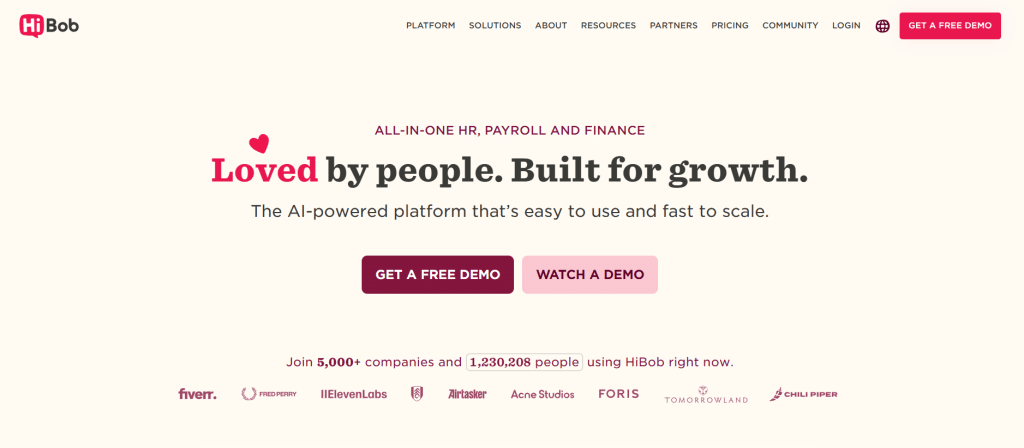
Securing the leading position, HiBob delivers a comprehensive application that consolidates compensation, talent tracking, staff planning, and culture building tools into one smart and simple solution. Unlike traditional systems that focus solely on administrative efficiency, this application balances operational needs with a strong focus on staff retention.
It offers deep localisation for global teams, making it easy to manage multi-country compensation connections and cultural customisations. It handles local regulatory requirements effortlessly, ensuring that right to work checks and tax codes are managed correctly.
Their smart automation features are designed to empower leaders by surfacing insights and automating routine tasks, rather than replacing human decision making. Importantly, the application maintains strict data privacy, with zero data retention by machine learning vendors.
The good: It hits the mid-tier sweet spot perfectly. The deep localisation supports global and multi-site operations effortlessly. The intuitive user experience drives high adoption rates across the company, and the smart automation features genuinely reduce manual work.
The bad: The comprehensive feature set is incredibly robust, which means it may require a dedicated administrator to fully utilise all of its capabilities.
The bottom line: It is the premier choice for mid-sized and multinational organisations looking for a flexible, secure, and engaging application to manage their growing workforce.
2. Rippling
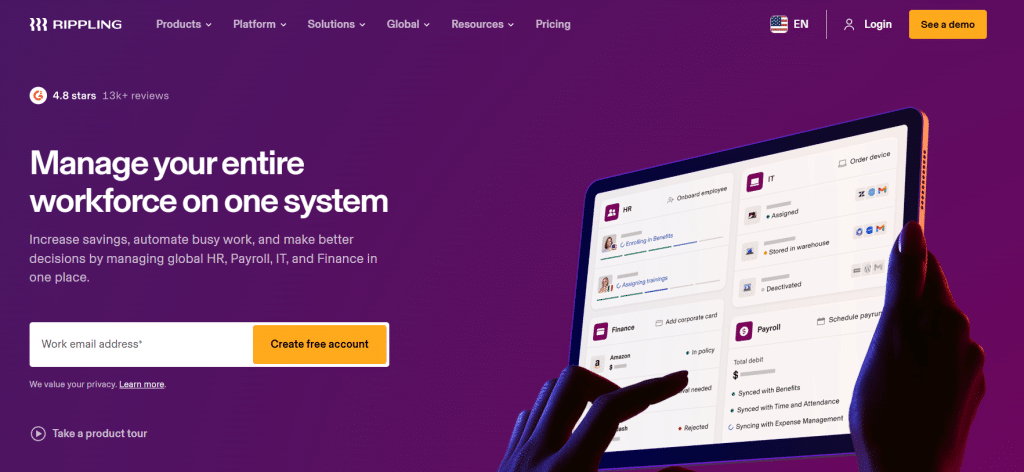
This provider merges device administration with employee databases. Rippling allows companies to manage employee laptops, software access, and compensation from a single dashboard. You can read more about user experiences on Rippling on G2.
While the automation capabilities are strong, the application’s broad scope can be a significant drawback for mid-market companies. Users frequently report that the interface is complex and overwhelming, requiring a steep learning curve. Technical support is another common issue, with reliance on scheduled support and automated chat bots causing frustrating delays.
The good: It provides strong workflow automation for onboarding and offboarding, and it centralises data across multiple business functions effectively.
The bad: The interface is difficult to navigate and overwhelming for new users. Live technical support is inconsistent, and the pricing lacks transparency due to numerous add on modules.
The bottom line: It works well for companies with strong technical administrators who want to tightly integrate their information technology provisioning with their workforce operations.
3. Personio
Focusing heavily on applicant tracking, absence logging, and digital personnel files, this continental provider has gained significant traction. Customer feedback is available on Personio on Capterra.
Despite its popularity, the application has limitations that affect mid-market companies. The pricing structure requires a sales consultation and scales with headcount and add on applications, making it difficult to compare costs upfront. Users find the staff appraisal tools to be overly rigid, which does not suit agile teams.
The good: It offers strong document management and regulatory tracking, providing good core features for European businesses.
The bad: Pricing is opaque and scales quickly with add ons. The appraisal cycles are inflexible, and compensation depth varies significantly by country.
The bottom line: It is a solid option for mid-market European businesses that need structured regulatory tools and operate primarily within a single country.
4. Ciphr
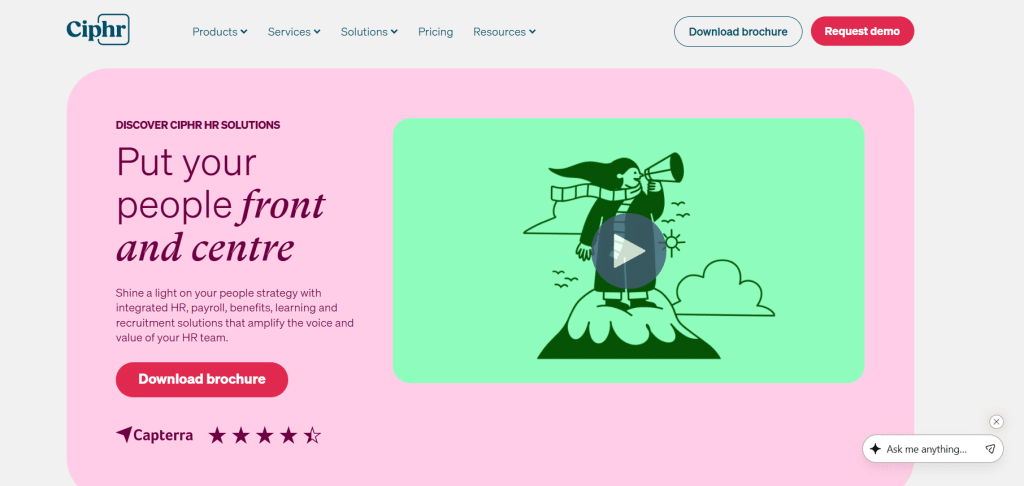
As a domestic provider, Ciphr targets mid-sized and enterprise organisations in Britain. It offers a range of modules covering core administration, compensation, and learning management. You can find user reviews on Ciphr on G2.
Because of its UK-native heritage, it handles regional regulatory rules very well. However, users frequently complain that the user interface feels incredibly dated and clunky compared to modern alternatives. The system is highly complex to configure, and the reporting tools are often described as unintuitive. It lacks the modern culture building features that today’s workforce expects.
The good: It provides strong local regulatory features and connects well with local compensation providers.
The bad: The user interface is outdated and clunky. Configuration is highly complex, and it lacks modern staff engagement tools.
The bottom line: It is an option for traditional companies that prioritise strict local regulatory adherence over a modern, engaging user experience.
5. BambooHR
Famous for its panda logo and small business focus, BambooHR provides a straightforward interface for tracking time off and staff records. You can view customer opinions on BambooHR on Capterra.
While it serves small domestic teams well, it struggles to meet the needs of scaling mid-market organisations. The application lacks the advanced customisation required for complex workflows. Users frequently note that the reporting capabilities are limited, making it difficult to extract granular insights.
The good: It has a very simple and clean user interface with good basic tools for tracking time off.
The bad: It has limited scalability for mid-sized and multinational companies. The rigid system architecture limits workflow customisation, and it provides inadequate compensation support for international staff.
The bottom line: It is best suited for small businesses with entirely domestic teams looking for a basic digital filing system.
6. Sage HR
Offering a piecemeal purchasing model, Sage HR allows businesses to pick and choose specific features, such as shift scheduling and staff appraisals. User reviews are available on Sage HR on G2.
The modular approach provides initial flexibility but often leads to unpredictable costs as a mid-market business grows. Users report that the interface is not intuitive, which hinders adoption across the team. The application also lacks a native compensation solution, forcing companies to rely on external connections.
The good: It gives companies the ability to purchase only specific modules and provides reliable tools for managing staff absences.
The bad: Costs escalate quickly when adding multiple modules. Navigation and setup can be confusing for new users, and it requires third party software for compensation processing.
The bottom line: It is a fit for small companies that only need to solve one specific problem, such as leave management, and have a separate system for compensation.
7. ADP Workforce Now
A titan in the compensation processing industry, ADP attempts to offer a full suite of workforce tools through its Workforce Now platform. It is highly reliable for processing complex compensation across different tax jurisdictions.
However, the workforce features often feel bolted on rather than seamlessly integrated. Users frequently complain about the clunky, outdated interface that makes simple tasks take longer than necessary. Technical support is notoriously slow, with users often waiting days for a resolution to critical issues.
The good: It provides extremely reliable and compliant compensation processing and handles complex tax situations very well.
The bad: The user interface is clunky and outdated. Technical support is notoriously slow to respond, and the system is very rigid with limited customisation options.
The bottom line: It is an option for companies whose primary concern is complex compensation processing and are willing to compromise on the user experience.
A quick wrap-up of the best HR software provider for mid-market companies
Choosing the right system matters as your business grows. The best HR software UK mid-market providers strike a balance between strong features and ease of use. You need something your team can rely on every day without it slowing them down.
For us, HiBob stands out as the clear winner. Their HR software combines practical functionality with a clean user experience that actually makes a real difference in day to day work. It handles core HR tasks well, supports growing teams, and adapts as the business expands.
By leveraging AI in ways that are practically useful, automation and added insights also makes life far easier for modern HR managers. In the UK, where regulations and their accompanying admin burdens can be crushing, HiBob has found a way to deliver HR software that is both effective and suited to scaling mid-market companies in the UK and beyond.
FAQs about the best HR software UK mid-market options
What defines the best HR software UK mid-market companies can use?
The top applications for this sector consolidate core functions like compensation, talent tracking, and staff appraisals into a single system. A comprehensive solution like HiBob ensures that all your people data is centralised, which reduces errors and supports scaling operations. It also provides the flexibility needed to adapt to changing business structures without requiring heavy technical intervention.
Why is localisation important for mid-market businesses?
As mid-market companies grow, they often expand internationally and hire talent across borders. Your software must handle different cultural norms, regulatory rules, and multi-country compensation connections to ensure smooth operations. Without these features, you will struggle to manage a global workforce effectively and remain compliant with local laws.
How do artificial intelligence features benefit mid-market teams?
Smart automation handles routine tasks and surfaces valuable insights from your workforce data. The best implementations empower leaders by suggesting constructive feedback or summarising meeting notes quickly. This technology keeps humans in control of the final decisions while significantly reducing the administrative burden on your team.
Should a mid-market company buy enterprise software?
While mid-market companies can purchase enterprise software, they often find it too complex, slow, and rigid for their needs. It is usually much better to select an application specifically designed for scaling mid-market businesses. This ensures a better user experience, faster implementation times, and a system that actually fits your agile workflows.
How can a new platform improve employee retention?
A modern application improves retention by providing a seamless and engaging staff experience from day one. Features like peer recognition, transparent goal tracking, and easy access to benefits make staff feel valued and supported. When administrative friction is removed, staff can focus on their actual work and career development.