

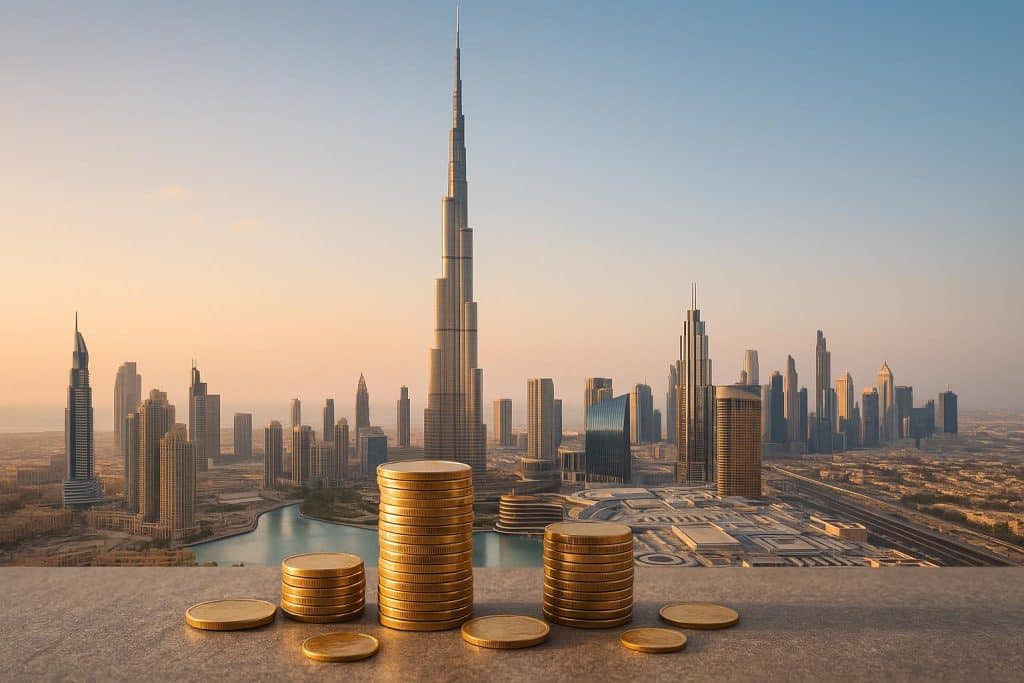
Ultra-high-net-worth individuals are increasingly selecting the UAE not simply because it is fashionable, but because it has become one of the few jurisdictions where tax efficiency, residency, security, mobility, and lifestyle now work together in a coherent way. The obvious headline is still powerful: the UAE currently has no personal income tax, and PwC’s latest summaries also show no individual capital gains tax, no inheritance tax, no gift tax, and no net wealth tax for individuals. For globally mobile families and principals, that is not a cosmetic advantage. It changes the economics of living, investing, and planning for the next generation.
But the tax story, while real, is only the surface. Wealth does not move in meaningful size for one reason alone. It moves when several forms of friction begin to disappear at the same time. The ultra wealthy are not only looking for lower tax. They are looking for a jurisdiction that feels stable, administratively clear, family-friendly, globally connected, and capable of supporting both private life and serious capital allocation. That is where the UAE has become unusually strong. Henley & Partners’ 2025 private wealth migration data projects the UAE to attract a net inflow of 9,800 millionaires, the highest in the world, while the UK is forecast to lose 16,500, the largest outflow globally.
That contrast tells you something important. The UAE is not just gaining from its own momentum. It is also benefiting from a growing sense that many older wealth centers are becoming less efficient for modern private capital. London still offers heritage and influence. New York still offers enormous scale. Switzerland still offers continuity. Singapore still offers precision. But affluent families are increasingly comparing those advantages against more layered tax burdens, higher transaction friction, and a broader sense that some legacy centers no longer make wealth planning easier. In that comparison, the UAE’s proposition can feel refreshingly direct.
Perhaps the best word for what the UAE gives the ultra wealthy is control. Control over tax exposure. Control over residency. Control over where a family office or holding structure can be based. Control over time zones and air access. Control over how children live, learn, and move through the world. This is why the UAE increasingly functions less like a destination and more like a platform. Families are not only relocating to Dubai or Abu Dhabi. They are using the country as a base from which to structure business, deploy capital, and build a more resilient long-term life. That is a much deeper shift than simple migration for convenience.
Residency is a major part of this appeal. In many countries, long-term residence still feels provisional, bureaucratic, or dependent on moving targets. The UAE’s Golden Visa changes that psychology. The official UAE government platform describes it as a long-term, renewable residence visa valid for 5 or 10 years, and specifically lists a 5-year route for real estate investment with a minimum capital requirement of AED 2 million. That matters because it turns property ownership into something larger than a lifestyle purchase. It can become part of a jurisdictional move, a family strategy, and a wealth-preservation framework all at once.
Safety is another reason the UAE continues to pull ahead. For ultra-wealthy families, safety is not a soft lifestyle benefit. It is a strategic variable. It affects how children are raised, how freely family members move, how principals travel, and how much friction exists in ordinary life. Numbeo’s current 2026 country rankings place the United Arab Emirates first globally for safety index, and its city rankings place Abu Dhabi and Dubai among the strongest city performers as well. Crowd-sourced rankings should always be read with some caution, but they reflect a broader and widely shared market perception: the UAE is seen as one of the safest places in the world to live and operate.
And safety, in practical terms, often means something even more valuable than prestige. It means lower noise. Lower noise in daily movement. Lower noise in administration. Lower noise in family life. Wealth tends to appreciate elegance, but what it values most, I think, is reliability. Families want the basics to work. They want airports that connect, infrastructure that functions, and systems that do not turn everyday life into a negotiation. The UAE has become very good at projecting that sense of predictability, and predictability is a serious luxury when the world feels increasingly disorderly.
The national narrative is helping too. In November 2025, the UAE President declared 2026 the Year of the Family as part of the National Family Growth Agenda 2031. That is not a private wealth initiative in itself, obviously, but it reinforces a broader message that the country wants to position itself as stable, cohesive, and family-oriented. Affluent families notice those signals. They pay attention to the direction a country seems to be taking. And right now the UAE is signalling continuity, ambition, and long-term social confidence rather than fragmentation or fatigue.
Another important shift is that Dubai now offers more than lifestyle and tax efficiency. It offers a real private wealth ecosystem. DIFC’s 2025 annual results show that the centre is home to 1,289 family-related entities, while DIFC-based families have established 1,115 foundations. That is significant because ultra-wealth is never only about income or returns. It is about governance, succession, privacy, philanthropy, structuring, and the orderly transfer of capital across generations. A jurisdiction becomes much more attractive when it can support not just the first move, but the second and third chapter after it. Dubai increasingly can.
This institutional maturity is one reason Dubai real estate now feels different from older stereotypes about the market. According to the Dubai Media Office, the emirate recorded more than 270,000 real estate transactions worth AED 917 billion in 2025, the strongest performance on record. Whether one takes every official phrase at face value or not, those numbers point to something undeniable: scale, liquidity, and sustained investor confidence. For the ultra wealthy, that matters. A prime residential market is more compelling when it sits inside a wider ecosystem of wealth migration, residency pathways, and institutional capital. Dubai is no longer just a place to buy a luxury apartment. It is increasingly a place to anchor a portfolio, a family, or both.
That is also why the type of property matters. At the highest end of the market, buyers are not just purchasing square footage. They are purchasing setting, privacy, legibility, and long-term relevance. Waterfront districts tend to resonate because they are globally understood. A buyer from London, Geneva, Riyadh, Mumbai, or New York may not know every Dubai submarket in detail, but they understand coastline, marina access, views, and low-noise residential environments. The best luxury assets rarely need over-explanation. They communicate value immediately, and that universality matters to internationally mobile capital. This is one reason areas such as Dubai Islands increasingly fit the mindset of sophisticated buyers thinking in family and legacy terms, not just near-term speculation. That final point is an inference from the broader trends in wealth migration, residency, safety, and market depth outlined here.
In the end, the ultra wealthy are not selecting the UAE because it is trendy. Trend alone would never move this much serious capital. They are selecting it because it increasingly behaves like a coherent system. Tax efficiency aligns with residency. Residency aligns with family planning. Family planning aligns with safety. Safety aligns with real estate ownership. And real estate ownership aligns with long-term capital positioning. Very few jurisdictions currently bring all of that together with the same clarity. That is why the UAE is not merely attracting attention in 2026. It is attracting conviction.