

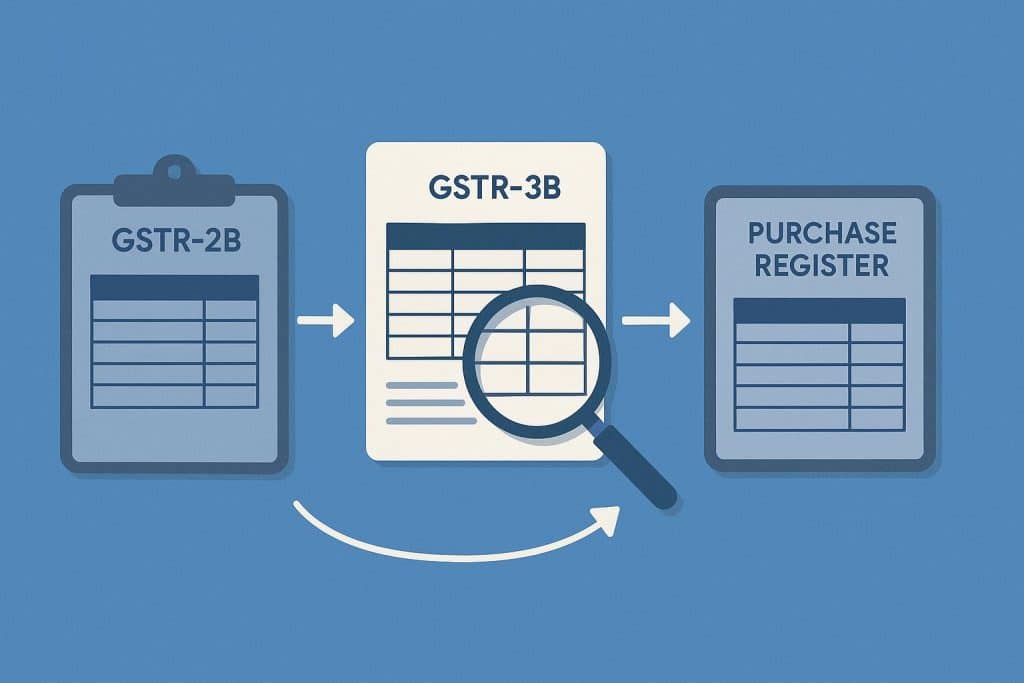
GST reconciliation is one of the most critical compliance activities for businesses registered under GST. Among all reconciliations, matching GSTR-2B, GSTR-3B, and the purchase register plays a key role in ensuring correct Input Tax Credit (ITC) claims, avoiding notices, and maintaining smooth cash flow.
With increased data analytics and scrutiny by tax authorities, mismatches between these records can quickly lead to ITC reversals, interest, penalties, and audits. This guide explains what these statements are, why reconciliation is important, common mismatches, and how businesses can reconcile them effectively.
Understanding GSTR-2B, GSTR-3B, and Purchase Register
Before reconciliation, it’s important to understand the role of each document.
GSTR-2B is a static auto-generated statement that reflects ITC available to a taxpayer based on supplier-filed returns (GSTR-1, GSTR-5, GSTR-6). It is generated monthly and does not change once issued.
GSTR-3B is a self-declared summary return where taxpayers report outward supplies, inward supplies, tax liability, and ITC claimed.
Purchase Register is an internal record maintained by the business containing details of all purchase invoices, debit notes, and credit notes.
Reconciliation ensures that ITC claimed in GSTR-3B is supported by supplier data in GSTR-2B and internal purchase records.
Why Reconciliation Is Critical Under GST
GST law allows ITC only when specific conditions are met, including that the supplier has uploaded the invoice and paid tax. Reconciliation helps businesses:
- Claim only eligible ITC
- Avoid excess or incorrect ITC claims
- Detect non-compliant vendors
- Prevent GST notices and scrutiny
- Maintain accurate cash flow planning
Failure to reconcile regularly can lead to accumulation of mismatches that become difficult to resolve later.
Importance of Reconciling GSTR-2B with Purchase Register
Reconciling GSTR-2B with the purchase register helps identify whether all purchase invoices are correctly reported by suppliers.
Common scenarios include:
- Invoice recorded in purchase register but missing in GSTR-2B
- Invoice appearing in GSTR-2B but not recorded internally
- Incorrect GSTIN, invoice number, or taxable value
- Duplicate invoices
Invoices missing in GSTR-2B usually indicate that the supplier has not filed GSTR-1 or has made reporting errors. ITC on such invoices cannot be claimed until corrected.
Importance of Reconciling GSTR-2B with GSTR-3B
GSTR-3B is where ITC is actually claimed. Reconciling it with GSTR-2B ensures that ITC claimed is valid and compliant.
If ITC claimed in GSTR-3B exceeds eligible ITC reflected in GSTR-2B, it can trigger:
- ITC reversal
- Interest liability
- Notices from the GST department
This reconciliation is essential to ensure that only eligible ITC is availed and excess claims are identified early.
Importance of Reconciling Purchase Register with GSTR-3B
Reconciling the purchase register with GSTR-3B ensures that:
- No eligible ITC is missed
- ITC is not claimed twice
- Ineligible ITC is excluded
It also helps businesses track timing differences, such as invoices booked internally but not yet eligible for ITC.
Common Mismatches Found During GST Reconciliation
Some of the most common mismatches include incorrect GSTIN, wrong invoice date or number, mismatch in taxable value or tax amount, supplier not filing returns, delayed filing by suppliers, incorrect classification of ITC, and claiming blocked credits.
These mismatches often arise due to manual data entry errors, lack of vendor follow-up, or GST return filing being done without proper review and reconciliation.
Step-by-Step Process to Reconcile GSTR-2B, GSTR-3B & Purchase Register
The first step is to download GSTR-2B for the relevant tax period from the GST portal. Next, extract the purchase register from accounting or ERP systems.
Match invoice-wise details such as GSTIN, invoice number, invoice date, taxable value, and tax amount.
Identify invoices that are:
- Present in purchase register but missing in GSTR-2B
- Present in GSTR-2B but missing in purchase register
- Present in both but with value differences
Then, compare eligible ITC from GSTR-2B with ITC claimed in GSTR-3B. Any excess or short claim should be identified.
Finally, take corrective actions such as vendor follow-up, ITC reversal, or claiming missed credits in subsequent returns.
Handling Invoices Missing in GSTR-2B
If an invoice is present in the purchase register but missing in GSTR-2B, businesses should:
- Contact the supplier to upload or correct the invoice
- Track the invoice until it appears in GSTR-2B
- Claim ITC only after it becomes eligible
Premature claiming can lead to reversals and interest.
Handling Excess ITC Claimed in GSTR-3B
If excess ITC is claimed due to reconciliation errors, businesses should:
- Reverse the excess ITC voluntarily
- Pay applicable interest
- Disclose corrections in subsequent returns
Timely correction helps reduce penalties and scrutiny.
Role of Automation in GST Reconciliation
Manual reconciliation is time-consuming and error-prone, especially for businesses with high transaction volumes. Automation tools help by:
- Matching invoices faster
- Highlighting mismatches
- Tracking vendor compliance
- Reducing human errors
Automation combined with expert review significantly improves GST compliance accuracy.
Consequences of Not Reconciling GST Returns
Failure to reconcile regularly can lead to ITC blockage, notices under GST law, interest and penalties, delayed refunds, and audit exposure. Over time, these issues can severely impact cash flow and compliance standing.
Best Practices for Effective GST Reconciliation
Businesses should reconcile monthly, not annually. Maintaining vendor compliance trackers, reviewing returns before filing, documenting reconciliation workings, and staying updated with GST rules are essential best practices.
Conclusion
Reconciliation of GSTR-2B, GSTR-3B, and the purchase register is no longer optional—it is a critical compliance requirement under GST. With increasing reliance on data matching by tax authorities, businesses must ensure that ITC claimed is accurate, eligible, and supported by supplier filings.
Regular reconciliation not only helps avoid notices and penalties but also ensures better cash flow management and financial control. Businesses that adopt structured reconciliation processes and use the right tools are better equipped to stay compliant and audit-ready in the evolving GST landscape.