

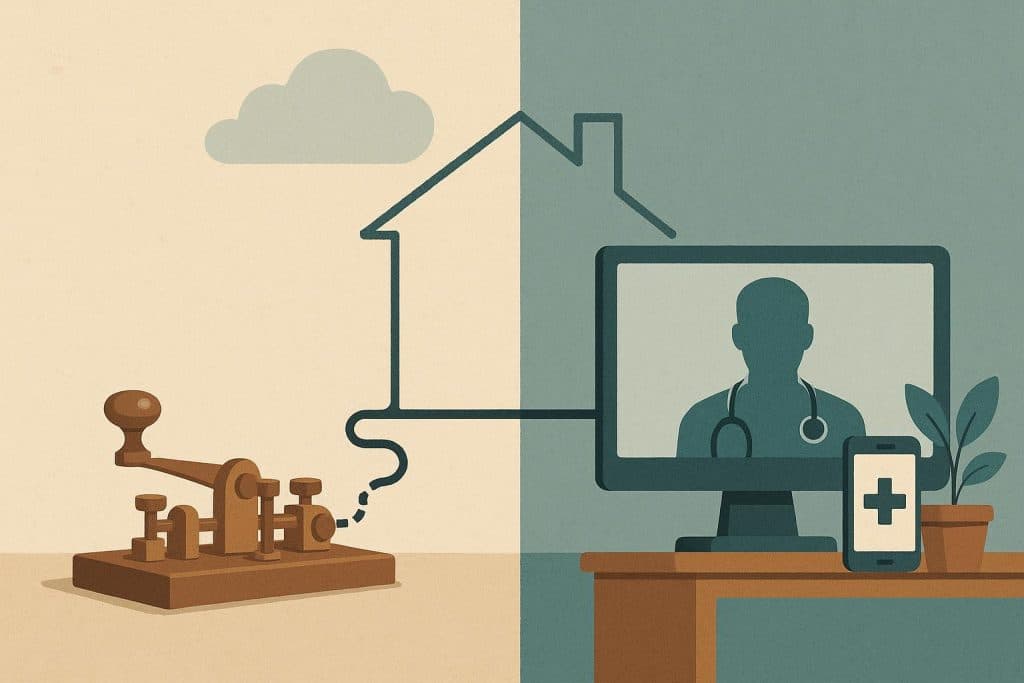
Most people assume telemedicine is a pandemic invention. A quick patch job stitched together when clinics went dark in 2020 and nobody could figure out where else to send patients. That story is wrong by roughly 160 years. The real history of remote medicine is older, stranger, and considerably more impressive than a Zoom call in sweatpants.
This piece traces the full arc, from the first documented attempt to transmit a health signal over distance to the sophisticated virtual care platforms operating today. If you’ve ever wondered how that “connect with your doctor from home” button became a normal thing to click, here’s where it actually started.
The Wire Before the Webcam
Remote medicine didn’t wait for the internet. According to a lecture on the history of telemedicine preserved by the National Library of Medicine, scholar Rashid Bashshur traces the technology foundations of telemedicine back to the optical telegraph system developed by Claude Chappe in the 18th century, with subsequent leaps arriving alongside wireless telegraphy in the 1870s. That is not a typo. People were thinking about how to move medical information across distances before electricity was standard.
The Civil War era added another layer. When 15,000 miles of telegraph cable were laid across the American continent in the 1860s, military medics began using the lines to coordinate casualty reports and request supply support. It wasn’t a video consultation, but the instinct was identical: get critical health information from where it exists to where it’s needed, as fast as the available technology permits.
Then came the telephone. In 1905, Dutch physiologist Willem Einthoven transmitted heart sounds from a hospital to his personal laboratory using a standard telephone line, proving that the human body’s signals could travel over copper wire without meaningful distortion. That experiment is the first recorded instance of remote biomedical data transmission. A doctor, a patient, a phone line, and a clinical question being answered from a different location. Sound familiar?
The 1959 Experiment That Rewrote the Definition
If Einthoven’s telephone demonstration was the proof of concept, 1959 was the proof of scale. Clinicians at the University of Nebraska became the first people to use two-way interactive television for medical purposes, transmitting neurological examinations to students and then, by 1964, establishing a telemedicine link with a state hospital 112 miles away to provide psychiatric assessments, speech therapy, and specialist consultations. This is documented in the Cleveland Clinic Journal of Medicine’s peer-reviewed review of telemedicine’s history, present, and future, and it changes how you should think about “new” technology.
A neurologist in Omaha. A patient in a facility more than a hundred miles out. Interactive video, real-time examination, a clinical decision made without anyone getting on a bus. That scenario was operational sixty-five years before most Americans had a primary care provider who offered video appointments.
The gap between “this is possible” and “this is normal” took decades to close, and it closed for a set of reasons that had very little to do with technology.
“The history of telemedicine closely follows the history and evolution of communication and information technologies. Medical professionals quickly recognized the potential of newly emerging technologies and sought to apply them to healthcare delivery.” — Framing consistent across multiple peer-reviewed histories of the field, including Bashshur and Shannon’s foundational 2009 academic volume on the subject.
The Three-Era Framework for Understanding Telehealth’s Growth
Here’s a way to think about the arc that most timelines skip. Telehealth’s evolution falls into three distinct eras defined not by technology, but by who was driving adoption.
Era 1: Institutional Experimentation (1950s to 1990s). Universities and defense agencies were the primary movers. NASA monitored astronaut vitals remotely. The military developed field telemedicine for combat medicine. No patient was calling to book a virtual appointment; researchers were building capability that the public wouldn’t see for decades.
Era 2: Regulatory Unlocking (1996 to 2019). HIPAA created data privacy standards that made clinical data transmission legally viable. Individual states began passing telemedicine parity laws. Broadband penetration finally reached a threshold where video calls were reliable enough for clinical use. Adoption was growing, but slowly. The technology was ready. The incentives weren’t quite aligned yet.
Era 3: Mass Normalization (2020 to present). Emergency regulatory waivers dropped longstanding barriers overnight. Physicians adopted virtual care at a pace that would have been unthinkable a decade earlier. And here’s the number that makes the scale concrete: according to the CDC’s National Center for Health Statistics, 80% of U.S. office-based physicians used telemedicine in 2024, based on data from the National Electronic Health Records Survey, compared to just 15.4% in 2019. Five years. A 65-point jump. That is not incremental adoption; that is a structural shift in how medicine is practiced.
| Year | Milestone | Significance |
|---|---|---|
| 1905 | Einthoven transmits heart sounds via telephone | First biomedical signal transmitted remotely |
| 1959 | University of Nebraska uses interactive TV for neurological exams | First video-based clinical telemedicine |
| 1996 | HIPAA enacted | Established legal framework for digital health data |
| 2020 | COVID-19 emergency waivers enacted | Regulatory barriers dropped; mass adoption begins |
| 2024 | 80% of U.S. physicians using telemedicine (CDC NCHS) | Virtual care becomes standard, not exception |
What “Telehealth” Actually Covers Today
This is where the modern picture gets more nuanced than the timeline suggests. Telehealth in 2024 is not a single thing. It’s a category that ranges from a quick video call with a general practitioner to sophisticated remote monitoring with wearable devices feeding continuous data to a clinical dashboard. The specialties involved span psychiatry, dermatology, endocrinology, physical therapy follow-ups, and well beyond.
One particularly interesting corner of the category is root-cause-oriented care delivered remotely. A provider offering functional medicine telehealth, for instance, applies the same investigative approach it uses in person, reviewing comprehensive labs, detailed patient histories, and lifestyle data through a secure virtual visit. That model would have been technically impossible in 1959 and legally murky as recently as 2019. Today it’s a standard service offering.
The diversity of what telehealth now includes is arguably its most underappreciated feature. Most people still picture a video call for a cold. The reality is much broader.
How to Actually Evaluate a Telehealth Provider
If you’re choosing a virtual care option for the first time, here’s a practical set of questions worth asking before you book anything. These aren’t obvious, and most comparison guides skip them.
- Does the provider see patients in your state? Physician licensing is state-specific. A provider licensed in California cannot legally treat you in Texas. Confirm this before you book.
- What platform do they use, and is it HIPAA-compliant? Consumer video apps are not built for clinical use. Ask directly.
- How are lab orders handled? If a provider can’t order and receive labs remotely, your virtual visit will hit a wall fast. Confirm the workflow upfront.
- Is there continuity between visits? A one-off video call and an ongoing virtual patient relationship are very different things. Understand which one you’re signing up for.
- Can they coordinate with your in-person care team? The best telehealth providers work alongside your existing providers, not in isolation from them.
Those five questions will eliminate a surprising number of providers that look polished on the outside but lack the infrastructure to deliver what they’re advertising.
The Distance Was Always the Problem
What connects a Civil War telegraph operator passing casualty counts down a wire and a patient opening a laptop for a virtual appointment in 2025 is the same basic problem: useful medical information trapped in one place while the person who needs it sits somewhere else. Every technological development in this history, from Einthoven’s telephone to today’s encrypted video platforms, is an attempt to solve that same gap.
The tools got better. The need never changed. And if the last 160 years are any guide, the solutions are going to keep getting more capable, more accessible, and considerably less dependent on anyone needing to sit in a waiting room.