

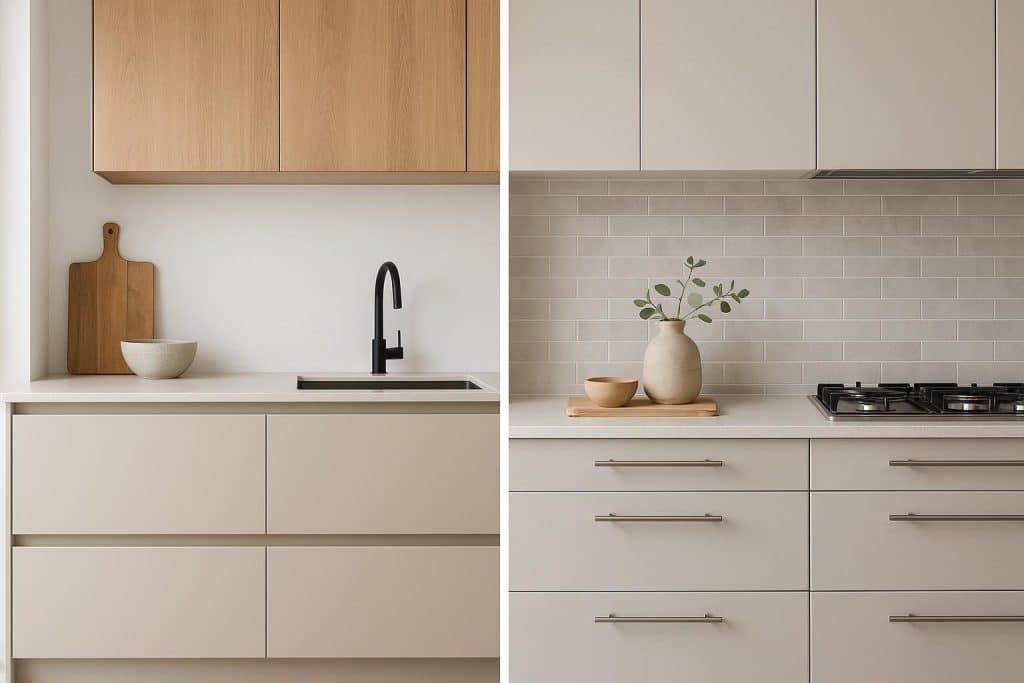
Cabinet hardware is one of those kitchen design decisions that most Perth homeowners treat as primarily aesthetic and later discover has significant functional implications they did not anticipate. The choice between handleless cabinetry and cabinetry with handles, pulls, or knobs is a decision that affects how the kitchen looks, how it works every day, how it is cleaned, and how it ages over the course of the renovation’s life.
This is worth a more careful analysis than the typical approach of choosing whichever looks better in the design direction you prefer. Both handleless and handled cabinetry have genuine advantages in specific contexts, and understanding what each delivers in daily use makes the choice more informed than a purely aesthetic one.
What Handleless Cabinetry Actually Means
The term handleless covers several different cabinetry opening mechanisms, and the differences between them matter in daily use.
Push-to-open (Tip-on). A spring-loaded mechanism inside the hinge that releases when the door is pressed. The user pushes the door lightly, the mechanism releases, and the door springs open slightly so it can be pulled. This mechanism works reliably for doors that are opened frequently, but some users find the push-release action less intuitive than a handle, and the mechanism has moving parts that can wear or require adjustment over time.
Grooved or recessed handle profiles. The most common form of handleless cabinetry in the contemporary Australian market, where the cabinet door or drawer front has an integrated groove or recess machined into its top or bottom edge that the fingers hook into to pull. This approach has no separate mechanism and no moving parts, but the groove must be positioned and sized so that it is genuinely comfortable to use across the full range of cabinet positions, from low base cabinets to high overhead cabinets.
J-pull profiles. A variation of the grooved profile where the cabinetry door face returns at a J-shaped angle at its top or bottom edge, creating a finger-grip space. J-pull profiles are a common choice in contemporary and Scandinavian kitchen designs because they create a very clean, uninterrupted face while maintaining a comfortable grip.
The Functional Case for Handles
Handles are functional as well as aesthetic, and their functional contributions are underappreciated by homeowners who are primarily thinking about how the kitchen will look.
Accessibility. Handles provide a firm grip point that is accessible without fine motor precision. For older household members, for people with arthritis or reduced hand strength, and for children who are learning to open cabinets, a handle requires less dexterity than a push-to-open mechanism or a narrow groove profile. This is a practical consideration that is worth factoring into the cabinet hardware decision for households where accessibility is a genuine requirement.
Consistency across all cabinet types. A handled cabinetry design uses the same opening mechanism for all drawers, doors, and panels regardless of their position in the kitchen. The handleless alternatives, where grooves or recessed profiles are machined into the cabinet faces, may not be equally practical for all cabinet positions. Low cabinets with a top-edge groove require awkward downward reach to access the groove; overhead cabinets with a bottom-edge groove may be difficult to grip when reaching up.
Longevity of the finish. In a handleless kitchen, the contact point for opening the cabinet is the cabinet face itself. In a handled kitchen, the contact point is the handle. Over the life of the kitchen, the area around a groove or push-to-open mechanism accumulates more wear, fingerprint oils, and cleaning product contact than the equivalent area in a handled kitchen. Handles take the wear instead of the cabinet face.
Hampton kitchen design and the handled approach. The Hampton kitchen aesthetic is fundamentally characterised by its hardware: the cup pulls, the bin pulls, the brushed nickel or satin brass bar handles that are as much a part of the Hampton look as the beaded inset cabinetry panels and the marble-effect benchtop. A Hampton kitchen without handles is not a Hampton kitchen. The hardware is a core design element of the style, not an accessory. For Perth homeowners drawn to the Hampton aesthetic, the choice of handled cabinetry is intrinsic to the design direction rather than a separate hardware decision.
The Functional Case for Handleless
Handleless cabinetry is not simply a trend. It delivers specific functional advantages that are genuine rather than marketing-derived.
Hygiene in the cooking zone. The cooking zone of the kitchen, adjacent to the cooktop and the main preparation area, accumulates grease, oil splatter, and cooking residue. In this zone, the absence of handle hardware means there are no crevices where grease can accumulate behind or around handles, and cleaning the cabinet faces requires wiping a flat surface rather than cleaning around and behind hardware components. For household cooks who want their cooking zone easy to clean and maintain, the handleless approach has a genuine hygiene advantage.
Visual simplicity. The handleless kitchen face has an uninterrupted quality that creates a specific visual effect: the kitchen reads as a series of panels and surfaces rather than as a collection of individually hardware-accented cabinet faces. This visual simplicity is the effect that the Scandinavian aesthetic, the contemporary minimalist aesthetic, and some industrial designs are specifically seeking.
No hardware to replace or update. Kitchen hardware styles change, and handles that look current today may look dated in ten years. A handleless kitchen has no hardware component that can date in this way. The cabinet profiles themselves are more enduring design elements than the hardware styles of any particular period.
How Design Style Should Guide the Decision
Rather than approaching the handleless versus handles question as a free-standing decision, it is more useful to consider how the choice aligns with the overall kitchen design direction.
Scandinavian. Handleless cabinetry, typically with clean J-pull or grooved profiles, is consistent with the Scandinavian aesthetic’s preference for surfaces without decorative elements. Some Scandinavian kitchens use very simple bar handles in brushed steel or black that are so restrained they read as nearly handleless.
Hampton. Handled cabinetry is a defining characteristic of the Hampton style. The cup pull, the bin pull, and the substantial bar handle are authentic Hampton hardware choices that cannot be substituted with handleless alternatives without losing the style’s character.
Industrial. The industrial kitchen accommodates both approaches. Exposed bolt-head hardware, oversized industrial pulls, and blackened steel handles are all authentic to the style. Handleless cabinetry in an industrial kitchen reads as modern industrial rather than traditional, which may or may not be the intended direction.
Coastal. The coastal kitchen aesthetic is flexible on hardware in a way that Hampton is not. A coastal kitchen can work with simple bar handles, with cup pulls in a natural material, or with a restrained handleless profile depending on how relaxed or refined the specific coastal direction is intended to be.
Mixed Approaches: The Best of Both
Perth kitchen designers increasingly take a mixed approach that uses handleless drawers in the base cabinet zone, where the horizontal groove profile is most naturally positioned, and handled doors in overhead cabinets, where accessing a groove requires reaching up and hooking fingers into a narrow profile that is less comfortable than a bar handle.
This mixed approach uses handleless profiles where they work most naturally, provides handles where they are functionally superior, and creates a visual hierarchy between the base cabinets and the overhead cabinets that can be a designed element rather than a compromise.
For Perth homeowners exploring custom kitchen designs that address both the aesthetic and functional dimensions of the hardware decision, discussing the specific mix of cabinet positions, the household members who will use the kitchen, and the design direction with an experienced kitchen designer produces a hardware specification that is genuinely considered rather than defaulting to one approach across the entire kitchen.
Conclusion
The handleless versus handled cabinetry decision in a Perth kitchen renovation is a functional specification as much as an aesthetic one. Hampton kitchens require handles as an authentic design element. Scandinavian kitchens typically suit handleless profiles. Industrial and coastal kitchens have more flexibility. And regardless of design direction, the accessibility needs of the household, the cleaning preferences of the household’s cook, and the specific positions of the cabinets in the kitchen all influence which approach genuinely serves the kitchen better.
Making this decision with both the aesthetic direction and the functional requirements in mind produces a kitchen that looks and works exactly as intended, rather than one that looks right but creates daily friction because the opening mechanism does not suit how the household uses the space.