

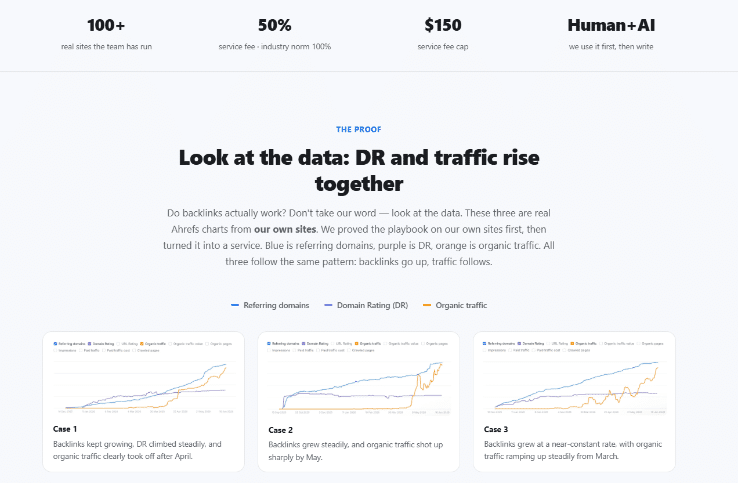
Domain Rating is useful because it compresses a messy link profile into one number. The trouble begins when that number is asked to choose a publisher by itself. A shortlist for Guest Posts needs to answer several different questions: whether the site has real search activity, whether its price fits the campaign, whether the buyer has used it before, whether its readers fit the proposed topic, and whether a competitor link makes it strategically interesting.
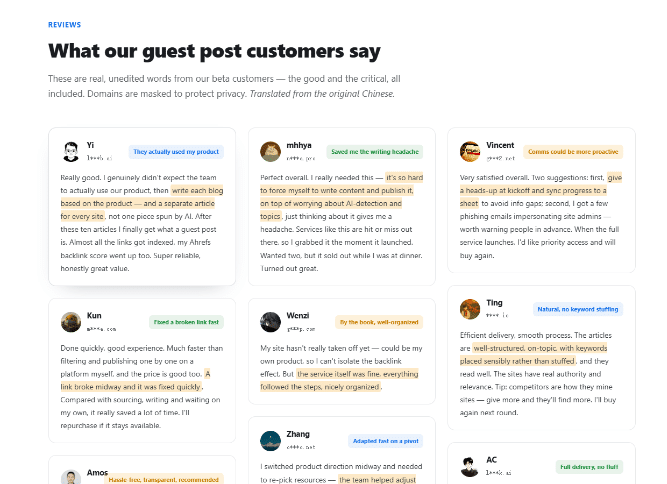
In the BestLinks AI workflow, the buyer keeps that decision. The team mines the client’s backlinks and competitor profiles through Ahrefs, then presents candidate sites with DR, traffic, and price for the client to choose. That workflow is strongest when the shortlist becomes a decision document rather than a ranked export.
DR Measures Strength Without Measuring Editorial Fit
A high DR can indicate that a domain has accumulated a strong backlink profile. It cannot tell a product team what the site’s readers expect, whether the relevant section is maintained, or whether the proposed article would belong there. Those are editorial questions, and they remain visible only when someone opens the site and reads it.
This is why sorting from highest DR to lowest often creates a misleading first impression. The top row feels safest, so teams start defending its price before they have written down the job it should do. A lower-DR publication with a clear audience and an active category may support a much more credible article. The metric still matters, but it becomes one input rather than the verdict.
The opposite mistake is possible too. Relevance cannot become an excuse to ignore a site whose search presence has faded or whose pages are barely maintained. Strong screening holds authority and editorial fit in the same view instead of letting either one cancel the other.
A practical review begins with the page that would plausibly host the article, not the domain homepage. Open several recent posts in that section. Check whether bylines look real, whether outbound references support the writing, and whether product coverage reads like editorial material or a wall of paid insertions. An attractive domain-level score can hide an unreadable section that no serious editor would choose.
Traffic Shows Activity But Needs A Second Question
Organic traffic adds a living signal to DR. If a site ranks for current queries and maintains pages that people can find, its link profile is not the only reason to consider it. Yet a single traffic total still does not reveal whether the active pages are related to the section that would host the article.
A reviewer should therefore ask where the traffic sits. A large total concentrated in an unrelated tool or a few old pages may have little connection to the proposed placement. A smaller site with consistent activity across relevant articles may offer a better editorial setting. No invented threshold can settle this for every campaign; the distribution and topic matter.
BestLinks AI includes traffic in the shortlist, which saves the buyer from gathering the first layer of evidence. The expensive part remains interpretation. If a candidate looks strong on the sheet but its suitable category has not published recently, the site deserves a question, not an automatic approval.
This check is deliberately qualitative. It should not invent a universal monthly-traffic floor. A niche publication and a general software site serve different markets. The reviewer records what the number can support, then keeps enough editorial evidence to explain the decision when another stakeholder asks why a smaller site was chosen.
Price Should Be Compared With The Article Job
Price has meaning only beside the work assigned to the placement. A broad educational article may fit many credible publishers, so paying a premium for one famous domain may not add much. A launch that needs a tightly matched industry audience may justify a narrower and more expensive choice.
The shortlist should record placement cost without turning the cheapest option into the default. Cheap sites can absorb hours if they require repeated edits, change the link, or offer an audience unrelated to the brief. An expensive placement can also disappoint if the team buys its metric rather than its editorial setting. Either error sends the article back to planning and creates avoidable rework.
A Decision Table Keeps Tradeoffs Visible
A useful Guest Posts decision table keeps the fields separate:
| Candidate signal | Question it can answer | Reason to pause |
|---|---|---|
| DR | Has the domain built link authority? | Authority alone does not prove topic fit |
| Organic traffic | Does the site have current search activity? | Traffic may sit outside the relevant section |
| Placement price | Does the site fit this campaign budget? | Low cost can hide editing and follow-up work |
| Previous use | Would this add a new referring domain? | A familiar site can become an easy repeat buy |
| Topic relevance | Can a credible article belong here? | A loose match produces thin product insertion |
| Competitor coverage | Has a comparable site earned attention here? | A competitor link does not prove equal access or value |
Shared Rows Turn Disagreement Into A Decision
No single row wins. A candidate becomes defensible when several rows tell a coherent story and the pause column has an answer.
The table also makes disagreement productive. Finance can challenge price, content can challenge topic fit, and SEO can challenge repeat use without speaking past one another. When those fields live in separate documents, the loudest objection tends to decide. When they share a row, the buyer can see which tradeoff is being accepted.
Previous Use Changes The Value Of Another Placement
A site the brand has used before is not automatically bad. It may have a strong audience and an editor who understands the product. But another article there serves a different strategic purpose from a first placement on a new referring domain. The shortlist should expose that difference before selection.
The BestLinks AI process uses existing client backlinks when mining candidates and aims to identify worthwhile sites not used yet. That prevents the research from acting as if every campaign begins with an empty history. For an established site, this matters more with every batch because the easiest publishers are also the ones most likely to recur.
Consider a candidate that scores well on DR, traffic, and price but already hosts two brand articles. A new piece may still be justified if it reaches a distinct section or supports a fresh editorial argument. If the only reason is that approval feels easy, the team is paying to avoid research. That is a process failure, not a publishing strategy.
History should include rejected and repaired placements as well as successful ones. A site may have published before but required repeated follow-up after dropping the destination during formatting. If that rework is missing from the shortlist, its price looks artificially low. The next buyer approves the same operational burden and loses another hour rediscovering it.
Competitor Links Create Leads Rather Than Proof
Competitor backlink profiles are valuable because they reveal publishers that have already covered adjacent products, categories, or problems. They shorten discovery. They do not prove that the same site will accept another article, charge the same price, or create equal value for a different domain.
Investigate Why The Competitor Earned The Link
The right question is why the competitor earned the link. It may have supplied original data, announced news, contributed a useful guide, or simply bought a placement. Each cause suggests a different path. Copying the domain without understanding the reason can produce a weak pitch and a discarded draft.
The first version of a competitor-derived list often overvalues visible overlap. A team sees three rivals on one publisher and assumes access is proven. Yet those links may be years old, appear in different sections, or support stories the current brand cannot responsibly tell. Review the actual pages before treating the domain as validated.
Attach A Verifiable Hypothesis To Every Candidate
For this reason, a publisher shortlist should attach a short hypothesis to every competitor-derived candidate. “Competitor appears here” is incomplete. “This publication regularly covers the operational problem our article can explain” gives the writer and buyer something they can verify.
The Final Choice Still Belongs To The Buyer
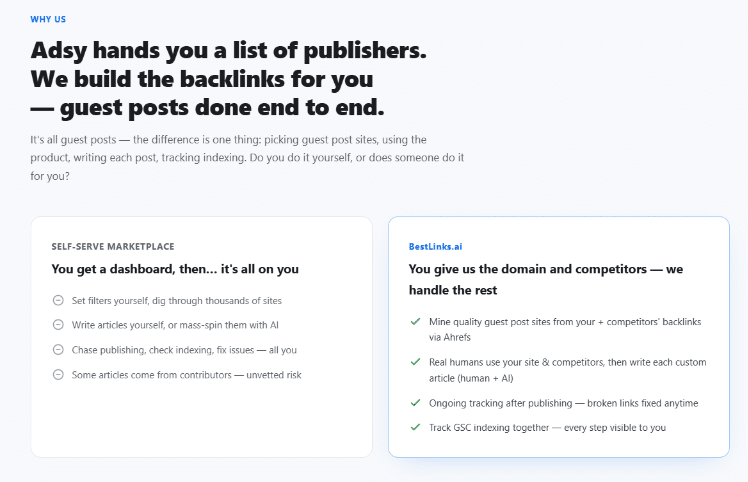
A managed research process can remove hours of collection and filtering. It cannot know every internal priority. The client knows which markets matter, which topics are sensitive, which previous relationships should be protected, and how much risk belongs in a particular batch.
BestLinks AI makes sense for teams that want a prepared shortlist and an execution partner while keeping approval authority. A buyer who expects one score to make the decision will be disappointed, because the strongest shortlist makes tradeoffs visible rather than pretending they have disappeared.
DR remains useful at the end of this process. It simply returns to its proper job: describing one dimension of a candidate while the article, audience, budget, history, and strategic reason decide whether the placement belongs in the plan.
A shortlist is finished when each selected row carries a reason a writer and budget owner can both understand.
That reason is the handoff from research to accountable spending.