

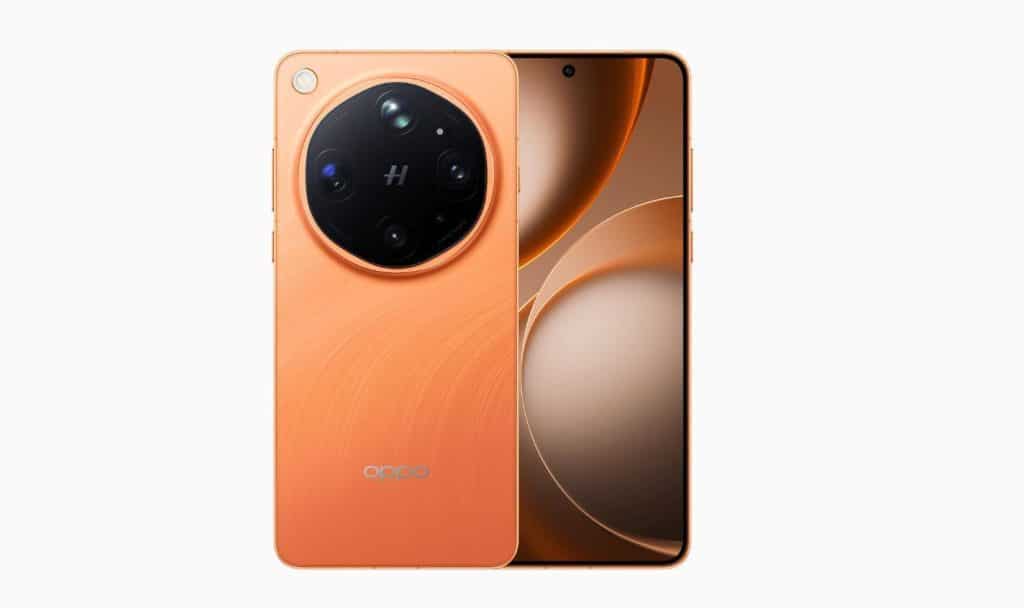
The OPPO Find X9 Ultra arrived in Thailand on 22 April 2026, one day after its global debut — one of the fastest regional turnarounds OPPO has managed for a flagship. Part of the Find X9 series, and carrying the tagline “Your Next Camera,” the Find X9 Ultra is also the first OPPO Ultra-branded phone to go beyond China and hit global markets. That alone makes it a different kind of launch for the brand.
The Portrait Argument
There are plenty of smartphones that claim to take good portraits. The OPPO Find X9 Ultra builds a more specific case: studio-quality results, across multiple focal lengths, whether standing in a rooftop bar in Bangkok or navigating a crowded Songkran street with a phone held above the crowd.
The centrepiece of that argument is the Hasselblad 200MP 3x Super Portrait Telephoto. A 70mm-equivalent focal length, f/2.2 aperture, and a 1/1.28-inch sensor — on paper. What that sensor size means for portraits is significant: it’s larger than what many main cameras carry this year. The 70mm focal length sits in the long-accepted sweet spot for portrait work: tight enough to flatter facial proportions without forcing uncomfortable proximity, open enough to keep some environmental context in the frame.
Compare that to the Find X9s — the more compact sibling in the Find X9 series, positioned as a travel companion — which carries a 50MP periscope telephoto at 73mm and f/2.6, while the Find X9 Ultra leverages its dual 200MP architecture for extreme cropping flexibility. The Find X9s is an exceptionally capable portrait phone for travel, whereas the Ultra caters to users seeking uncompromised light-gathering hardware.
What makes this lens feel purpose-built for human subjects is the Hasselblad Portrait Mode layered on top. The LUMO True Face Algorithm handles skin tones — an area where mobile portrait modes have historically stumbled, either smoothing everything into a plastic finish or losing texture in darker skin under artificial light. OPPO’s approach targets tone correction over cosmetic enhancement. Skin stays textured. Eyes stay sharp. The algorithm is focused on accuracy, not beautification.
Night portraits get specific attention through the Full-Focal Portrait Flash. Most smartphone flash systems are designed for static distances, producing that flat, washed-out effect the moment light doesn’t bounce as expected. OPPO’s LUMO Portrait Flash Algorithm adjusts based on subject distance — a visible difference when shooting across a dim café table versus capturing someone standing further back during a festival. The flash doesn’t overpower; it fills. That distinction matters more than it sounds in Bangkok’s mix of neon-lit street environments and dim indoor spaces.
Then there is the Natural Portrait Bokeh. Bokeh from computational cameras has improved substantially, but edge separation — where subject meets background — is still where it tends to fall apart, particularly around hair and loose fabric. The 1/1.28-inch sensor gives the OPPO Find X9 Ultra a physical head start that software alone cannot replicate. Background blur with smooth tonal transitions, as specified, comes partly from the optics rather than purely from algorithmic processing.
Hasselblad Nature Tonality: The Bit Most Coverage Skips
Most reviews stop at megapixels and sensor sizes. The Hasselblad Nature Tonality system deserves more than a footnote. Co-developed with Hasselblad, the tonal curves work at a global processing level — shaping how highlights compress and how shadow detail renders, rather than applying a preset filter after the fact. The result in portrait shots is that light falloff behaves more like film. Skin catching warm golden-hour light won’t blow out into pure white; the transition holds more gradation through the midtones. For anyone shooting near Bangkok’s riverside at dusk, or in the mixed warm-and-cool lighting of a hotel lobby, this affects the final image quality in a way that raw sharpness figures don’t capture.
Colour Science: The True Color Camera
Underneath all five rear cameras sits a dedicated New-Generation True Color Camera with 24 spectral channels and 15 stops of dynamic range. This isn’t a shooting lens — it continuously samples colour temperature and feeds real-time corrections across all focal lengths. Shooting inside a Yaowarat market, where tungsten light mixes with LED strips and cooler daylight from open doorways? The True Color Camera is working in the background, keeping skin tones calibrated without manual white balance adjustment.
The Find X9s also carries a spectral sensor, so colour science is shared across the series to a degree. Where the OPPO Find X9 Ultra separates further is the Hasselblad Natural Colour Solution running full-link original colour ProXDR — covering HDR and SDR capture across photo, Motion Photo, and video simultaneously. The Find X9s handles Hasselblad Portrait Mode and natural bokeh, but without the dual 200MP sensor architecture feeding the pipeline.
The Rest of the Camera System, Briefly
The main camera on the OPPO Find X9 Ultra is a 200MP sensor at 23mm, f/1.5, featuring a massive a 1/1.12-inch sensor. The ultra-wide runs 50MP at 14mm, f/2.0, with a 1/1.95-inch sensor. The 10x telephoto — exclusive to the Ultra in this series — is a 50MP lens at 230mm, f/3.5, with a 1/2.75-inch sensor and a Quintuple Prism Reflection Periscope structure, supporting up to 20x optical-quality zoom and 120x digital zoom.
The Find X9s, by comparison, runs a 50MP triple system: 24mm main at f/1.8 with a 1/1.56-inch sensor, a 73mm periscope telephoto at f/2.6, and a 15mm ultra-wide at f/2.0. Capable hardware for travel portraits, but the OPPO Find X9 Ultra’s sensor sizes, pixel count, and additional 10x telephoto are not replicated in the smaller model.
One genuine point of note: the OPPO Find X9 Ultra runs Snapdragon 8 Elite Gen 5, while the Find X9s uses MediaTek Dimensity 9500s. Both are current-generation chips, but the chipset choice reflects different priorities — the Ultra skews toward camera processing headroom and raw performance, the Find X9s toward efficiency and compact form.
Who Is the OPPO Find X9 Ultra Actually For?
Priced at approximately 42,330 THB in Thailand, this sits at the top of the market. For buyers who photograph people regularly — content creators, event coverage, anyone wanting their shots of friends at street food stalls or night markets to look genuinely considered — the 3x portrait telephoto and its associated processing stack are difficult to match at this focal length and sensor size.
The Find X9s is the better option for someone who wants Hasselblad portrait character in a lighter, more pocketable phone, and doesn’t need 200MP resolution or a second periscope telephoto. The OPPO Find X9 Ultra is for buyers who want the full system, and are willing to carry the weight and spend the price that comes with it.
For portraits specifically — which is the single clearest use case this phone has been built around — the hardware justification is there.