

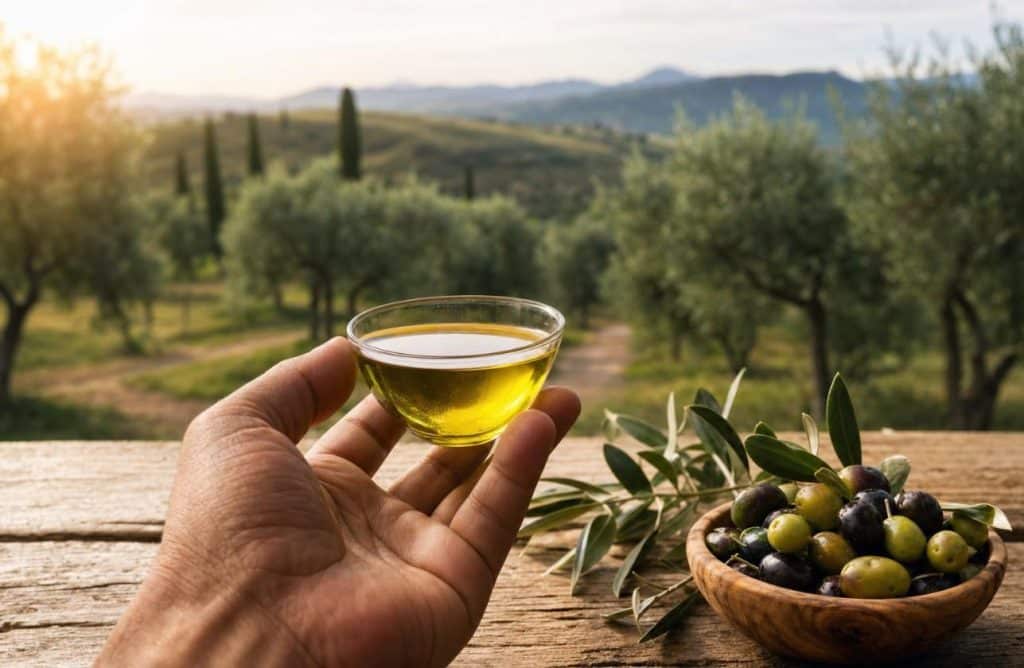
What does terroir taste like in olive oil? It shows up as a cluster of sensations—green or ripe aromas, a bitterness spread across the tongue, a peppery catch at the back of the throat—that together point toward a place, its olive varieties, and the choices made while picking and pressing the fruit. Learn to read them, and a tasting becomes a way of understanding the land itself.
Terroir, and how to taste for it
The word terroir comes from the French terre, meaning land, and it describes the mark a place leaves on what grows there. In olive oil that mark survives unusually well. According to European regulations, extra virgin olive oil is obtained by mechanical pressing with no treatment other than washing, decantation and filtration, which keeps the accent of its origin intact on the way to the bottle.
You do not need a laboratory to read it. Many tasters pour a little oil into a small neutral cup, cup it in the palm to warm it gently, and move through a short sequence: smell first, then take a small sip and draw air across the oil to release its aromas, then weigh the bitterness on the tongue against the pungency in the throat and judge how everything balances. That balance—aroma family, intensity, texture, aftertaste—is the report the glass is offering.
Guided sessions turn these abstractions into something you can smell and taste in real time, which is why a tasting in a producing region teaches more than a bottle opened alone at the kitchen counter. On-site formats that pair a walk through the grove with a structured tasting—such as the experiences run by Love Olive Oil in Tuscany—set the oil against the landscape and the harvest that shaped it, which is exactly the connection a glass on its own cannot supply.
Tasting is more than quality control: it’s a way to read a place
Most people approach a tasting with one question: do I like it? That instinct isn’t wrong, but it stops short. Sensory analysis—the structured act of smelling, sipping and assessing—was built to verify quality, yet the same tools reveal something richer. They let you trace a finished oil back toward its origin.
Two forces are always at work. There is terroir in the environmental sense: soil, altitude, rainfall, exposure, the moderating breath of the sea. And there are human choices: when to harvest, how quickly to mill, whether to filter. Both leave traces you can detect in the glass. Treating a tasting as a reading exercise means asking not only whether an oil pleases you, but what it might be telling you about where it came from.
What terroir means for olive oil (and what it doesn’t)
For olives, terroir has concrete components rather than a vague halo. Cultivar genetics set the baseline aromatic palette. Altitude and temperature range influence how the fruit ripens. Rainfall and soil—whether free-draining ground or heavier clay—shape vigour and concentration. Proximity to the coast can soften or sharpen a profile through milder nights and salt-laden air.
Here is the caveat tourism copy tends to skip: in olive oil, terroir is inseparable from handling. A grove can sit on an ideal hillside and still yield a tired oil if the fruit is mishandled between tree and bottle. The environment offers potential; the choices made afterward decide how much of it survives. A workable definition for a taster, then: terroir is the sum of natural conditions plus the agronomic and milling decisions that preserve them. Keep both halves in mind.
A short tasting protocol to capture landscape signals
What you need is a quiet palate and a little patience. It helps to taste before coffee or anything strongly scented, so the nose stays clear. From there, a simple order keeps the assessment honest:
- Smell. Inhale and name what you find. Tasters tend to sort aromas into two broad families: green and herbaceous notes such as freshly cut grass and leaf, or softer, riper notes such as ripe fruit and nuts.
- Sip. Take a small amount and draw air across it. Many tasters find this lifts the aromas perceived through the back of the nose, beyond what the first sniff revealed.
- Assess bitterness and pungency. Bitterness sits on the tongue; pungency is the peppery catch in the throat that can make you cough.
Take notes as if drawing a map: aromas first, then texture, then aftertaste and balance. A few beginner habits get in the way. Many people read bitterness as a fault, when experienced tasters tend to treat it as a characteristic to interpret rather than a flaw. Others mistake the throat sting for acidity—but acidity, in the regulatory sense, is a chemical value measured in a laboratory and expressed as a percentage, not a sensation you feel. And many reach for bread too soon, masking the very signals they came to find. Taste the oil on its own first.
Sensory clues that point to harvest timing and climate
Once you can describe an oil, you can begin to interpret it. The green-versus-ripe axis is the clearest entry point. As a rule of thumb rather than a guarantee, the greener, grassier, more assertively bitter register is often associated with fruit gathered earlier in the season, and the softer, rounder register with later picking. Neither is superior; they are different readings of the same calendar, and microclimate or picking decisions can override any broad expectation.
Intensity also shifts from one season to the next, and from one slope to the next. It would be a mistake to reduce a whole year to a single rule. The honest move is to read the glass in front of you rather than the cliché about the vintage.
Cultivars: the dialects of a territory
If terroir is a language, cultivars are its dialects. Identifying the olive variety helps link an oil to its landscape, because each cultivar carries a typical aromatic character before the environment even gets a vote. Tuscany offers a useful reference set: the native varieties behind its protected oils include frantoio, leccino, moraiolo, maurino, leccio del corno, pendolino and correggiolo. A blend that pairs several of them can be read as a deliberate balancing act.
That is the real distinction between monovarietals and blends. A single-variety oil shows you one dialect clearly, which makes it a good teaching sample. A blend is a sentence built from several—sometimes for tradition, sometimes to balance a vigorous cultivar against a milder partner. Neither is more authentic. The best way to learn is to ask the producer direct questions: which cultivars, from which groves, picked in what window. The answers tend to sharpen what your palate already suspected.
From grove to mill: the steps that preserve or blur terroir
The route from tree to bottle is where terroir is either protected or quietly lost, and handling clearly matters to the oil that results. Some estates take that seriously enough to harvest entirely by hand and press the fruit the same day, picking early when temperatures favour extraction. The speed from grove to mill keeps aromas clean; long delays and rough handling blur them. None of this is a universal recipe, but it explains why two groves on similar soil can deliver very different oils.
Filtration sits among the permitted treatments for virgin and extra virgin categories, alongside washing and decantation. Whether a producer filters or leaves an oil unfiltered is worth asking about at a tasting, since it speaks to the house style and the choices behind the bottle.
The rules that make tasting trustworthy
Sensory description only means something if the categories are reliable, and here European law does the heavy lifting. Under EU marketing standards, extra virgin olive oil must be free of organoleptic defects, must be fruity, and must have a free acidity no higher than 0.8%. Virgin olive oil may carry minor sensory defects and allows acidity up to 2%. The longstanding framework set out in Regulation (EEC) No 2568/91 was overhauled when Commission Delegated Regulation (EU) 2022/2104, adopted on 29 July 2022, replaced it to simplify and clarify the standards covering categories, labelling, packaging and blending.
This is also where authenticity is defended. Designations of origin tie an oil to a defined territory and a verified process, and for a taster they work as a shortcut: they promise that the place named on the bottle is real.
What does Toscano PGI guarantee?
Tuscan oil has been protected since 1998 by the Toscano PGI, whose rules require that all stages—olive production, pressing and packaging—take place within the administrative territory of the Region of Tuscany. The designation also carries eight additional geographical mentions tied to specific areas:
- Seggiano
- Colline Lucchesi
- Colline della Lunigiana
- Colline di Arezzo
- Colline Senesi
- Colline di Firenze
- Montalbano
- Monti Pisani
Alongside the PGI, Tuscany holds four protected designations of origin—Chianti Classico DOP, Terre di Siena DOP, Lucca DOP and Seggiano DOP—each narrowing the territory further. The tighter the geographical claim on the label, the more a tasting and a place can be expected to line up.
Tradition you can taste
The cultural layer is not decoration; it is information. In Tuscany the classic uses—new oil poured over warm bread, white beans, vegetable soups, grilled meats—suit a robust, bitter, peppery oil that holds its own against them. Try it directly: pour an assertive, peppery oil over a bowl of plain white beans and it pushes back through the dish; spoon a soft, ripe oil over the same beans and it recedes into the background. Same plate, two different conversations. Regional preferences encode local agronomy, and a thoughtful pairing at a tasting shows you what an oil was made to do.
Scale gives this context weight. One published estimate puts Italy at roughly 300,000 tons of olive oil a year across about 1.1 million hectares, with southern regions—Puglia and Sicily above all—accounting for around 80% of the harvest. By that measure Tuscany is a small, distinctive voice in a large chorus, which is part of why its protected, place-bound oils reward attentive tasting. And the practice itself is ancient: archaeological findings in the Golan Heights date olive oil production to the Copper Age, roughly 6,000 years ago—a continuity that turns each glass into a long conversation between land and craft.
Choosing a tasting that truly reflects terroir
Not every tasting teaches. The serious ones share recognisable signals. They use a structured sensory method rather than vague praise. They are transparent about cultivars, harvest dates and milling, and they can tell you which lot you’re drinking. A well-run session offers comparative samples, so you taste a green-fruity oil beside a riper one and feel the difference instead of being told about it. It also explains why the extra virgin category demands an oil free of sensory defects, rather than leaving quality as an abstraction.
Walking a grove before tasting closes the loop. Seeing the slope, the soil and the spacing of the trees, then tasting the oil they produced, fixes the idea of terroir into memory in a way no glass alone can manage. That is the argument for an on-site experience over a supermarket bottle: it leaves you with a reference point you can carry everywhere afterward.
Turning one tasting into a reusable map
The point of all this is not a single pleasant afternoon. It is a method you keep. After a good tasting, you can shop differently. Look for a stated harvest year and, where it matters to you, a recent one. Seek out specific origin—a PGI or DOP, a named area—rather than only a country on the label. And trust your trained palate to judge balance: bitterness and pungency in proportion, aromas clean and lively.
Build a personal library of sensations. Note the oils that moved you, the cultivars behind them, the regions they came from. Taste seasonally, when the new oil arrives, and set bottles from different territories side by side. Do this for a year and a habit forms. You stop simply drinking olive oil and start reading it—each glass a short report from a particular hillside, written in bitterness, pepper, and the green smell of fresh-cut grass.