

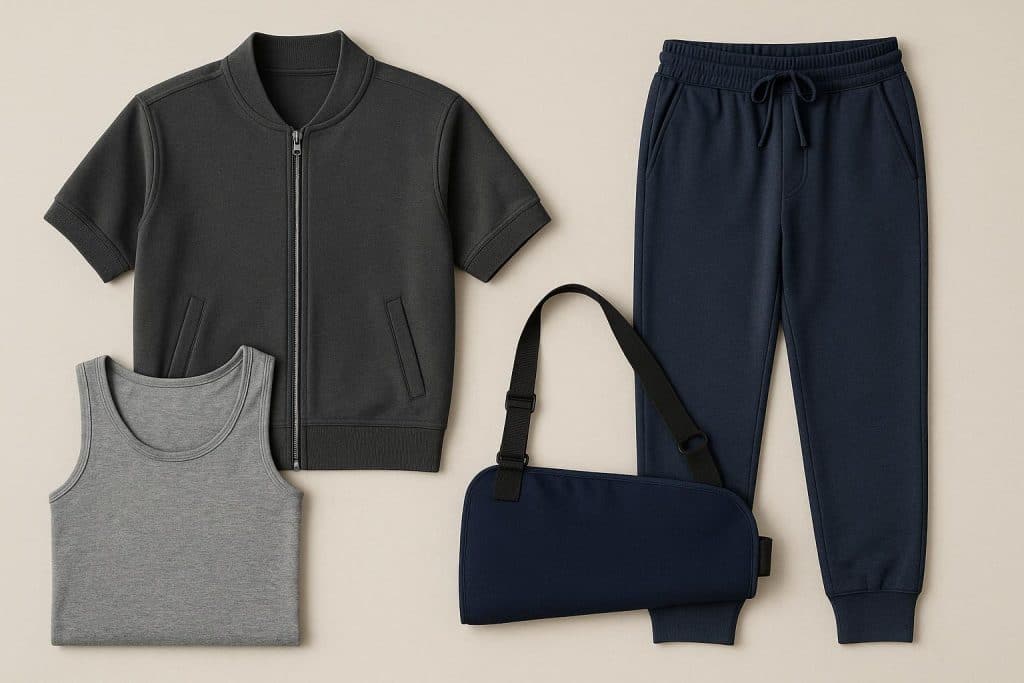
Most people preparing for shoulder surgery spend weeks getting the medical side right — choosing a surgeon, understanding the procedure, lining up help for the first few days. Almost nobody spends five minutes thinking about what to wear after shoulder surgery, and that’s usually the first thing to go wrong once you’re actually home.
Here’s why: after most shoulder procedures, you’ll spend weeks in a sling, with your surgical arm held close to your body and very little range of motion to work with. The clothes sitting in your closet right now were not designed with that in mind.
The Test That Replaces a Whole Shopping List
You don’t need a spreadsheet of approved garments to prep your wardrobe for recovery. You need one question, applied to everything you own: can I put this on, or take this off, without lifting my arm overhead or reaching behind my back?
Run that test on a pullover sweater, and it fails instantly — both sleeves require overhead motion you won’t have. Run it on a button-down shirt, and it mostly passes, since the closures sit in front and the sleeves go on one arm at a time. Run it on a back-closure bra, and it fails for the same reason the sweater did: any garment that asks your healing arm to do work behind your body is off the table for a while.
The test works because it cuts through guesswork. You don’t need to know every product category in advance. You just need to be honest about what your arm can and can’t do.
Why This Matters More Than People Expect
It’s easy to assume clothing is a minor detail compared to everything else surgery involves. In practice, it’s one of the first things patients struggle with, often within hours of getting home. Getting dressed becomes a task that requires help, takes far longer than it should, or gets skipped some days entirely because it’s simply too frustrating.
That frustration is avoidable, but only if the prep happens before surgery, not after. Once you’re in a sling, you won’t have the mobility or the patience to sort your closet. The smarter move is doing it now, while you still have both arms free to dig through drawers and make decisions, and ideally, before you’re relying on someone else to help you get dressed every morning.
It also helps to know the general timeline. Sling protocols vary by procedure and surgeon, ranging from a couple of weeks for less involved repairs to six weeks or longer for more extensive ones. Whatever your specific timeline turns out to be, the prep itself doesn’t change.
Building the List From the Test
Run the test across your whole closet, and the pattern shows up fast: front-fastening pieces pass; anything requiring overhead reach or behind-the-back motion doesn’t. That holds for sleepwear and underlayers just as much as outerwear.
This is also where most people get stuck, because the test tells you what to avoid but not necessarily what to buy instead, particularly when it comes to supportive garments like bras, where front closures and adjustable, medical-grade fastenings make a real difference during a sling-bound recovery.
That’s the gap worth filling before surgery, not after. This guide on what to wear after shoulder surgery walks through specific categories — namely bras, tops, outerwear, and sleepwear — in more detail, so you’re not guessing in the days right before your procedure.
The Bottom Line
You can’t control how your shoulder heals. You can control whether your closet helps or hinders that process, and that’s worth sorting out before surgery, not after.