

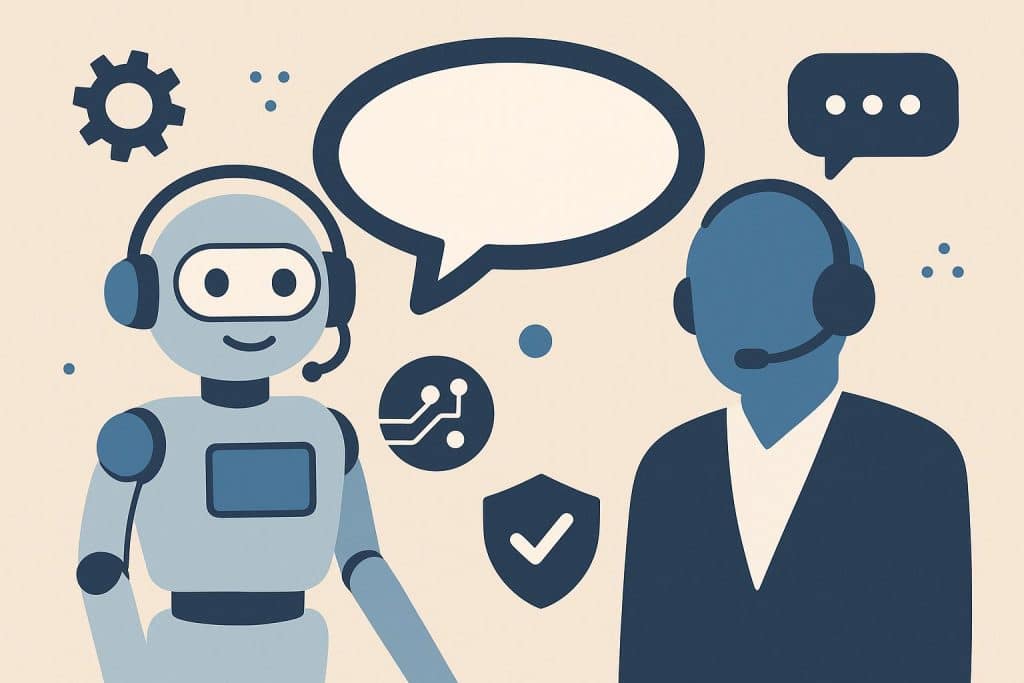
Businesses spent years hearing the same promise: AI would replace large parts of customer service. In practice, that prediction turned out to be only half right.
AI has absolutely changed support operations. It can answer routine questions instantly, route calls, qualify leads, summarize conversations, and help companies respond around the clock. But many businesses have discovered the same hard truth: when a customer has an urgent, emotional, or unusual issue, they still want the option to speak with a real person.
That is why the strongest customer service strategy in 2026 is not AI alone. It is a hybrid model built around speed, consistency, and human backup.
Why AI-only support often falls short
AI works best when the interaction is clear and repeatable. If a customer wants office hours, pricing basics, an appointment confirmation, or an order update, automation can be excellent. It is fast, available 24/7, and far more scalable than a fully manual team.
The problem starts when real life gets messy.
Customers do not always explain their issue perfectly. They may be frustrated, distracted, in a hurry, or calling about something that does not fit neatly into a scripted flow. A system that can answer ten common questions may still fail on the eleventh. That is where many businesses lose trust: not because they adopted AI, but because they adopted AI without a safety net.
A support experience should never make customers feel trapped. The best systems give callers an answer quickly, but they also make escalation easy when needed.
The rise of the hybrid support model
Hybrid customer service combines AI automation with live human assistance. The AI handles the repetitive front line: greetings, FAQs, lead capture, routing, appointment requests, basic qualification, and after-hours coverage. When the conversation becomes sensitive or more complex, the interaction moves to a trained person.
This model does three things especially well.
First, it reduces response time. Customers no longer wait in a queue for basic information.
Second, it improves consistency. AI can follow the same approved flow every time, reducing missed steps and lost details.
Third, it protects the customer experience. If the AI cannot resolve the issue, the customer still has a path to a human conversation.
For service businesses, that last point matters more than many leaders expect. A missed call is rarely just a missed call. It can be a missed booking, a missed lead, or a frustrated customer who simply calls a competitor.
Why outsourcing is becoming part of the equation
Hybrid support becomes even more powerful when businesses combine AI with outsourced live coverage.
Many small and mid-sized companies cannot justify staffing phones 24/7. Even larger companies struggle with evenings, weekends, overflows, seasonality, or sudden spikes in call volume. Outsourced live support fills that gap without forcing the company to build a full in-house operation.
This is where the outsourcing conversation has changed. It is no longer just about lowering labor costs. It is about building a support stack that is more flexible, more available, and easier to scale.
A modern outsourced model is not “replace your team with strangers.” It is “let automation cover the routine, let trained people handle the exceptions, and keep your internal team focused on higher-value work.”
What businesses should look for now
Not every AI support platform is built the same. Businesses should look for tools that offer:
- script and workflow control rather than completely unpredictable AI behavior
- easy call routing and escalation
- lead capture and appointment support
- after-hours availability
- live human backup for failed or sensitive interactions
- reporting that helps improve workflows over time
A useful example is Joy’s small business AI answering service, which shows how businesses can use AI to answer calls, capture leads, and route customers while still keeping human support available when needed.
For broader industry context, IBM has outlined how AI in customer service is improving response speed and efficiency, while McKinsey continues to track how automation and generative AI are reshaping operations across service-heavy industries in its research on the economic potential of generative AI. Salesforce has also published extensively on how customer expectations keep rising, especially around speed and convenience.
The future of customer service is not a choice between machines and people. It is a better division of labor between the two.
AI should handle the repetitive work humans no longer need to do. Humans should handle the moments that require judgment, reassurance, and flexibility. Businesses that get that balance right will not just save time. They will create customer experiences that feel faster, smarter, and far more trustworthy.