

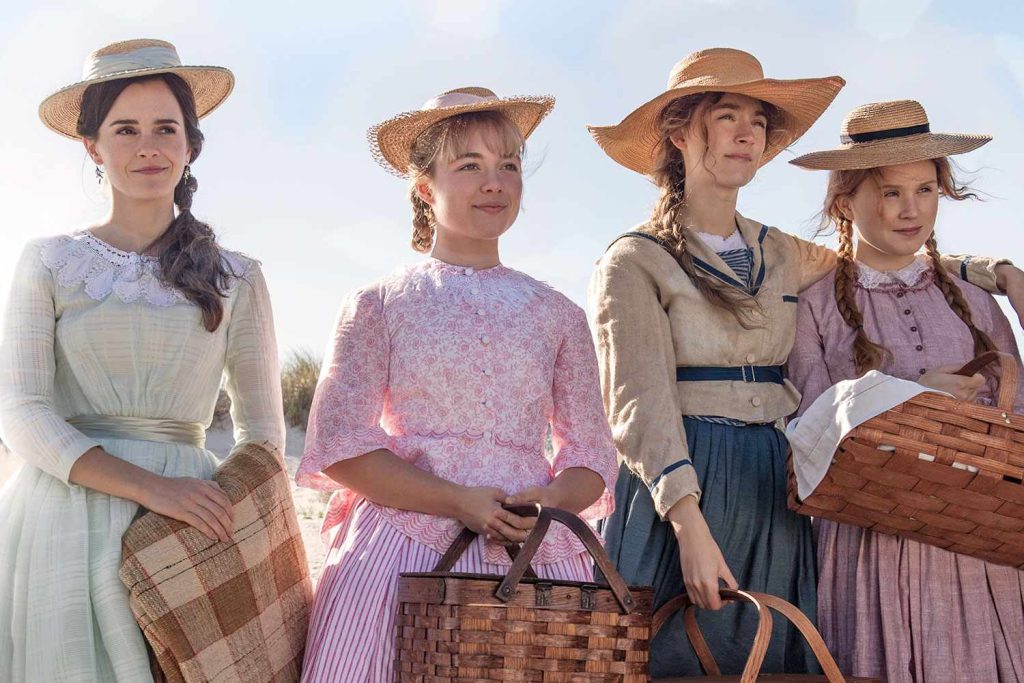
Most audiences expect Little Women to be a cozy romance, yet Greta Gerwig’s 2019 adaptation focuses sharply on the “girls with bills” reality of the Civil War era. By trading stiff period costumes for a chaotic, “lived-in” aesthetic, the film creates an urgent sense of economic agency rarely seen in costume dramas. It isn’t just a retelling of Louisa May Alcott’s novel; it is a modern conversation about art, money, and survival (Little Women 2019).
Little Women 2019: The ‘Vibe Check’: Decoding the Golden Past and the Blue Present
Have you ever noticed how childhood memories feel sunnier in your head than reality? Greta Gerwig captures this nostalgia using the symbolism of color palettes. When we see the March sisters—played by Saoirse Ronan and Florence Pugh—growing up, the screen is bathed in a warm, golden amber. This acts as a visual map, immediately signaling the safe, hopeful era of childhood where the biggest worry is a burnt dress or a creative dispute.
Fast forward to adulthood, and that warmth vanishes. The film shifts to cool blues and stark grays, reflecting the financial anxieties and grief that come with growing up. Even the costume design adapts, becoming darker and more practical to match this harsher reality. This visual cue helps you navigate the story without needing a title card; if the screen looks cold, you know the characters are facing the hard truths of the adult world. By painting the past in gold and the present in blue, the film turns a confusing timeline into a clear emotional experience.
Shuffling the Pages: Understanding the Non-Linear Narrative
Greta Gerwig utilizes a non-linear narrative structure, shuffling the timeline to place scenes of childhood hope directly against adult reality. This turns the movie into a conversation between the sisters’ younger and older selves, highlighting how their dreams evolved—or evaporated—over time.
This structural remix sets the stage for the film’s boldest move: treating Jo March as a meta-fictional representation of Louisa May Alcott. In the 1860s, a heroine had to marry to satisfy readers, but Gerwig wants to honor the author, who never married. The solution is a brilliant “double ending.” We see Jo chasing Professor Bhaer in a scene that feels almost too perfect, while simultaneously watching the real Jo negotiate the copyright for her novel.
The 2019 film ending suggests that the romance is likely the fiction Jo wrote to sell copies, while the publication is her true happy ending. Here are the clues to look for:
- The Lighting: The romantic chase scene uses the “golden” childhood lighting, signaling it is a story, not reality.
- The Negotiation: Jo fights for copyright ownership, prioritizing her economic future over romance.
- The Final Shot: The movie ends with Jo holding her finished book, not a husband.
Little Women 2019: How to Watch Little Women Like a Pro
You are ready to see Little Women not just as a costume drama, but as a conversation between a woman and her past. Understanding the March sisters’ dynamics becomes clearer when hunting for these cinematic techniques in Gerwig’s work:
- Overlapping Dialogue: Listen for the realistic chaos of sisters speaking simultaneously.
- Shared Wardrobe: Spot the vests Jo and Laurie swap to show their bond.
- The Red Book: Watch the binding process visualize Jo owning her art.