

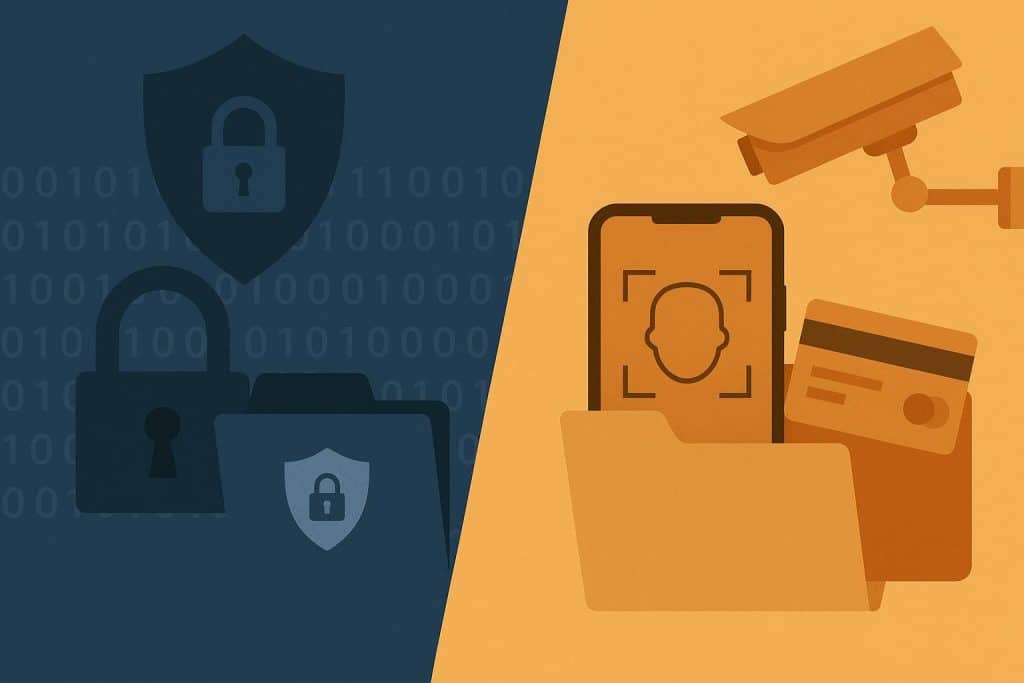
Security sells. Open a new account today and you are immediately offered protection, like extra verification steps, device recognition or fingerprint login. The promise sounds simple: More safety. Fewer risks. What tends to receive less attention is the cost behind those reassuring checkmarks. That cost is personal data.
Over the past decade, digital platforms have tightened their defenses. Data breaches, phishing campaigns and account hijacking have forced companies to rethink how identity is confirmed online. Passwords alone no longer suffice. Additional safeguards became standard. At the same time, users grew used to instant access. Nobody wants to wrestle with complicated login routines every morning. Smooth experiences win.
This delicate balance is particularly visible in spaces built on personal trust, including social media and Online Dating platforms. To limit impersonation and fraud, services increasingly request verification steps, like a phone number, a government-issued ID or occasionally even a short selfie video. Each measure strengthens accountability − but each one also enlarges the data trail attached to a profile.
Two-Factor Authentication: Stronger Locks, Wider Keys
Multi-factor authentication is widely recommended by cybersecurity authorities around the world. The idea is straightforward: even if a password leaks, a second barrier prevents immediate access. Authentication apps generate time-based codes. Some services still rely on SMS messages.
Security researchers have long pointed out weaknesses in SMS-based systems, particularly in cases of SIM swapping, where attackers transfer a victim’s phone number to another device. App-based authenticators are generally considered more resilient. Still, they require device registration and ongoing linkage between account and hardware. The protection improves and with it the circle of stored information expands.
Security rarely comes free of context. It builds upon identifiers. Every additional factor narrows the chance of intrusion, while broadening the profile attached to a user.
Biometrics: Convenience at the Speed of a Glance
Unlocking a phone with a fingerprint or a brief look at the screen feels effortless. Biometric authentication has moved from novelty to routine in just a few years. Most modern smartphones store biometric templates locally within isolated hardware components designed to prevent external access.
Even so, biometric data carries a different weight than passwords. A password can be changed within seconds. A fingerprint cannot. Facial geometry does not expire. That permanence is precisely why regulators in multiple jurisdictions classify biometric information as sensitive. But when physical traits become digital credentials, the boundary between body and data grows thinner.
Location Access and Invisible Patterns
Location services illustrate the same trade-off in a different way. In navigation apps or delivery services, real-time positioning is essential. Elsewhere, it is often optional.
Operating systems now offer more nuanced controls, such as granting access only while an app is in use or sharing approximate location instead of precise coordinates. Location history can reveal more than a point on a map. It can outline routines, commutes and frequent stops. Those patterns matter because platforms use them to flag anomalies.
An unexpected login from a new country may trigger an alert precisely because previous logins were stored and analyzed. Behavioral signals extend beyond geography. Time of access, device model, typing rhythm: These markers help identify suspicious activity. They also form a behavioral signature that exists quietly in the background.
Identity Checks Beyond Banking
Formal identity verification was once associated primarily with financial institutions. Increasingly, other digital services have adopted similar approaches. Uploading an ID document or completing a brief video verification is becoming less unusual.
The rationale is clear: verified identities reduce fake accounts and organized fraud. At the same time, identity documents contain detailed information, like full names, dates of birth, document numbers and photographs. When such material is processed, the stakes rise.
High-profile data breaches over recent years have demonstrated that no system is invulnerable. Companies invest heavily in security infrastructure. Yet risk cannot be eliminated entirely. Verification enhances trust within a platform, but it also concentrates sensitive data in fewer places.
The Web of Connected Accounts
Single sign-on services allow users to access multiple apps through one central account. The convenience is undeniable: Fewer passwords, faster onboarding and less friction.
However, centralization introduces dependency. If the primary account is compromised, connected services may be affected as well. Linking platforms also creates bridges between datasets that might otherwise remain separate.
Choosing Deliberately
Data protection laws in regions such as the European Union and parts of North America emphasize principles like transparency and purpose limitation. Users are entitled to understand how their information is handled.
Legal frameworks matter. Personal choices matter just as much. Security tools are not inherently intrusive. Nor are they neutral. They operate on data. Deciding which safeguards to enable involves weighing exposure against protection.
Digital life does not require total surrender of privacy to remain secure − but it does require awareness. Each additional layer of protection rests on information about the person being protected. Recognizing that link changes the perspective.
Convenience and caution are not enemies. They coexist in tension. The balance is rarely perfect and never permanent. It shifts with every new feature, every updated policy, every tap on a confirmation screen. The question is not whether data will be used for security. It already is. The real question is how consciously we decide to participate.