

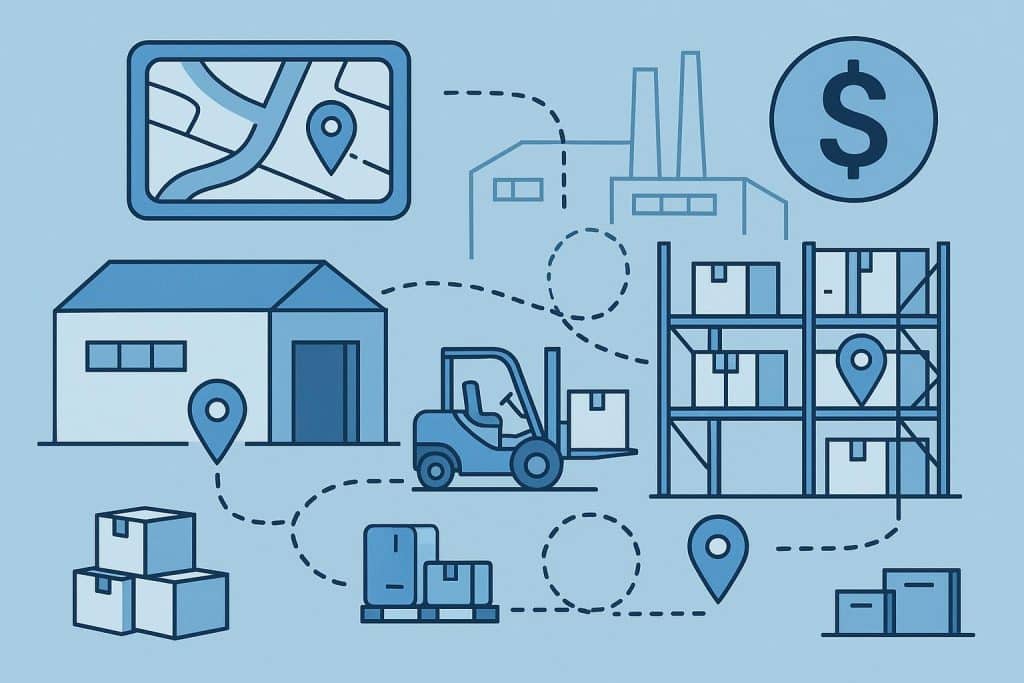
Industrial real estate eats up a massive chunk of a business balance sheet. When a manufacturing plant or logistics distribution center is struggling to keep up with daily throughput, the physical floor usually reflects that mess. You’ve got pallets double-stacked where they shouldn’t be, staging lanes spilling over into driving paths, and forklifts creating bottlenecks at the dock doors.
When facility directors walk out and look at all this congestion, the gut reaction is almost always the same: we are out of room. The immediate reflex is to go out and sign a lease for a larger building, start pouring concrete for a massive expansion, or rent a temporary off-site warehouse just to handle the overflow.
But expanding your physical footprint is easily the most expensive, disruptive, and headache-inducing way to solve a capacity problem. The hard truth is that most facilities aren’t actually out of space at all. They are just out of visibility. They are dealing with severe spatial inefficiency caused by blind spots, outdated routing habits, and manual inventory tracking. Before you commit millions to a new expansion, you really need to look at how digitizing your physical operations can unlock a massive amount of hidden capacity right beneath the roof you already pay for.
How RTLS Breaks the Illusion of Space Crunch
To understand how you’re wasting space today, you have to look at how facilities traditionally manage their floor plans. Without continuous, live spatial data, operations are forced to rely on rigid, static zoning rules.
You block off specific square footage just for receiving. You dedicate specific racks strictly for certain product lines. And most importantly, you carve out massive, oversized buffer zones just in case the supply chain throws a massive surge at you. Because you don’t have eyes on the exact physical location of every single asset, you compensate by hoarding floor space.
Think about what happens when an expeditor can’t find a critical batch of raw materials. They don’t just stop production; they rush order a replacement batch. Now, that new batch takes up even more rack space. The original materials aren’t actually gone they’re just sitting in a blind spot somewhere, acting as phantom inventory and chewing up valuable square footage.
Deploying a modern real time location system (RTLS) completely breaks this rigid, wasteful cycle. By putting active tracking tags on your high-value assets and material handling equipment, you turn your physical building into a living, breathing digital twin.
Transitioning from Static to Dynamic Storage
When a real time location system is tracking the precise X,Y coordinates of everything moving across your concrete, you no longer need those dedicated, single-use storage lanes. You can confidently move to a dynamic storage model.
If a forklift driver is in a hurry and drops a pallet in an unmarked, temporary overflow aisle, it’s not a disaster anymore. The forklift tracking system automatically captures that exact drop-off coordinate. Your Warehouse Management System (WMS) updates instantly, without the driver ever having to jump off the lift to scan a barcode. Because the system always knows exactly where the asset is resting, literally any open slot in your racking becomes a perfectly viable storage location. You can finally eliminate those massive, empty buffer zones you were holding in reserve, which often instantly reclaims 10% to 15% of your usable floor space.
Reclaiming the Dead Zones with Real-Time Location Tracking
Beyond just fixing how you store things, spatial intelligence exposes the “dead zones” hiding in your facility’s footprint.
Every single warehouse has areas that are chronically underutilized. Sometimes it’s because of poor workflow design, and sometimes it’s just human habit. By looking at historical heat maps and the actual physical paths, your forklift fleet and human workers take every day, you can visualize the real flow of traffic. You’ll usually find that certain aisles are completely avoided because workers think they are too congested, while others are absolute bottlenecks.
With sub-meter spatial data, you can redesign your racking layout based on how things actually move, rather than how a theoretical blueprint says they should. You can narrow the aisles where only specialized, automated equipment travels. You can physically reposition your high-velocity inventory closer to the dock doors. All of this dramatically reduces the physical footprint you actually need to hit your daily volume.
Increasing Worker and Forklift Safety with Real-Time Digital Twin
Now, there is a very valid concern that comes with shrinking your footprint. If you condense your operations, pack your racking tighter, and push your throughput velocity higher, the floor inherently becomes more dangerous. You are forcing heavy machinery and human workers into much closer proximity.
You simply cannot optimize your space if it leads to an increase in OSHA recordable incidents or puts your team at risk. This is where your technology has to pull double duty.
The exact same infrastructure you use to track your pallets and forklifts must also protect your most valuable assets: your people. By integrating lone worker safety with UWB RTLS, the facility becomes deeply aware of the human element. The Real-time or RTLS Digital Twin system creates virtual, moving safety bubbles around your forklifts. If a worker steps out from a blind aisle directly into the path of an oncoming vehicle, the system instantly catches that proximity breach. It can automatically trigger a loud alarm, flash a warning light, or even talk directly to the forklift’s telematics to force the vehicle to slow down.
You can safely run a dense, highly condensed, fast-paced facility because the digital twin system is actively predicting and preventing the collisions that those old, massive spatial buffers used to absorb.
The RTLS Execution Engine
Hardware vendors will be more than happy to sell you a thousand tracking tags, and commercial real estate brokers will always be knocking on your door trying to lease you a bigger warehouse. But you didn’t get into operations to manage unnecessary real estate leases, and you definitely didn’t get into it to troubleshoot blinking blue dots on a software map. You got into it to push maximum volume with maximum efficiency.
To actually shrink your footprint and delay spending millions on a capital expansion, you need an intelligence layer that enforces real operational discipline. We don’t manufacture the tracking hardware, and we don’t just push passive dashboards that tell you what went wrong yesterday.
LocaXion delivers the complete execution solution. We take the raw spatial data streaming off your floor and translate it into the automated inventory workflows, predictive safety protocols, and dynamic spatial logic your facility needs to operate flawlessly within the footprint you already have.
Visit https://locaxion.com/ to learn how to unlock your hidden capacity today.