

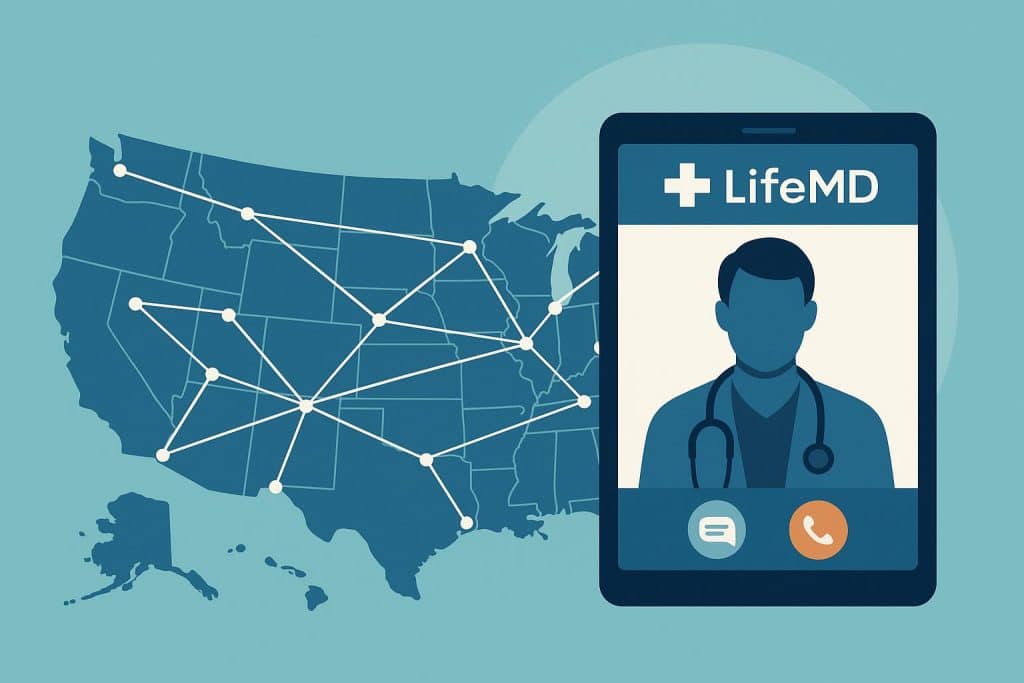
The Infrastructure Behind Nationwide Telehealth Availability
When someone in rural Montana needs medical care at 10 PM on a Saturday, they face the same licensing barriers as a patient in downtown Manhattan seeking a specialist consultation across state lines. The difference is that Montana residents have fewer alternatives. This is where the infrastructure behind telehealth platforms becomes critical—not just having the technology, but having the legal framework to deliver care anywhere.
Understanding the Affiliated Medical Group Model
LifeMD operates through a network of regional medical Professional Corporations and Professional Associations collectively called “LifeMD Affiliated P.C.s,” which provide licensed medical services across all 50 states. This structure includes entities such as LifeMD Southern Patient Medical Care P.C., LifeMD Atlantic Patient Medical Care P.C., LifeMD Kansas Patient Medical Care P.A., and several other regional organizations administratively led by LifeMD Southern Patient Medical Care P.C. in Florida.
This isn’t simply a matter of convenience—it represents a significant infrastructure investment designed to navigate one of telehealth’s most persistent challenges: state-by-state medical licensing requirements.
The State Licensing Challenge
Medical licensing in the United States operates on a state-by-state basis, a system rooted in the Tenth Amendment to the U.S. Constitution (ratified in 1791), which reserves to the states the authority to regulate health, safety, and the practice of medicine.
For traditional in-person medicine, this made sense. For telehealth, it creates complexity.
Healthcare providers must generally be licensed in the state where the patient is located at the time of care. If a physician in Washington conducts a virtual visit with a patient in Florida, that physician typically needs licenses in both states.
While some states have developed special telehealth registrations or joined interstate compacts to streamline this process, requirements vary significantly. According to the Federation of State Medical Boards, many states have created telemedicine-specific licenses or registration pathways, and more than 40 states plus the District of Columbia offer some form of limited licensure exception or consultation allowance for cross-state services. However, these exceptions often come with restrictions—some only apply to provider-to-provider consultations, others require established patient relationships, and many involve infrequent interactions only.
The Interstate Medical Licensure Compact (IMLC) helps by creating an expedited pathway for physicians to obtain multiple state licenses, though it still requires separate licensing in each state and involves fees for each license.
What Nationwide Coverage Actually Means
For a telehealth platform to claim true nationwide availability, providers must maintain proper licensure or affiliations in every state where they see patients. LifeMD’s affiliated medical group structure addresses this by establishing properly licensed entities in different regions, allowing the platform to serve patients regardless of their location.
This infrastructure becomes particularly meaningful when examining geographic healthcare disparities. Rural communities face substantial access challenges: they have approximately 68 physicians per 100,000 people compared to 80 in urban areas.
A 2018 Pew Research Center study cited by the Association of American Medical Colleges found that people living in rural areas travel an average of 17 minutes by car to reach the nearest hospital, compared to 10.4 minutes for urban residents. More than 100 rural hospitals closed between 2013 and 2020, forcing residents to travel approximately 20 additional miles for common services like inpatient care.
Beyond rural areas, other populations face access barriers. More than half of rural counties lacked hospital-based obstetric services in 2018, and by 2030, the anticipated supply of OB/GYNs is expected to meet only about 50% of demand in rural areas. Specialty care access presents similar challenges across many underserved communities.
Continuity Across State Lines
One practical advantage of nationwide provider networks involves continuity of care for patients who travel or relocate. Traditional state licensing restrictions mean that if a patient with an established provider relationship travels to another state, their provider may not be legally authorized to continue their care via telehealth during that period—even if it’s the same virtual visit they’d conduct if the patient were home.
A properly structured nationwide network allows for greater flexibility in maintaining care relationships regardless of temporary or permanent location changes. For patients managing chronic conditions or ongoing treatment plans, this continuity can be clinically significant.
The Broader Infrastructure
LifeMD reports serving over 600,000 patients to date. The platform offers not just urgent care, but primary care, chronic disease management, and specialized services for conditions including men’s and women’s health, dermatology, and allergy and asthma care. This scope requires providers who can legally practice across jurisdictions and coordinate care that often involves prescription medications, lab work, and ongoing monitoring.
The infrastructure supporting this care includes not only the affiliated medical group network but also partnerships with nationwide lab facilities, diagnostic services, and a mail-order pharmacy network. Each component must navigate its own regulatory landscape while maintaining integration with the telehealth platform itself.
What This Means for Access
The significance of robust telehealth infrastructure becomes clearest when considering populations with limited alternatives. In states that haven’t adopted Medicaid expansion, rural areas with hospital closures, or communities with severe provider shortages, telehealth platforms with true nationwide reach can represent the difference between delayed care and timely treatment.
According to research from the Commonwealth Fund comparing the United States with other high-income countries, urban–rural health disparities are worse in the U.S. than in peer nations; rural Americans are significantly more likely to report problems paying medical bills and accessing care. Approximately 46 million Americans—about 15 percent of the U.S. population—live in rural areas. Many of these residents face substantial access barriers.
For these populations, the question isn’t whether virtual care is preferable to in-person care, but whether accessible care exists at all. A 2019 study found that lower mortality was associated with an increase of 10 primary care physicians per 100,000 population. When those physicians aren’t available locally, properly licensed telehealth providers can help address part of that gap.
The Patient Perspective
For patients, the practical implication is straightforward: when selecting a telehealth provider, confirmation that the platform maintains proper licensing for their state matters. Without it, the impressive technology and convenient interface can’t legally deliver care.
The regulatory landscape continues evolving, with state approaches to telehealth licensing developing at different paces. Some states maintain strict requirements for full licensure, while others have implemented special telehealth registrations designed to maintain oversight while reducing administrative burden. What’s clear is that telehealth platforms choosing to serve patients nationwide must invest in the regulatory infrastructure to do so properly.
This requires more than technology—it requires legal entities properly structured for each jurisdiction, providers maintaining appropriate credentials, and systems ensuring that the right licensure exists for each patient interaction. For platforms like LifeMD, the 50-state network represents the foundation that makes nationwide access possible, transforming telehealth from a convenient option for some to an accessible solution for millions.