

Food banks rarely struggle due to a lack of generosity. Many people are happy to give.
The trouble is everything between the pantry shelf at home and the pantry shelf at the food bank.
Someone has to remember to bring the cans to the office. Someone has to empty the bin. Someone has to load a car, drive across town, and unload it on a weekday afternoon.
Logistics people call this the last mile, and in most food drives it is where good intentions quietly run out of steam.
One pest control company noticed, years ago, that it had already solved that problem by accident.
A Fleet That Visits Doorsteps Every Day
EcoShield Pest Solutions runs a route-based business. On any given weekday, its technicians are scheduled at homes across dozens of markets for recurring service visits.
Co-founders Greg Nygren and Doug Cardon saw what that meant for hunger relief. If a customer set a few cans on the porch, the technician who was already coming could pick them up.
At the end of the route, those cans could go to a local pantry. The hardest part of a food drive, getting donations from homes to the people who need them, was already built into the daily schedule.
“We can make it really easy for people to give food,” Nygren told Pest Control Technology. “We could pick it up and drop it off.”
That idea became Exterminate Hunger, a program the company has run for more than 15 years.
How the Program Works
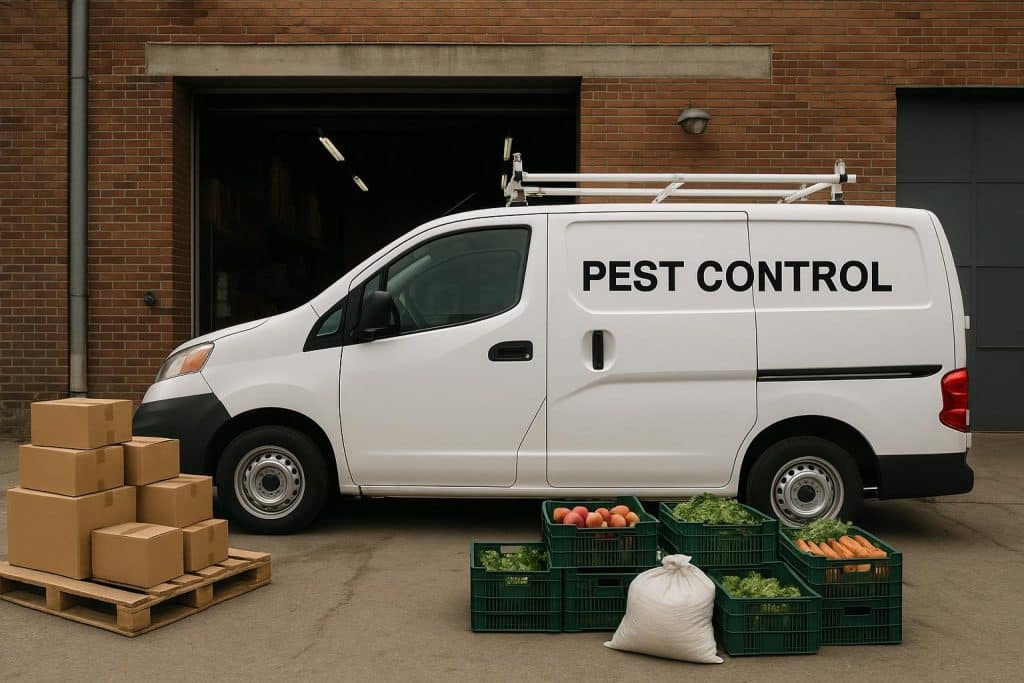
The model is simple by design. During the campaign window, customers who want to participate leave canned goods or other nonperishable items on their doorstep on service day. The technician collects them during the visit.
The branch sorts and packages the donations and delivers them to partner food pantries and food banks in the same community.
Customers can also drop donations at a local EcoShield office. Past campaigns have accepted baby formula, hygiene products and other pantry staples alongside canned food.
The program paused during the COVID-19 pandemic and relaunched in 2022, when more than 30 offices took part with a goal of 25,000 food items.
It has grown with the company since. The 2026 campaign runs from October 1 through November 19 across more than 50 EcoShield offices, with a goal of more than 50,000 donations.
Why the Model Works
Several things set this approach apart from the typical office food drive.
- Collection happens where people already are. Donors do not have to change their routine or remember to bring anything anywhere. The donation leaves the house the same way it would if a friend stopped by to pick it up.
- Transport is already paid for. The truck, the fuel and the driver’s time are part of the existing service route. The marginal cost of carrying a bag of cans back to the branch is close to zero.
- Donations stay local. Each branch delivers to pantries in its own service area, so food collected in a neighborhood feeds families in that same region. That local connection is part of what keeps people participating year after year.
- It scales with the business. Every new branch is a new collection network on day one. The program does not need a separate footprint, warehouse or staff to expand.
The Need Has Not Gone Away
According to the U.S. Department of Agriculture, 47.4 million people in the United States lived in food-insecure households in 2023. Food banks see demand climb heading into the holidays, which is exactly when the Exterminate Hunger campaign runs.
For pantry partners, a steady stream of donations from a single, reliable source is valuable in its own right.
It arrives on a predictable schedule, and it comes from the neighborhoods the pantry already serves.
A Model Worth Borrowing
Perhaps the most interesting part of the story is that Nygren does not see it as something only his company can do. “We could see in the future where this doesn’t necessarily have to be EcoShield exclusive,” he said.
That is a real invitation. Plenty of businesses already send vehicles to customers’ homes on a schedule: lawn care companies, HVAC and plumbing providers, home health agencies, grocery and meal delivery services. Any of them could run a version of this program with the infrastructure they already have.
For Nygren, the payoff goes beyond the pounds of food collected. “When you serve and you give, you’re just as blessed as the people that are receiving,” he said.
Customers in EcoShield’s service areas can learn more about the 2026 campaign at ecoshieldpest.com.