

For years, parents have worried that automation would hollow out the job market their children were preparing to enter.
Now that worry has a name and a face: generative AI. The understandable instinct is to push students toward ever more technical training.
But a growing number of educators are reaching the opposite conclusion. As machines absorb routine tasks, the human skills they cannot replicate become the real differentiators.
That argument was front and center at High Point University in North Carolina this spring.
At HPU’s “AI For Extraordinary Education” summit on May 5, faculty from across the university gathered to work through how AI is reshaping the classroom.
The conclusion many of them drew was not that students need to out-code the machines, but that they need to out-human them, and that universities have a responsibility to teach those capacities deliberately.
The Counterintuitive Case for Human Skills
Dr. Matthew Brophy, associate professor of philosophy at High Point University, made the point directly after co-leading a summit session on AI-assisted writing. “Summit presentations highlighted that AI makes human life skills more vital than ever,” Brophy said.
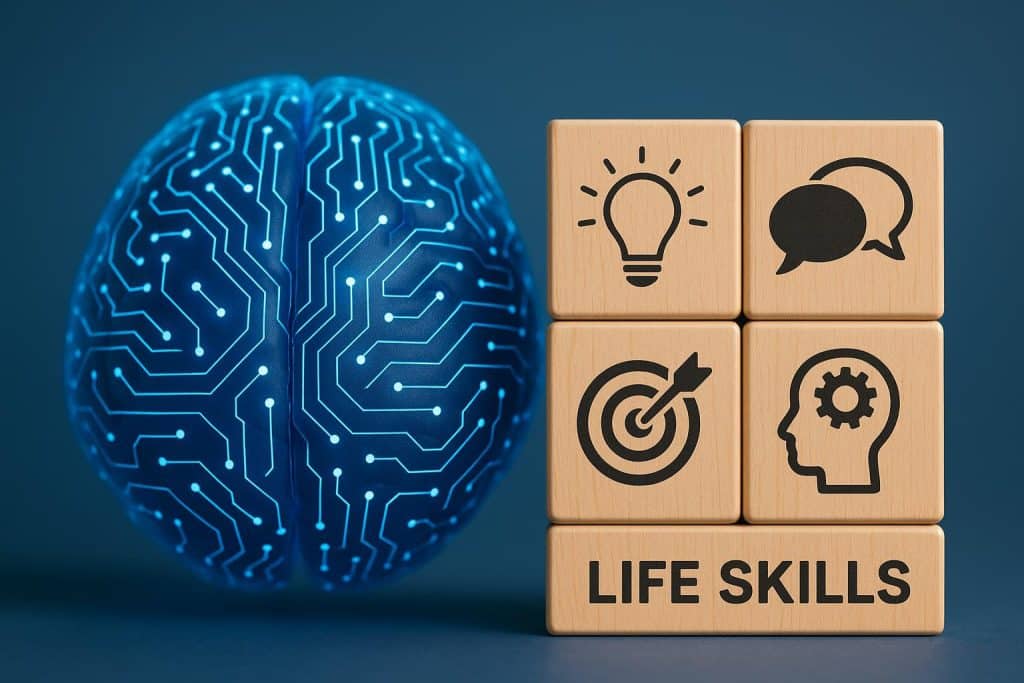
“As students learn to work with AI, they will also need critical thinking, ethical judgment, emotional intelligence, creativity, collaboration and problem-solving.”
If an AI tool can produce a competent first draft of almost anything, the value a person adds shifts to the things the tool cannot do well: deciding what is worth making, judging whether an answer is sound, reading a room, working with other people, and taking ethical responsibility for the result.
Those are precisely the abilities HPU has long branded as “life skills,” and the summit reframed them as the core competencies of an AI-saturated economy rather than soft extras.
Why Universities Have to Teach This on Purpose
One reason the message landed is that HPU does not treat life skills as something students absorb by osmosis.
The summit itself modeled the principle. Rather than importing outside experts to dictate rules, the university asked 25 of its own faculty to lead 19 sessions teaching one another how to use AI responsibly.
The day was structured to leave faculty with practical strategies for guiding students, not just talking points.
Brophy described the throughline that connected those sessions. “Students need guided, ethically grounded practice using AI as a scaffold for thinking, not a substitute for it,” he said.
The phrase captures the educators’ central worry: that students who lean on AI as a shortcut will arrive in the workforce having skipped the very reasoning and judgment that make them valuable.
The remedy is not to forbid the tool but to teach students to use it in ways that build, rather than bypass, their thinking.
A Message Aimed at Parents and Prospective Students
For families weighing where to invest four years of tuition, the takeaway is reassuring. The skills employers say they want, and that AI cannot easily reproduce, are teachable, and they are the ones HPU has organized its model around.
President Nido Qubein framed the university’s goal in exactly those terms at the summit. “Our goal is to help students build both practical AI skills and the ability to understand ethical considerations and use these tools responsibly in professional settings,” he said.
That dual emphasis, fluency with the tools and the human judgment to wield them well, is the heart of the pitch.
Students at High Point University are not being taught to avoid AI, nor to surrender to it, but to remain the decision-makers in the loop.
In a labor market where technical tasks are increasingly automated, that positioning may prove more durable than any single coding language or software platform a student could learn today.
Backing the Philosophy With Structure
The university has put institutional weight behind the idea. HPU’s Center for Innovative Teaching and Learning, which hosted the summit, brought on Dr. Zawan Al Bulushi in January as a faculty development specialist for AI in education, a role created to keep AI integration thoughtful, ethical and academically grounded.
Heidi Echols, the center’s director, told faculty that AI is changing both how students learn and how teachers teach.
The answer? Involve students actively in their own education rather than letting the technology do the work for them.
That structure matters because it signals the life-skills argument is not a marketing line but an operating principle.
Individual schools, including the Earl N. Phillips School of Business, have stood up their own AI committees, and the center runs faculty workshops nearly every week.
The infrastructure exists so that the human-skills emphasis survives the next wave of technological change rather than being overtaken by it.
The Bottom Line for the AI Era
The advice emerging from High Point University inverts a common assumption about preparing for an automated future.
The students best positioned to thrive will not necessarily be the ones who memorize the most technical detail.
They will be the ones who can think critically, collaborate, exercise judgment and bring emotional intelligence to their work, using AI fluently as a partner.
As HPU expands its AI programs across academic schools in Fall 2026, that conviction is shaping how the university prepares graduates.
For parents asking what their children should actually learn in the age of AI, the educators’ answer is clear: the human skills, more than ever.