

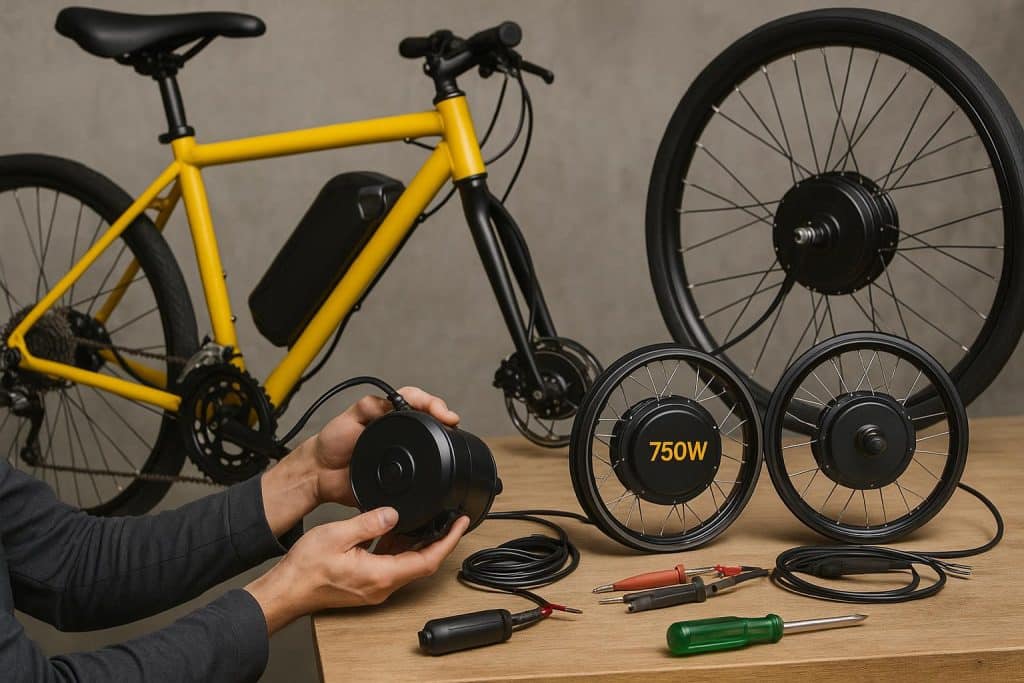
The first decision most people get wrong when converting a bike to electric is treating wattage like a simple scale where more is always better. The logic feels intuitive — higher wattage means more power, more power means better performance, so why not go as high as the budget allows? In practice, the wattage that works best for a given build depends on the bike, the terrain, the rider’s weight, the intended use case, and a set of mechanical and legal considerations that have nothing to do with raw power. Getting this decision right from the start saves money, prevents compatibility headaches, and results in a bike that actually rides the way you want it to.
This guide is for people who are past the “should I convert?” question and are trying to make a smart, informed choice about the specific motor rating that fits their situation.
The Wattage Rating Question: What It Actually Measures
When a conversion kit is rated at 1500 watts or 2000 watts, that number describes the sustained power the motor can handle under continuous load. It’s not a peak number — most hub motors can exceed their rated wattage briefly during high-demand moments like climbing or acceleration — but it’s the baseline around which the rest of the system is designed. A motor rated for higher wattage uses heavier magnets, heavier copper windings, and more robust construction throughout.
What wattage affects in practice is how the motor performs under load. A 1500W motor on a flat urban commute with a light rider is barely working. The same motor on a hilly route with a heavier rider is operating near its limits, generating more heat and wearing components faster. A 2000W motor handles that second scenario with more headroom, but it adds weight, draws more current from the battery, and in most jurisdictions, exceeds the legal power limit for road-legal e-bikes.
Understanding your actual use case — not the use case you’d like to imagine — is the starting point for making this choice well.
Who a Mid-Range Wattage Kit Actually Serves Best
The 1500W range is where most practical conversions land, and for good reason. This power level offers enough torque for moderate hills, enough top speed for mixed urban and suburban riding, and enough range efficiency that a reasonably sized battery pack can cover real-world distances without requiring oversized cells or a second battery.
A 1500w e bike conversion kit works well for riders in the 150–220 lb range who are dealing with moderate terrain — a mix of flat and rolling, occasional grades, standard city street riding. It’s legal in most states under the Class 3 e-bike definition when paired with a properly configured controller, which matters for riders who use bike lanes, shared paths, or roads where e-bike regulations are enforced.
The frame compatibility consideration at this wattage range is manageable for most standard bike designs. Steel and aluminum frames built around conventional hub spacing can handle the torque output without modification in most cases. Thin carbon dropouts and low-end fork materials are exceptions — motors at this power level put real stress on the dropout under hard acceleration, and frames not designed for it can develop cracks over time.
Battery sizing at 1500W also remains practical. A 48V 15Ah battery provides a reasonable balance of range and weight for this power level. Larger batteries extend range but add weight and bulk; the 1500W motor’s efficiency means that range-to-weight tradeoffs are manageable rather than demanding.
When 2000W Makes Sense
The jump to 2000W is meaningful rather than marginal. At this power level, the motor produces substantially more torque, which translates directly into climbing performance, acceleration from stops, and the ability to maintain speed under load conditions — carrying cargo, towing a trailer, or riding with a significantly heavier rider — that would cause a 1500W motor to work hard.
A 2000w electric bike kit is well-suited to riders who regularly deal with significant elevation change, carry cargo consistently, or are at the heavier end of the weight range that 1500W handles adequately. It’s also the right choice for builds where range between charges is less of a priority than performance — when the ride is short and demanding rather than long and moderate.
The trade-offs at 2000W deserve honest consideration before committing. Legal compliance in many jurisdictions is more complicated at this power level — most U.S. states cap road-legal e-bikes at 750W, and 2000W puts the build into a grey area that varies by local enforcement, riding environment, and how the controller is configured. Riders using these builds on private property, off-road trails, or in contexts where e-bike regulations don’t apply won’t face this issue. Riders who plan to commute on public roads should research their specific jurisdiction’s rules before buying.
Battery demands at 2000W also increase. Higher current draw means a larger, heavier, more expensive battery pack is needed to maintain range comparable to a lower-wattage build. The total system cost rises accordingly, and the build weight increases in ways that matter more on some frame types than others.
Direct Drive vs. Geared Hubs: The Context for These Wattage Decisions
The motor type matters alongside the wattage rating, and most higher-wattage conversion kits use direct drive hub motors rather than geared hubs. Understanding the difference helps explain why the two design approaches suit different use cases.
A direct drive hub motor has no internal reduction gearing. The motor coil and the wheel turn at the same rate, which means the motor needs to be physically large to generate torque at low wheel speeds. This design is simpler mechanically — fewer moving parts — and handles high power levels and regenerative braking better than geared designs. The trade-offs are weight (the motor is heavier) and efficiency at low speeds, where geared hubs perform more efficiently.
Geared hub motors use an internal planetary gear system to allow a smaller, higher-RPM motor to drive the wheel through a reduction. They’re lighter, more efficient at low speeds, and better suited to flat or moderate terrain. They don’t handle sustained high power levels or regenerative braking as well as direct drive designs.
For builds in the 1500W-and-above range, direct drive motors are the typical choice because the power levels they’re handling align with the design’s strengths. A full electric bike conversion kit that includes controller, motor, display, and throttle as a matched system is worth considering over mixing components, because the controller is calibrated to the motor’s specific characteristics and the system performs as a designed unit rather than a collection of parts that may or may not work optimally together.
Frame and Wheel Compatibility: The Practical Constraints
Wattage selection happens in the context of a specific bike, and that bike’s physical characteristics set real constraints on which kit will actually work.
Wheel size matters because hub motor kits are sized to fit a specific rim diameter and width. Most kits come in 26″, 27.5″, and 700c configurations, with some covering fat tire widths. Getting the right shell size for the wheel is a basic compatibility requirement.
Dropout spacing is the distance between the two fork ends or rear stays where the axle seats. Most conversion kits use a 135mm or 100mm dropout spacing. Standard mountain bike rear spacing is 135mm; road bikes and some hybrids may use 130mm, which requires slight cold-setting of the frame to accommodate the wider axle. This is a minor adjustment for steel frames and a more significant concern for aluminum or carbon frames where flexibility is lower.
The fork material question applies specifically to front-wheel conversion kits. Front hub motors place the motor’s torque load directly on the fork dropouts, which are not designed for that stress in most standard forks. Steel forks handle this well. Aluminum and especially carbon fiber forks require torque arms — retention hardware that distributes the motor’s reaction force across a larger area of the fork — to avoid damage or failure.
Controller Settings and Their Role in Real-World Performance
The controller is the component that translates the battery’s power into the motor’s output, and its configuration has a significant effect on how a given wattage rating feels in practice. Controllers can be set to limit current, which effectively caps performance below the motor’s rated ceiling, or they can be configured to allow the full rated current, which maximizes performance at the cost of higher battery drain and more heat generation.
For riders who want to run a high-wattage motor with legal street compliance, the controller configuration is often where the compliance work happens — limiting maximum power output through software or hardware adjustments while retaining the motor’s torque capacity for demanding situations. This approach is common enough that many kits are sold with this use case in mind.
The display and PAS (pedal assist sensor) configuration also affect the ride experience significantly. A well-configured PAS system that responds smoothly to pedaling input produces a ride that feels natural and efficient. A poorly configured or mismatched system can produce jerky assist response, lag between pedaling and motor engagement, or assist levels that don’t correspond intuitively to the display readout.
Making the Final Wattage Decision
The decision framework comes down to four variables: your weight and typical cargo load, your terrain, your intended legal operating environment, and your battery budget.
Riders under 200 lbs on mostly flat terrain who commute on public roads and want a straightforward, legal, efficient build will find the 1500W range adequate and appropriate. The performance headroom is sufficient for the use case, the legal profile is manageable, and the battery sizing stays practical.
Riders over 200 lbs, riders dealing with regular significant elevation gain, and riders who prioritize raw performance over legal compliance on public roads should look seriously at the 2000W range. The extra torque margin makes a real difference precisely in the conditions that stress lower-wattage builds most.
Neither choice is universally right. The correct answer is specific to the combination of rider, route, and intent that will actually define how the bike gets used. Buying more motors than the use case requires means carrying weight and spending money for power that never gets deployed. Buying less motor than the use case requires means either underperforming frustration or pushing the motor harder than it should be pushed for longer than it should be pushed — which shortens its life.
The right wattage is the one that matches what the bike is actually going to do.